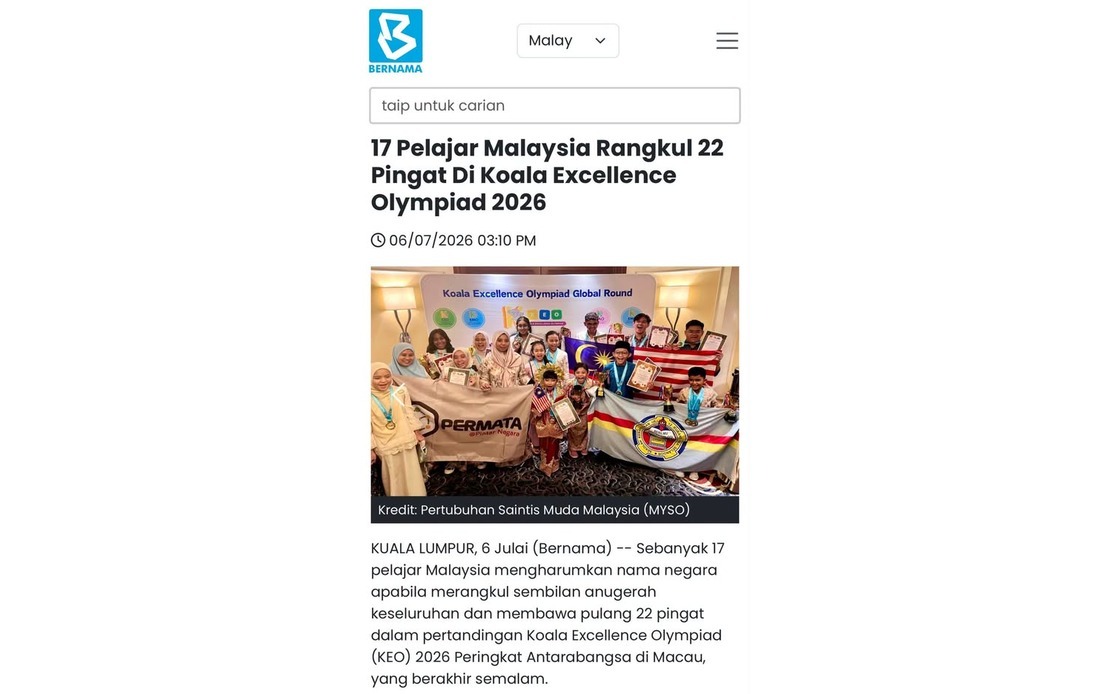
Prime Minister Datuk Seri Anwar Ibrahim has extended his congratulations to 17 Malaysian students who demonstrated exceptional academic prowess at the 2016 Koala Excellence Olympiad (KEO) Global Finals in Macau. The Malaysian contingent's stellar performance resulted in the acquisition of nine overall awards and an impressive tally of 22 medals across multiple disciplines, underscoring the nation's growing strength in international academic competitions. The Prime Minister's recognition of these young achievers reflects the government's commitment to nurturing talent and promoting educational excellence among Malaysian youth on the global stage.
In a statement posted on social media platform X, Anwar Ibrahim encouraged the students to maintain their momentum and pursue even loftier aspirations. His message emphasised the importance of continuous self-improvement and dedication to academic pursuits, sending a powerful signal about the administration's investment in human capital development. The recognition serves to elevate the profile of these young scholars and inspire their peers across the nation to pursue similar paths of distinction.
The Malaysian team's medal haul comprised five gold, six silver, and eleven bronze medals, according to Aidah Misran, coordinator of the Malaysia Young Scientists Organisation (MYSO) and head of the Malaysian delegation. This breakdown reveals a balanced distribution of excellence across the team, suggesting that Malaysia's competitive strength extends beyond a small cluster of elite performers. The diversity of medal-winning students indicates that the nation has cultivated a broad base of academic talent capable of competing effectively in rigorous international forums.
The Koala Excellence Olympiad itself represents a significant evolution in international academic competition frameworks. Developed by a consortium of Australian educational experts and graduates, KEO encompasses four core disciplines—English, Mathematics, Science, and Arts—providing a comprehensive assessment of student capabilities across both traditional and creative academic domains. This multidisciplinary approach distinguishes KEO from narrower competition formats, requiring participants to demonstrate well-rounded intellectual abilities rather than specialised expertise in isolated fields.
The 2016 Global Finals in Macau drew students from multiple countries, creating an intellectually stimulating environment where Malaysian representatives competed alongside peers from diverse educational systems and cultural backgrounds. This exposure to international academic standards and approaches benefits Malaysian students in ways that extend beyond medal placement. Participation in such competitions facilitates cross-cultural exchange, broadens students' perspectives on problem-solving methodologies, and establishes networks with similarly ambitious young scholars from around the world.
The coordination of Malaysia's participation in KEO falls under the Malaysia Young Scientists Organisation, which has positioned itself as the national focal point for advancing scientific education and international academic competition participation. MYSO's role in organising the Malaysian contingent and liaising with KEO organisers and Miss Man International Group underscores the collaborative infrastructure now supporting Malaysian students' engagement with global academic platforms. This institutional framework enables consistent, professionally managed participation rather than ad hoc representation.
The success of Malaysian students at KEO 2026 carries implications for national educational policy and planning. The demonstrated capability of these students suggests that Malaysia's educational system is producing individuals capable of competing effectively in international arenas dominated by highly developed nations with substantially greater resources. This achievement provides empirical validation of teaching methodologies employed in Malaysian schools and institutions, even as it highlights areas where continued investment and curriculum refinement might yield further improvements.
For Malaysian students, participation in international Olympiads and competitions offers tangible career and educational advantages. Victory in prestigious competitions enhances university applications, particularly when seeking admission to top-tier institutions globally. Medals and awards serve as visible credentials of academic excellence, distinguishing students in competitive application processes. Beyond institutional recognition, such achievements build confidence and self-efficacy that proves invaluable as these young people pursue further studies and professional careers.
The broader significance of this achievement for Southeast Asia extends to questions of educational competitiveness and talent development within the region. As regional nations increasingly view education as a strategic priority, comparative performance at international competitions becomes a metric through which progress is measured. Malaysia's showing at KEO 2026 contributes to a narrative of regional educational advancement, though it also underscores the competitive pressures facing Southeast Asian nations as they work to develop world-class educational systems capable of competing globally.
Moving forward, the momentum generated by these students' success should catalyse renewed efforts to expand access to competition preparation and international participation opportunities. Currently, such opportunities may remain concentrated among students in urban centres with access to well-resourced schools. Democratising access to competition training and international academic platforms across Malaysian states would multiply the pipeline of talent available for future competitions. Identifying and nurturing academic talent among underrepresented communities would not only enhance Malaysia's competitive positioning but also contribute to more equitable distribution of educational opportunities across the nation.

