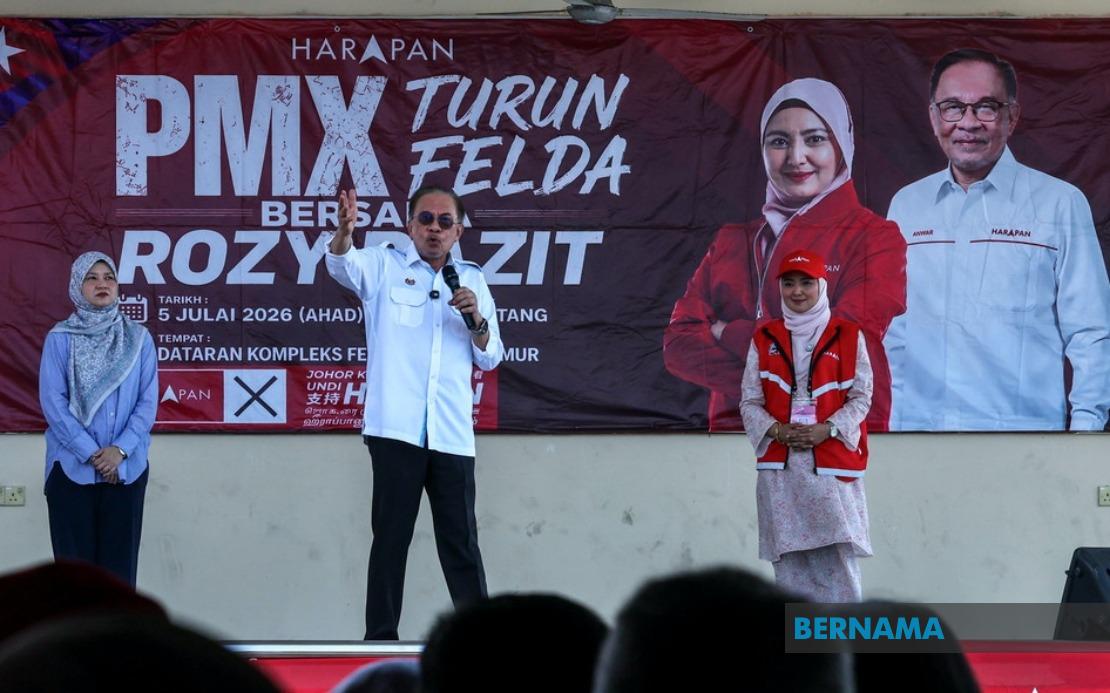
Prime Minister Datuk Seri Anwar Ibrahim has publicly committed to tackling the housing predicament that has plagued the second generation of Federal Land Development Authority (FELDA) settlers for decades, signalling that resolving this contentious issue remains a priority for his administration. Speaking during a community engagement session in Segamat, Anwar underscored the government's determination to ensure that housing sites are secured and protected for the children of original FELDA beneficiaries, a demographic whose demands have persisted largely unmet since the scheme's inception.
The Prime Minister's pledge carries particular significance given the scale of the problem. FELDA, established to resettle rural poor and enable land development, created a structured system whereby pioneer settlers received land allocations and housing support. However, when these original settlers aged, questions about succession and provision for their descendants created a governance vacuum that successive administrations have struggled to address comprehensively. The issue has become emblematic of broader tensions between first-generation FELDA residents who benefited substantially from the scheme and their children who inherited unclear rights and limited access to comparable opportunities.
Anwar emphasised that while the government's policy direction is clear, the actual implementation of housing solutions requires extensive coordination with state administrations, particularly concerning matters that fall squarely within their constitutional remit. Land administration and the development of essential infrastructure—water supply, electricity, road networks, and sanitation—remain state responsibilities under Malaysia's federal system. This delineation means that even with strong federal political will, success ultimately depends on alignment between Kuala Lumpur and state capitals, a factor that has historically complicated land-related initiatives across the country.
The Prime Minister's statement that he wants these unresolved issues settled during his tenure signals an awareness that the matter has festered for too long and represents a political liability. Second-generation FELDA settlers constitute a constituency of considerable size, particularly in rural areas where FELDA schemes dominate, and their grievances have occasionally boiled over into public protest. By attaching his personal commitment to the resolution, Anwar is effectively raising the political stakes, making the outcome a measure of his administration's effectiveness in delivering on promises to rural Malaysians.
The specific framing of Anwar's commitment also reveals tactical thinking. By mentioning the minister responsible for FELDA affairs as a partner in this endeavour, he is distributing accountability while ensuring that the FELDA ministry maintains focused attention on the issue. This approach mirrors how successful policy initiatives are often driven by high-level sponsorship coupled with institutional responsibility, preventing the matter from becoming merely another unfinished agenda item filed away in bureaucratic archives.
Several senior political figures accompanied Anwar to the Buloh Kasap constituency event, including Selangor Menteri Besar Datuk Seri Amirudin Shari, whose presence underscores the importance of state-level buy-in. Selangor, as the most developed and wealthy state, hosts significant FELDA operations, and Amirudin's participation suggests potential receptiveness to federal initiatives on this matter. Education Minister Fadhlina Sidek and Deputy National Unity Minister R. Yuneswaran were also present, the latter particularly relevant given that Yuneswaran represents Segamat, a constituency where FELDA settlers represent a meaningful voting bloc.
The housing crisis for second-generation FELDA members reflects deeper structural issues within the scheme. When FELDA was established, the model presumed that settlers' children would either inherit the land or move into employment elsewhere. In practice, many descendants remained attached to their family's FELDA plots, viewing them as legitimate inheritance, yet lacked formal mechanisms to obtain official housing allocations or secure tenure. This created a generation whose expectations, shaped by witnessing their parents' gains, collided with institutional constraints that offered no parallel pathway.
From a Malaysian perspective, the FELDA housing issue exemplifies tensions between equity and institutional capacity. Rural communities have historically lagged urban centres in development indicators, and FELDA was conceived partly to address this disparity. When the scheme failed to extend its benefits intergenerationally, it inadvertently created a sense of broken social contracts among its beneficiaries' descendants. Resolving this validates the original scheme's developmental logic while demonstrating that government can adapt institutions to meet evolving social needs.
The challenge ahead is translating political commitment into concrete action. Previous governments have acknowledged the problem without delivering comprehensive solutions, partly because housing provision requires sustained capital investment, land availability in appropriate locations, and coordination across multiple state and federal agencies. Without clear timelines, allocated budgets, and designated implementing structures, Anwar's pledge risks becoming another unfulfilled promise that further erodes public confidence in institutional capacity.
For Southeast Asian context, Malaysia's FELDA situation offers lessons about agricultural settlement schemes. Similar programmes across the region have faced comparable challenges when first-generation benefits failed to extend to descendants. How Malaysia handles this issue could inform policy discussions in neighbouring countries wrestling with comparable land tenure and housing problems in rural development schemes.
Moving forward, success will depend on whether the government can navigate state-level politics while maintaining momentum. Selangor's cooperation is crucial, but so too is engagement with other states hosting FELDA settlements. The announcement itself signals recognition that unresolved rural grievances can accumulate into political problems, and that addressing them requires combining political will with acknowledgment of federalism's constraints—a delicate balance that will test Anwar's administration's capacity to govern effectively across multiple jurisdictional boundaries.

