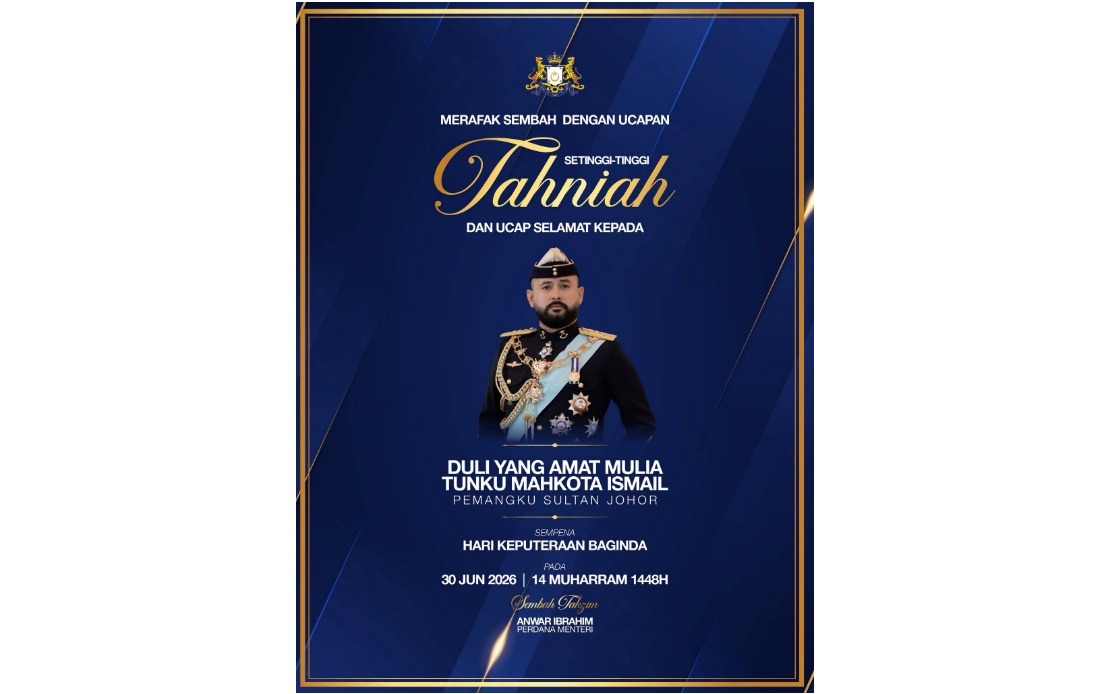
Prime Minister Datuk Seri Anwar Ibrahim has publicly marked the birthday of Tunku Mahkota Ismail, the Regent of Johor, with formal congratulations and expressions of goodwill conveyed through his official social media channels. The gesture reflects the constitutional protocols observed within Malaysia's federal system, where the prime minister routinely acknowledges significant personal occasions within the royal household.
Anwar's birthday message, shared on Facebook, encompassed traditional wishes for the royal heir to enjoy continued robust health, personal well-being, and divine grace as he performs his constitutional duties. The tone of the greeting emphasizes the formal nature of state relations while simultaneously expressing the warmth typically extended between senior government figures and members of the royal establishment.
Complementing the Prime Minister's message, Deputy Prime Minister Datuk Seri Dr Ahmad Zahid Hamidi similarly issued his own set of birthday greetings through social media channels. Zahid's public remarks extended beyond simple well-wishes to incorporate a more substantive invocation of divine blessings specifically directed toward the Regent's role in governing Johor Darul Ta'zim and leading the Bangsa Johor, the Johor ethnic and cultural identity.
In his formal statement, Zahid articulated a prayer asking for divine protection and continued mercies for Tunku Mahkota Ismail, while simultaneously requesting that Allah SWT grant the royal figure the wisdom necessary to effectively administer Johor and serve its people. This layering of political courtesy with spiritual reference reflects the interconnected nature of governance and religious observance within Malaysia's constitutional monarchy framework.
The simultaneous greetings from both the Prime Minister and Deputy Prime Minister underscore the significance accorded to the Johor royalty within the broader Malaysian political landscape. Johor holds particular historical and administrative importance as the nation's southernmost peninsular state, commanding substantial economic and demographic weight within the federation. The Regent, as the primary executive authority when the Sultan is unavailable or traveling, holds considerable influence in state affairs.
Tunku Mahkota Ismail's position as heir apparent to the Johor throne carries additional weight given the state's long historical trajectory and its role in Malaysia's founding narrative. The ceremonial acknowledgment from the nation's highest executive officials signals the government's respect for the institution of hereditary monarchy and the careful maintenance of formal relationships between the federal government and state-level royal establishments.
Within Malaysia's constitutional framework, the observance of royal birthdays by senior government figures represents an important cultural and diplomatic custom that reinforces the legitimacy of the constitutional monarchy system. These public acknowledgments serve multiple functions: they demonstrate governmental respect for royal institutions, they affirm the separation and balance between executive and royal authority, and they maintain social cohesion by celebrating shared national institutions.
The use of Facebook as the medium for both messages reflects contemporary political communication practices in Malaysia, where senior government figures maintain direct channels to constituents and the broader public through social media platforms. This approach allows for immediate dissemination of official statements while also creating a publicly accessible record of governmental relations with the royal establishment.
For Southeast Asian readers and observers of Malaysian politics, these seemingly routine birthday greetings carry subtle significance in demonstrating the enduring stability of Malaysia's constitutional arrangements. In a region where some neighboring nations have experienced significant political turbulence, the smooth functioning of formal protocols between different layers of government—federal and state, executive and royal—underscores institutional resilience.
The greetings from Anwar and Zahid also reflect the current political configuration within the federal government, where both figures represent different components of the ruling coalition and different regional constituencies. Johor's economic importance and Zahid's own political history within the state make the Deputy Prime Minister's message particularly noteworthy, suggesting continued attention to state-level dynamics despite the demands of federal governance.
More broadly, these public well-wishes demonstrate how Malaysian political culture integrates hierarchical respect, constitutional formality, and spiritual observance into everyday official communications. The inclusion of Islamic references and invocations of divine blessing reflects the Islamic framework within which Malaysia's constitutional monarchy operates, as enshrined in the Federal Constitution's provisions regarding Islam and the role of rulers as protectors of Islam within their respective states.

