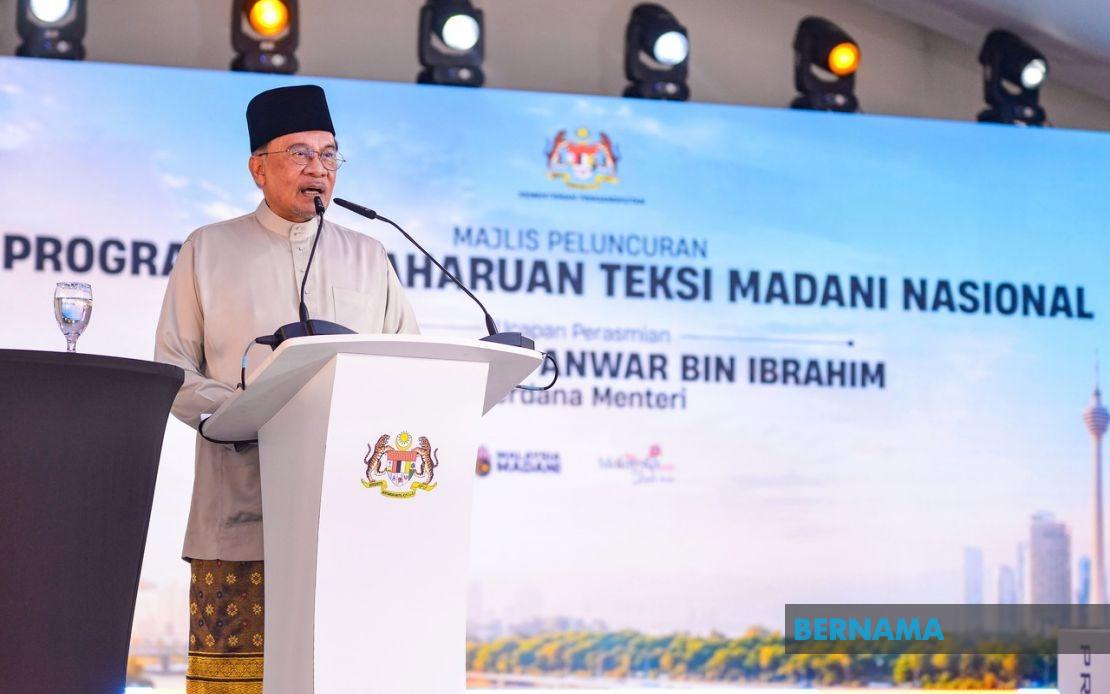
Prime Minister Datuk Seri Anwar Ibrahim unveiled an additional RM10 million in funding for the Vehicle Replacement Matching Grant Programme on Wednesday, signalling the government's intensified commitment to modernising Malaysia's ageing taxi fleet. The fresh allocation came as Anwar, who doubles as Finance Minister, presided over the launch of the National MADANI Taxi Reform Programme at Dataran Merdeka, with Transport Minister Anthony Loke and other senior officials in attendance. This move reflects growing recognition of the taxi sector's vital role in urban mobility and the economic pressures facing drivers operating vehicles that have long exceeded their operational lifespan.
The decision to inject additional capital follows an encouraging response to the original RM10 million earmarked in Budget 2026, indicating that demand from the taxi community substantially outpaced the initial provision. Anwar's approval of the supplementary funds underscores the government's willingness to accelerate vehicle modernisation efforts beyond the originally tabled financial package. The scaling up of funding within months of the budget announcement suggests that policymakers have recognised the extent of the replacement need within the sector, where many vehicles operating on city streets are substantially older and less fuel-efficient than contemporary alternatives.
Critically, the government has negotiated a strategic partnership with Proton and the Transport Ministry to create a bespoke financing arrangement that would allow taxi operators to purchase the Proton S70 on favourable terms. This development represents a convergence of industrial policy and social support, as it aims to simultaneously assist domestic taxi drivers while boosting demand for Malaysian-manufactured vehicles. The Proton S70, positioned as a modern, cost-effective option, stands to benefit from this structured financing pathway, potentially capturing significant market share within the taxi sector if the scheme generates the anticipated uptake.
The taxi industry in Malaysia has long grappled with structural challenges stemming from vehicle age and associated operating costs. Many drivers operate vehicles well beyond 15 years old, incurring higher maintenance expenses, fuel consumption, and repair downtime that directly erodes their earnings. Passengers, meanwhile, often encounter safety and comfort concerns in older cabs, creating a feedback loop that dampens consumer confidence in the sector. By facilitating vehicle replacement through targeted grants and financing schemes, the government seeks to address these interconnected problems in a manner that benefits all stakeholders—drivers gain modern, efficient vehicles; consumers receive improved service quality; and the automotive industry achieves fresh demand stimulus.
From a financial perspective, the dual-pronged approach of grant allocation combined with dedicated financing represents a pragmatic strategy to overcome traditional barriers to vehicle renewal. A grant component reduces the upfront burden on individual drivers, while the financing arrangement spread the remaining cost over a manageable payment period, making the total acquisition cost far less prohibitive than conventional commercial lending. For drivers operating on thin margins, such support can prove transformative, as it permits them to invest capital in productivity improvements rather than sinking revenue into maintaining increasingly unreliable vehicles.
The involvement of Transport Minister Anthony Loke and Chief Secretary to the Government Tan Sri Shamsul Azri Abu Bakar at the launch ceremony underscores the cross-ministerial coordination required to execute such initiatives effectively. Transport policy cannot operate in isolation from finance, employment, or industrial concerns, and the presence of multiple senior government figures reflects the holistic approach being pursued. Minister in the Prime Minister's Department (Federal Territories) Hannah Yeoh's attendance also signals that the federal territories component of the programme carries particular importance, given the concentration of taxi activity in Kuala Lumpur and surrounding areas.
For Southeast Asian context, Malaysia's experience with vehicle replacement schemes offers lessons for the region. Many neighbouring countries face similar challenges with ageing taxi fleets, congestion, and air quality concerns in major urban centres. Malaysia's willingness to combine direct financial support with private-sector partnerships demonstrates a model that balances market mechanisms with targeted government intervention. Should the scheme succeed in materially replacing vehicles and improving service standards, it could provide a replicable template for other nations grappling with comparable transport sector modernisation needs.
The implicit industrial policy dimension also warrants consideration. By structuring the financing scheme specifically around the Proton S70, the government supports domestic automotive manufacturing at a time when the sector faces international competitive pressures. This approach creates a sympathetic policy environment for local producers while simultaneously serving the legitimate modernisation needs of the taxi sector. Such alignment of public welfare objectives with industrial development objectives has characterised Malaysian policy in numerous sectors, and the taxi programme represents a contemporary application of this principle.
Looking ahead, the success of the combined grant and financing initiative will depend significantly on implementation efficiency and uptake rates among eligible drivers. Bureaucratic delays in processing applications or accessing funds could undermine the programme's effectiveness, as could unrealistic eligibility criteria that exclude substantial portions of the target population. Monitoring and evaluation mechanisms will be essential to identify bottlenecks and adjust the scheme as necessary. Furthermore, complementary measures addressing licensing, operational standards, and consumer protection frameworks may be required to fully realise the potential of a modernised taxi fleet.

