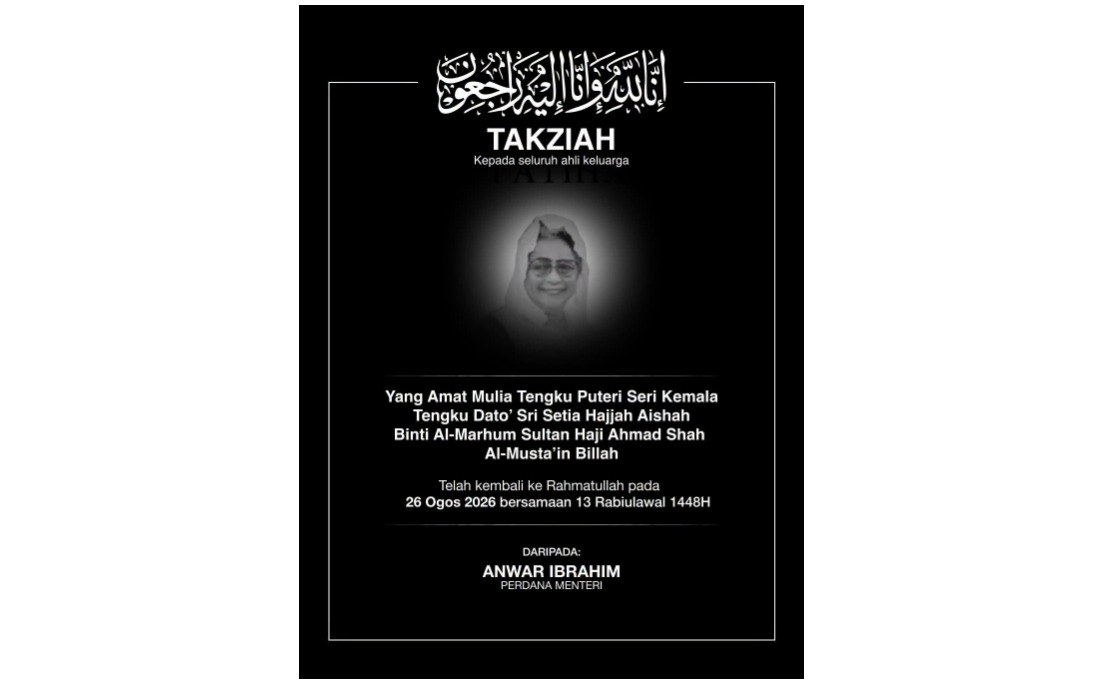
Prime Minister Datuk Seri Anwar Ibrahim has extended his deepest sympathies to Al-Sultan Abdullah Ri'ayatuddin Al-Mustafa Billah Shah and members of the Pahang Royal Family following the passing of Tengku Puteri Seri Kemala Tengku Datuk Seri Aishah Almarhum Sultan Ahmad Shah, the Sultan's elder sister, on August 26.
In a statement posted on social media, the Prime Minister acknowledged the loss and offered prayers for the deceased. Anwar invoked Allah's mercy upon Tengku Datuk Seri Aishah's soul, requesting forgiveness of her transgressions and placement among the virtuous in the afterlife, reflecting the Islamic traditions that guide such expressions of condolence within Malaysia's constitutional monarchy framework.
Beyond the immediate expression of sympathy, Anwar extended his prayers to provide spiritual comfort to the bereaved royal household. The Premier requested divine strength and forbearance for Al-Sultan Abdullah, Tengku Ampuan of Pahang Tunku Azizah Aminah Maimunah Iskandariah, and all members of the Pahang Royal Family as they navigate this period of mourning and adjustment to their collective loss.
Tengku Datuk Seri Aishah passed away at a private medical facility in Kuala Lumpur at 9:15 pm on August 26. The timing of her death in the nation's capital reflects the accessibility of advanced healthcare available to senior members of the royal households, even as arrangements for final rites proceeded according to Islamic protocols and royal traditions.
The late Tengku Puteri held significance within the broader structure of Pahang's royal lineage. As the elder sister to the reigning Sultan, she occupied a position of respect within the state's hierarchy and would have been a custodian of institutional memory regarding the sultanate's recent history and the evolution of Pahang's governance through multiple generations of leadership.
Arrangements for the funeral honours reflected the status of the deceased within the royal hierarchy. Her remains were scheduled to be committed to rest at the Pahang Royal Mausoleum situated in Pekan, the state capital, on August 27. This burial site serves as the final resting place for members of the Pahang royal line and underscores the ceremonial significance accorded to senior members of the royal household.
The expression of condolence from the Prime Minister carries institutional weight in Malaysia's constitutional framework, where the relationship between the federal government and the various state rulers is governed by clearly defined protocols. Such statements typically reflect the respect that the federal executive branch extends toward the hereditary sultans and their families, notwithstanding the political differences that may occasionally characterise centre-state relations.
In the Malaysian context, expressions of sympathy from high-ranking government officials following the death of royal family members represent customary observances that reinforce social cohesion and institutional continuity. These gestures serve multiple purposes: they acknowledge shared national values rooted in Islam and Malay-Muslim traditions, they affirm the constitutional status of the monarchy, and they provide a measure of official recognition to the grieving family.
The passing of Tengku Datuk Seri Aishah represents a generational transition within Pahang's royal lineage. As a member of the preceding generation, her death would naturally prompt reflection on the continuity of institutional knowledge and the succession arrangements that characterise Malaysia's monarchical system, where nine state rulers serve defined terms as constitutional heads of their respective states.
For Malaysian society more broadly, such developments within the royal household carry symbolic importance. The regularised expressions of condolence from political leaders, the adherence to Islamic funeral rites, and the commitment to royal burial traditions all reinforce the institutional frameworks that have structured Malaysian public life since independence. These ceremonies and formalities, while outwardly solemn occasions, also serve to reaffirm the constitutional arrangements that have provided political stability across multiple decades.

