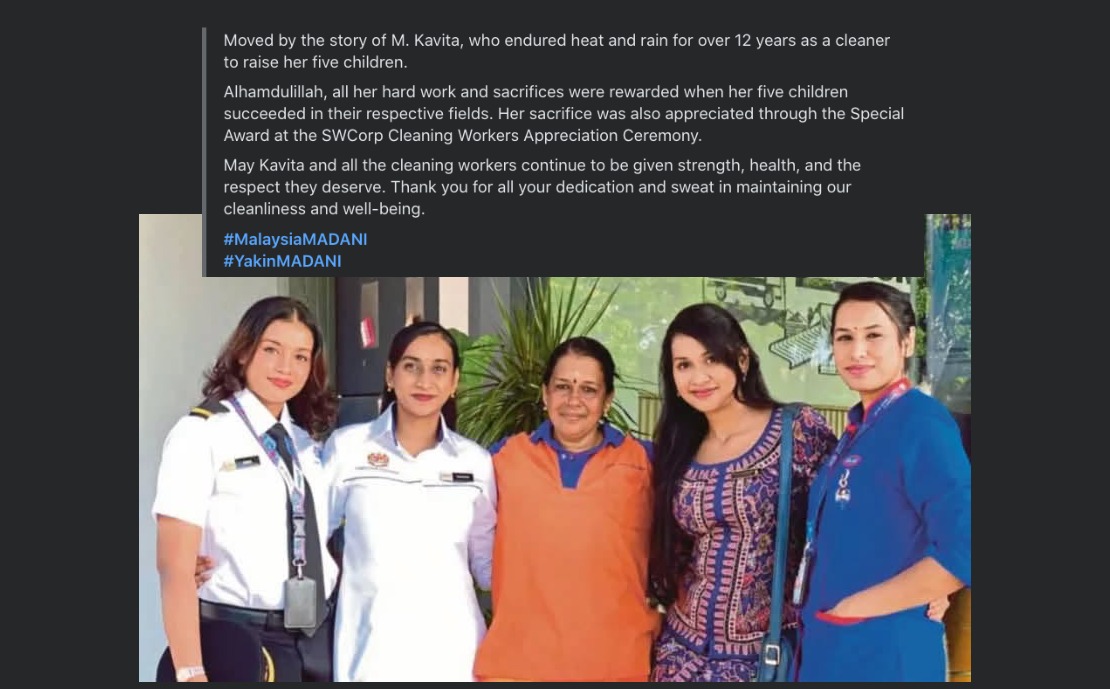
Prime Minister Datuk Seri Anwar Ibrahim has publicly acknowledged the extraordinary journey of M. Kavita, a street sweeper employed by SWM Environment in Seremban, whose more than 12 years of dedicated labour in challenging weather conditions enabled her to raise five accomplished children. Through a Facebook post, Anwar reflected on how Kavita's personal story of perseverance and sacrifice resonated with him, offering a poignant reminder of the often-overlooked contributions that essential workers make to Malaysian society. The tribute comes at a moment when discussions about workers' dignity and recognition are gaining traction across the nation, highlighting the gap between public appreciation and the daily realities faced by those in sanitation and cleaning professions.
Kavita's achievements extend far beyond her own professional commitment. All five of her children have established successful careers across various sectors, a testament to the values of hard work and education she instilled in them despite the financial constraints and physical demands of her own employment. The recognition from the nation's highest office serves as a validation not only of Kavita's personal resilience but also of the broader contributions made by cleaning workers who maintain public health and environmental standards across Malaysian cities and towns. Her story challenges conventional narratives about social mobility and demonstrates how parental sacrifice, regardless of occupation or socioeconomic status, can shape the trajectories of the next generation.
The public attention surrounding Kavita intensified when a viral social media moment captured her genuine emotional reaction to an unexpected birthday surprise last month. Her four daughters coordinated a touching gesture by visiting their mother at her workplace while she was on duty, each wearing the uniform of their respective professions—including a pilot, cabin crew member, and registered nurse. The spontaneity and emotional authenticity of the moment resonated across digital platforms, transforming what could have been a private family celebration into a national conversation about recognition, gratitude, and the human dimension of service work. The visual contrast between Kavita in her street sweeper's uniform and her daughters in their professional attire created a powerful symbolic representation of intergenerational advancement and familial bonds transcending occupational hierarchies.
Beyond Anwar's personal recognition, Kavita received formal acknowledgement from institutional structures within Malaysia's cleanliness sector. She was presented with a Special Award during SWCorp's Cleaning Workers' Day Appreciation ceremony, indicating that her story had captured the attention of organizations dedicated to honouring those employed in sanitation and environmental services. This dual recognition—both from the political leadership and from industry-specific institutions—suggests a growing momentum toward elevating the status and visibility of cleaning workers within Malaysian public consciousness. The ceremony itself represents a structured attempt to counterbalance the tendency to render such workers invisible despite their essential contributions to urban and rural infrastructure.
The Prime Minister's remarks extended beyond personal tribute to encompass broader systemic appreciation. Anwar explicitly called for Kavita and all street sweepers and cleaning workers to receive not merely material recognition but also the social respect they deserve. His invocation of strength, good health, and dignity indicates an understanding that these workers operate within structural constraints—exposure to weather, physical labour demands, and potential health hazards—that warrant systematic attention from policymakers and employers. The public platform provided by his office amplifies what might otherwise remain localized acknowledgement, potentially influencing how government agencies and private employers approach worker welfare policies for sanitation staff across the country.
For Malaysian readers, particularly those from middle and upper-income backgrounds with limited direct interaction with cleaning workers, Kavita's story offers a window into the realities of essential service employment. It demonstrates that income constraints and occupational prestige do not determine parental capacity to nurture ambitious, accomplished children. Conversely, for workers in similar circumstances, the narrative validates their efforts and suggests that societal recognition, even if delayed or incomplete, remains possible. The story also reflects broader regional patterns in Southeast Asia, where migrant and domestic workers often form the backbone of urban sanitation systems while remaining largely invisible in mainstream public discourse and policy considerations.
The implications for Malaysia's social policy landscape merit careful consideration. As the nation grapples with questions of inclusive development and ensuring no community is left behind, the treatment and recognition of essential workers represents a critical measure of societal values. Anwar's intervention, while primarily symbolic, creates space for substantive discussions about wage structures, working conditions, health and safety protocols, and career progression opportunities within the sanitation sector. Whether this moment of public attention translates into concrete policy improvements—enhanced benefits, better working conditions, professional development pathways—will determine the lasting impact of Kavita's story on systemic conditions affecting hundreds of thousands of workers nationwide.
The story also resonates with questions about meritocracy and social mobility in Malaysia. Kavita's children succeeded not through exceptional advantage but despite significant obstacles, undermining any notion that socioeconomic advancement requires privileged starting positions. This has particular relevance for policy discussions around education, skills training, and economic opportunity, suggesting that investment in education infrastructure and support systems remains the most reliable mechanism for breaking cycles of poverty. The diversity of her children's careers—spanning aviation, healthcare, and other professional fields—further indicates that occupational choice and advancement remain accessible to those from modest backgrounds when educational foundations are secure.
Community responses to Kavita's recognition illustrate how individual stories can serve as catalysts for broader social conversations. The viral social media moment transformed a personal family achievement into a collective reflection on values, sacrifice, and recognition. In the Malaysian context, where discussions of privilege and inequality have become increasingly prominent, Kavita's narrative offers a counterpoint that neither denies structural challenges nor surrenders to determinism. Her story suggests that while systemic factors matter profoundly, individual agency, family commitment, and educational opportunity interact in complex ways to shape outcomes. For policymakers and organizational leaders, the popularity of Kavita's story indicates public appetite for recognition that extends beyond elite professional narratives to encompass the experiences of workers across the entire occupational spectrum, offering a potential mandate for policies that expand opportunity and dignity across Malaysian society.

