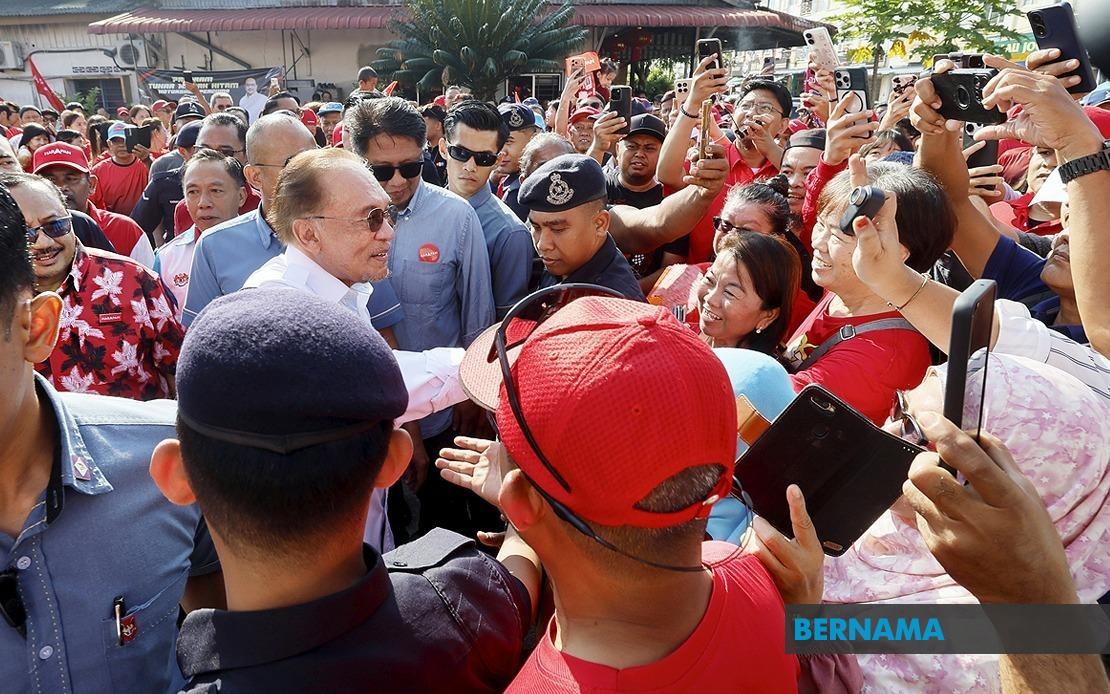
Prime Minister Datuk Seri Anwar Ibrahim took time out of his schedule during a campaign event in Senggarang, Batu Pahat, to meet an elderly couple whose determined journey to greet him had captured public imagination. Abdul Razak Pelangga, 86, and his wife Jamilah Samsudin, 64, had gained widespread attention after pedalling their trishaw for nearly one kilometre the previous week to catch a glimpse of the Prime Minister during his breakfast stop at a local eatery in the same constituency.
The reunion took place on Tuesday at the "Yok! Meriahkan Johor! Undi Harapan" programme, which formed part of the broader campaign activities ahead of the Johor state election. The encounter between the Prime Minister and the couple was marked by warmth and camaraderie, with Anwar engaging in light-hearted banter with Abdul Razak about his physical prowess in propelling the trishaw, despite his advanced age. The moment underscored the personal connection that such spontaneous interactions can generate between political leaders and constituents.
The original incident that brought the couple into the public spotlight occurred when Jamilah expressed a heartfelt wish to meet the Prime Minister. Rather than dismiss the idea, Abdul Razak took it upon himself to pedal their traditional trishaw through the streets of Senggarang to reach the eatery where Anwar was scheduled to stop. The distance covered—nearly one kilometre—was a testament to the octogenarian's determination and the couple's commitment to expressing their support for the ruling coalition.
The Tuesday event was attended by several key figures within the Pakatan Harapan coalition. Datuk Fahmi Fadzil, who serves as both the Communications Minister and PH Communications director, was present to witness the reunion. Additionally, three PH candidates contesting in the Johor state election participated in the programme: Onn Abu Bakar, representing Senggarang; Mohd Khuzzan Abu Bakar, the candidate for Semerah; and Felicia Poh Rui Ling, contesting in Penggaram.
This incident illustrates a broader pattern in Malaysian politics where earnest gestures from ordinary citizens resonate strongly with the electorate and generate significant social media traction. The couple's trishaw journey became emblematic of grassroots support and personal sacrifice, qualities that political parties often attempt to leverage during electoral campaigns. By reuniting with the couple in a public setting, the Prime Minister's office effectively transformed a spontaneous moment of citizen engagement into a coordinated campaign appearance.
The timing of the reunion is particularly significant given the electoral calendar in Johor. The state election was scheduled to be held on Saturday, with early voting having already taken place the previous Tuesday. Such campaign events serve multiple purposes: they energize party supporters, generate positive media coverage, and reinforce the image of the leadership as accessible and responsive to constituents' aspirations. The visibility of the Prime Minister interacting with ordinary citizens, particularly an elderly couple, appeals to demographic groups that form crucial voting blocs in state elections.
Johor has historically been a politically significant state in Malaysia, and elections there often carry implications beyond the state level. The Pakatan Harapan coalition, which has governed Malaysia since 2018 with varying coalition partners, has focused on demonstrating its connection to grassroots communities throughout its campaign efforts. Events like this reunion allow the coalition to present itself as responsive to citizen initiatives and sympathetic to the lived experiences of ordinary Malaysians.
The trishaw as the mode of transport for Abdul Razak and Jamilah also carries symbolic weight in the Malaysian context. Trishaws represent traditional, community-oriented transport and are becoming increasingly rare in urban areas as modernization progresses. The couple's choice to use this vehicle to reach the Prime Minister added a nostalgic and culturally resonant dimension to their story, appealing to voters who value continuity and tradition alongside progress.
For Southeast Asian readers, the incident reflects broader patterns in the region's democratic politics, where political leaders frequently engage in grassroots campaign activities designed to strengthen personal connections with voters. Such interactions, when they generate social media attention, can significantly amplify political messaging at minimal financial cost compared to traditional advertising. The couple's story demonstrates how individual acts of political participation, when sufficiently photogenic or emotionally compelling, can acquire outsized influence in shaping public perception of political actors and movements.
The Prime Minister's response—taking time to acknowledge the couple's effort and engaging with them warmly—represents a form of political capital investment that costs little in material terms but potentially yields substantial returns in voter sentiment. By validating the couple's initiative rather than overlooking it, Anwar's office signalled that grassroots support matters and that citizens need not feel distant from the country's highest political office. This approach to campaigning emphasizes personal narrative and emotional connection over policy detail or partisan argumentation.
As the Johor state election approached its culmination, such campaign moments accumulated to shape the overall narrative each coalition sought to promote. For Pakatan Harapan, emphasizing accessibility and responsiveness to ordinary citizens served as a counterpoint to potential criticisms regarding governance performance or political complexity. The reunification with Abdul Razak and Jamilah effectively communicated that despite holding the nation's highest office, the Prime Minister remained attuned to the aspirations and gestures of everyday Malaysians.

