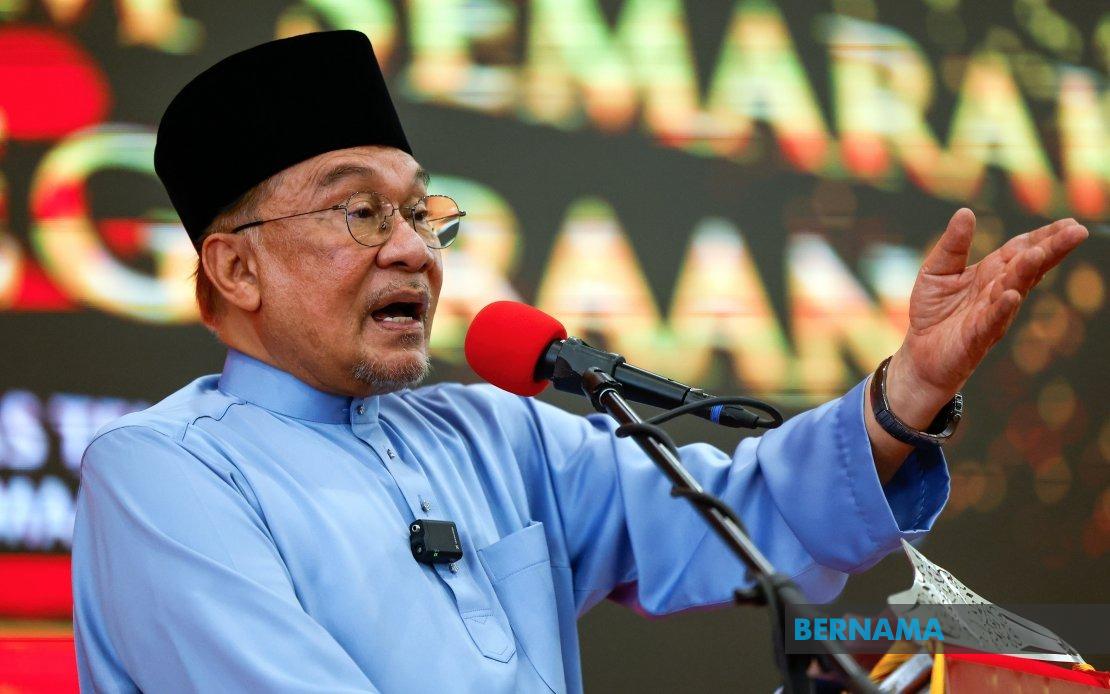
Prime Minister Datuk Seri Anwar Ibrahim is mounting a high-visibility campaign drive through Negeri Sembilan, executing an ambitious schedule of public engagements designed to strengthen Pakatan Harapan's position in the final stretch before voters go to the polls on Saturday. The coordinated effort underscores the coalition's determination to consolidate support across the state's diverse constituencies and communities in the crucial days remaining before the campaign officially concludes on Friday evening.
Anwar's itinerary spans multiple constituencies and venues, beginning with an afternoon community gathering in Chennah, which falls within the Jelebu district. The gathering precedes a broader townhall-style Temu Anwar forum scheduled for the Islamic Dakwah Centre Hall in Paroi, where residents will have the opportunity to engage directly with the Prime Minister and raise constituency concerns. This format of community dialogue has become a hallmark of recent electoral campaigns across Malaysia, allowing political leadership to connect with grassroots concerns and project accessibility to ordinary voters.
The schedule extends into the evening with a dedicated engagement session targeting Negeri Sembilan's Indian community, hosted at Klana Resort. Such targeted outreach to specific demographic groups reflects the coalition's strategy of addressing the particular interests and grievances of distinct voter blocs within the state. For Malaysian election strategists, these segmented engagement approaches have proven effective in demonstrating that political leadership recognises and values the concerns of minority communities.
Two major campaign rallies bookend Anwar's day, beginning at Betaria Business Centre in Seremban itself at 9 pm, followed by a continuation at Desa Cempaka Night Market in Nilai at 10.30 pm. The decision to hold evening events, particularly at a night market venue, targets both working-class voters and families who can attend after completing daily obligations. This timing strategy maximises accessibility and reflects campaign planners' understanding of voter behaviour patterns in suburban and semi-urban Malaysian settings.
The campaign activities bring together the senior leadership of Pakatan Harapan's component parties. Negeri Sembilan Menteri Besar Datuk Seri Aminuddin Harun, who represents the Linggi seat, will share the platform alongside Anwar, lending incumbency and local administrative credibility to the coalition's messaging. DAP's secretary-general Anthony Loke Siew Fook, who is personally contesting the Chennah seat, adds additional senior party representation, while Amanah president Datuk Seri Mohamad Sabu and PKR vice-president Datuk Seri Amirudin Shari round out the visible coalition leadership.
The presence of multiple party hierarchies signals the degree to which Pakatan Harapan views the Negeri Sembilan contest as strategically significant for the broader political landscape. State elections in Malaysia often serve as barometers of federal coalition health and voter sentiment. Strong performance in Negeri Sembilan would provide momentum for the federal government, particularly as it navigates economic and governance challenges that have tested public confidence in recent months.
Pakatan Harapan's campaign strategy involves contesting all 36 state assembly seats, a comprehensive approach that reflects confidence in the coalition's preparedness and organisational capacity. The coalition's candidate distribution—16 from PKR, 11 from DAP, and nine from Amanah—reflects negotiated seat allocation that attempts to balance internal coalition dynamics while fielding competitive candidates across diverse constituencies. This arrangement mirrors similar seat-sharing agreements in previous federal elections and reflects the mature working relationships established between the three parties since their 2018 alliance.
The 16th Negeri Sembilan state election will draw participation from 867,151 ordinary voters choosing among 103 candidates competing for the 36 assembly seats. The substantial candidate pool relative to available positions indicates robust political competition and reflects the state's importance within Malaysia's wider electoral geography. Negeri Sembilan's economic significance—with its position along the central corridor linking Kuala Lumpur and the southern region—makes its electoral direction materially relevant to national political calculations.
Campaigning must formally conclude at 11.59 pm on Friday, leaving approximately 36 hours for Anwar and other campaign figures to pursue final voter contact efforts. The compressed timeline of the final campaign phase typically drives political leaders to concentrate their personal appearances in constituencies where races are perceived as competitive or where their intervention might shift marginal voter populations. Anwar's choice to conduct this extended campaign day in Negeri Sembilan suggests the coalition's assessment that the state remains contestable and that prime ministerial visibility could meaningfully influence outcomes.
For Malaysian observers, Anwar's willingness to conduct such an intensive personal campaign schedule—particularly spanning multiple constituencies and evening events that demand considerable physical stamina—demonstrates the premium placed on prime ministerial engagement in state-level contests. The distribution of campaign activities across both urban centres like Seremban and suburban venues like the night market in Nilai reflects recognition that winning coalitions must build support across socioeconomic and geographic divides rather than concentrating efforts in particular demographic strongholds.
The coordination of campaign messaging across senior figures from three distinct political parties, each with its own organisational structure and constituency base, underscores both the benefits and complexities of coalition governance in Malaysia. While Pakatan Harapan's unity in presenting a consolidated campaign front offers voters clarity about coalition direction, the necessity of managing divergent party interests remains an ongoing challenge that state elections periodically test.
The Negeri Sembilan election ultimately serves as a significant mid-term referendum on the Pakatan Harapan federal government's performance and public acceptability. Strong results would provide political capital for continued policy implementation and legislative initiatives, while disappointing outcomes might intensify internal coalition pressures and embolden opposition forces. Anwar's comprehensive campaign engagement therefore carries implications extending well beyond the state's borders into Malaysia's broader political equilibrium.

