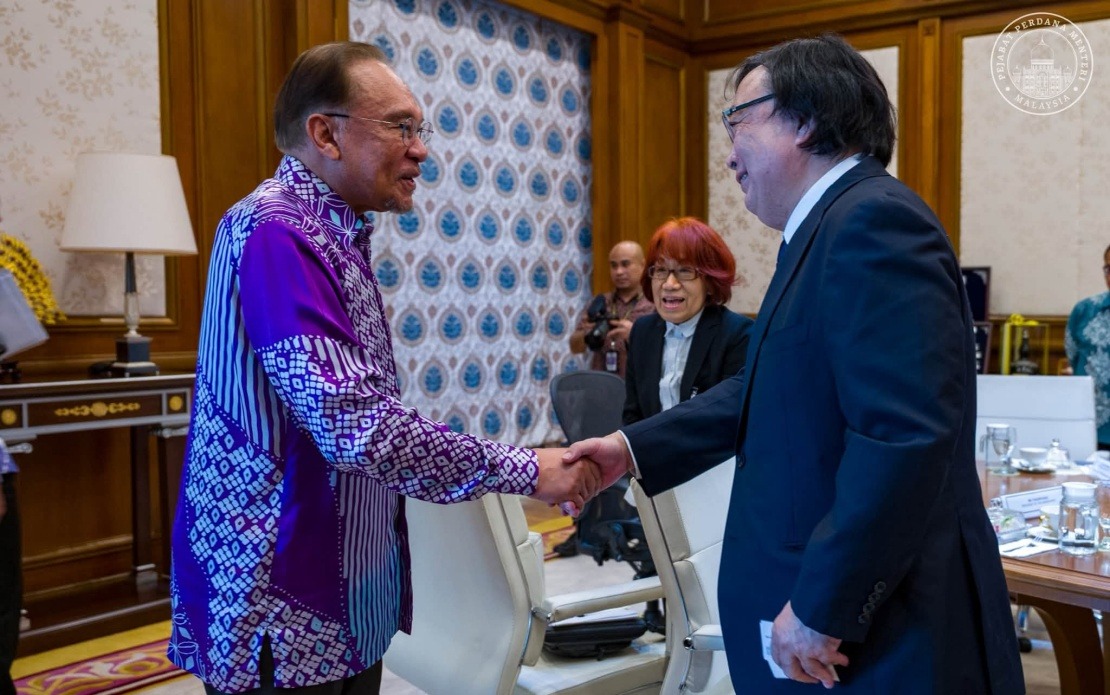
Prime Minister Datuk Seri Anwar Ibrahim welcomed The Genron NPO President Yasushi Kudo to a bilateral meeting in Kuala Lumpur on July 23, marking another chapter in Malaysia's deepening engagement with Japan through both governmental and intellectual channels. The encounter provided an opportunity to explore how established dialogue mechanisms can be leveraged to tackle interconnected regional and global issues that increasingly demand coordinated responses from Asian nations.
The Genron NPO, headquartered in Japan, operates as an independent non-profit think tank focused on policy research and strategic analysis. Its platform carries substantial influence in shaping discourse around Asia-Pacific affairs and has positioned itself as a bridge-builder among regional leaders grappling with complex security, economic and developmental challenges. By engaging directly with the organisation's leadership, Malaysia signals its commitment to participating in high-level intellectual forums that extend beyond traditional diplomatic channels.
Central to the discussion was the Asia Leaders Roundtable, a convening mechanism that brings together prominent political figures and thinkers to deliberate on pressing regional concerns. The roundtable's significance for Malaysia lies in its capacity to provide a neutral space where nations can air perspectives and seek common ground on matters ranging from maritime security to economic integration. For a country like Malaysia with substantial interests across the South China Sea and Southeast Asian economic ecosystems, such platforms offer invaluable opportunities to shape narrative and consensus among fellow leaders.
Anwar used the meeting to reiterate Malaysia's appreciation for Japan's hospitality during his official visit to Tokyo in June. This reference to his recent trip underscores the frequency and warmth of high-level exchanges between the two nations, reflecting a relationship that has transcended formal protocol to encompass genuine collaboration. The gesture of acknowledging Japan's welcome demonstrates the diplomatic courtesy that underpins productive bilateral relationships in a region where personal connections between leaders often translate into concrete policy outcomes.
The Comprehensive Strategic Partnership between Malaysia and Japan occupies an increasingly prominent position in Kuala Lumpur's foreign policy architecture. This partnership encompasses trade, defence cooperation, technology transfer and people-to-people exchanges, making Japan one of Malaysia's most consequential strategic allies. For Malaysian policymakers, the relationship offers tangible benefits including Japanese investment flows into manufacturing and infrastructure projects, as well as security cooperation mechanisms that bolster regional stability.
Anwar also acknowledged the Genron NPO's invitation for him to participate in the Tokyo Conference 2027, while expressing gratitude for the opportunity to contribute a video message to the 2026 iteration of the conference. These invitations signal Malaysia's rising profile within Japan-centric intellectual and policy circles, suggesting that Anwar's government has successfully repositioned the country as an indispensable voice in regional discourse. Malaysia's participation in such conferences serves both symbolic and substantive purposes, allowing the nation to project its perspectives on issues ranging from regional development to global governance reform.
The emphasis placed on the Asia Leaders Roundtable during the meeting reflects broader recognition that traditional state-to-state diplomacy must be complemented by sustained dialogue among intellectual elites and policy influencers. Think tanks like the Genron NPO perform a critical function in this ecosystem, providing venues where leaders can explore ideas more candidly than formal ministerial meetings often permit. For Malaysia, such engagement offers channels to shape perceptions of its strategic intentions and development model among Japan's policymaking and academic communities.
From an economic perspective, the strengthened coordination between Malaysia and Japan carries implications for regional trade architecture and investment patterns. Japan remains a significant source of foreign direct investment for Malaysia, particularly in electronics manufacturing, automotive components and renewable energy sectors. Enhanced dialogue frameworks can facilitate smoother negotiations on trade agreements and technology partnerships that benefit both economies while contributing to broader regional prosperity.
The timing of this meeting also reflects the evolving geopolitical context in Asia, where traditional partnerships are being reassessed in light of emerging security challenges and shifting power dynamics. Malaysia's emphasis on its strategic partnership with Japan suggests a deliberate strategy of deepening ties with stable, rules-based democracies that share interests in maintaining open maritime routes and predictable international order. This approach complements Malaysia's broader hedging strategy in a multipolar region where no single power dominates.
Looking ahead, the dialogue platforms emerging from such meetings will likely shape Malaysia's positioning on critical regional issues in the coming years. As challenges ranging from climate change to digital governance become increasingly transnational, the need for coordinated responses among Asian nations grows more acute. Malaysia's participation in initiatives like the Asia Leaders Roundtable positions it to influence the terms of such regional cooperation and ensure that Southeast Asian perspectives are adequately represented in discussions that affect the broader continent.
The meeting ultimately reinforces Malaysia's commitment to maintaining diversified strategic partnerships and engaging actively in multilateral dialogue mechanisms. By fostering relationships with influential think tanks and their leaders, the government ensures that Malaysian viewpoints permeate international policy discussions at foundational levels. For Japan, continued engagement with Malaysian leadership provides opportunities to strengthen partnerships with a strategically located nation that wields considerable influence within ASEAN, the region's primary multilateral institution.

