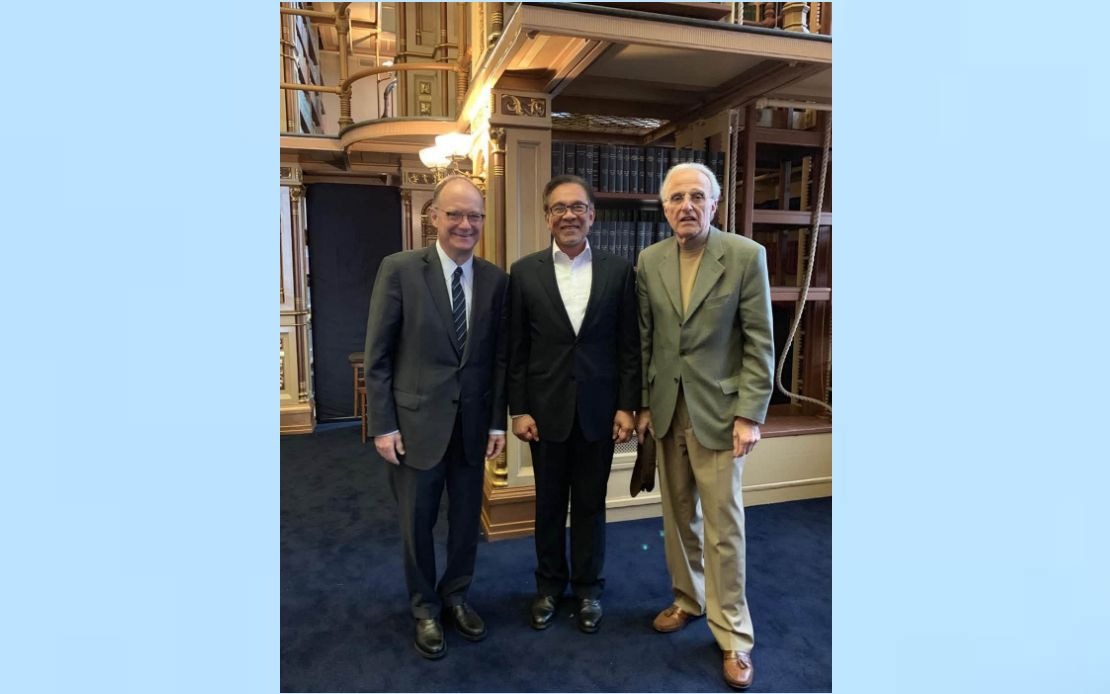
Prime Minister Datuk Seri Anwar Ibrahim has mourned the passing of Professor John L. Esposito, one of the world's most prominent voices in Islamic scholarship and Muslim-Christian relations. In a heartfelt social media statement, Anwar reflected on the American academic's towering intellectual legacy and their enduring personal bond, describing Esposito as a scholar who fundamentally reshaped how the Western world understands Islam.
The relationship between Malaysia's leader and the Georgetown University professor extended across more than five decades, beginning in the early 1970s. This long association places Anwar among those who witnessed Esposito's scholarly evolution from his early work through decades of prolific writing and institutional leadership. The friendship transcended typical academic networks, evolving into a genuine personal rapport that saw Esposito stand by Anwar through significant moments in his political career and intellectual journey.
Esposito's most enduring contribution to global understanding came through his founding of Georgetown University's Centre for Muslim-Christian Understanding, an institution that became pivotal in bridging theological and cultural divides during increasingly fraught periods of international relations. The centre represented a deliberate institutional effort to move beyond polemical exchanges toward substantive scholarly engagement, a mission that proved especially crucial following the September 11 attacks when misunderstandings and stereotypes about Islam proliferated rapidly across the Western world.
Among his numerous scholarly works, Esposito's more accessible publications became particularly influential in reaching general audiences beyond the academy. His books, including "What Everyone Needs to Know About Islam" and "Who Speaks for Islam?", brought scholarly precision to complex religious and political questions at moments when public discourse was becoming increasingly polarized and emotionally charged. These works demonstrated that rigorous academic analysis need not remain confined to specialist journals but could illuminate public understanding when presented with clarity and accessibility.
Anwar emphasised that Esposito functioned as a builder rather than a divider, operating in an era when many intellectuals and political actors were content to entrench civilisational boundaries. This characterization captures something essential about Esposito's mission: rejecting the notion that Islam and the West were locked in irreducible conflict, he instead sought common ground, shared values, and possibilities for productive coexistence. His intellectual framework rejected both the triumphalism of Western civilisation narratives and the defensive essentialism that sometimes characterised Muslim responses to Western critique.
The co-authorship of "Makers of Contemporary Islam" represented another dimension of Esposito's scholarly reach, offering analysis of the diverse figures and movements shaping Islamic thought and practice in the modern era. This work underscored his commitment to understanding Islam as a living, evolving intellectual and spiritual tradition rather than a frozen historical artifact. By examining contemporary Islamic thinkers and activists, Esposito demonstrated the vibrancy and complexity of Islamic intellectual life, challenging simplistic framings that reduced Islam to either monolithic traditionalism or violent extremism.
Anwar's personal reflections highlighted dimensions of Esposito often invisible to those encountering only his published work. The Prime Minister described him as generous in private conversation, generous with his time and wisdom despite the demands of his academic and institutional responsibilities. More significantly, Anwar characterised Esposito as someone who remained steadfast in solidarity with the Muslim world and its leaders, maintaining integrity and friendship through varying political circumstances. This loyalty distinguished Esposito from critics who maintained intellectual distance or engaged in polemical exchanges.
The timing of this tribute carries particular resonance for Malaysia and the broader Southeast Asian region. As nations across the region navigate questions of religious identity, interfaith relations, and engagement with the West, Esposito's model of scholarly engagement becomes increasingly relevant. His insistence that serious engagement across religious lines was both possible and necessary offers a counternarrative to rising polarization, demonstrating that mutual understanding could coexist with honest disagreement about substantive theological and political questions.
For Malaysian policymakers and intellectuals, Esposito's legacy provides both methodological guidance and moral inspiration. His work showed that Western scholars could engage with Islam as an intellectually serious subject without condescension, and that Islamic scholars and leaders could engage with Western academic standards and audiences without surrendering their principles or identity. This reciprocal respect, modelled over decades of scholarship and dialogue, offers lessons for multicultural societies navigating religious diversity and interfaith cooperation in increasingly complex global circumstances.

