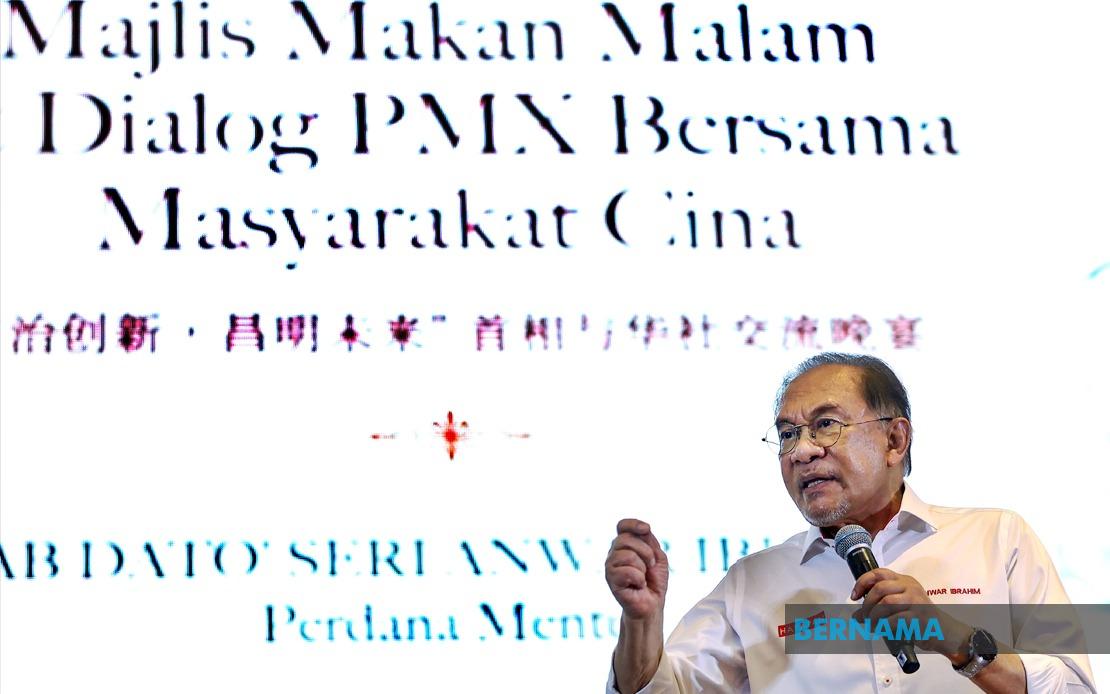
Prime Minister Datuk Seri Anwar Ibrahim has doubled down on his vision for Malaysia's future, using an engagement with the Chinese community in Johor Bahru to outline what he sees as the defining principles of his leadership. At a community dinner on July 4, Anwar articulated a philosophy centred on serving every citizen regardless of ethnic or religious background, framing this inclusive approach as fundamental to national success and his personal legacy.
The Prime Minister's remarks reflect a deliberate attempt to position himself as a leader transcending traditional communal politics. In emphasizing that every single citizen holds equal importance to his administration, Anwar appears mindful of Malaysia's diverse population and the sensitivities that come with governing a multi-ethnic democracy. This message carries particular weight in Johor Bahru, a state with significant Chinese commercial and political influence, where maintaining confidence across communities remains strategically important.
Anwar's articulation of legacy concerns goes beyond the immediate political moment. By acknowledging his age and the finite nature of his tenure, he signals a focus on long-term impact rather than short-term political gains. This temporal framing—looking towards retirement while still in office—suggests a leadership philosophy that prioritizes institutional integrity and public trust over transactional politics. For a Prime Minister who has navigated multiple political comebacks and setbacks throughout his career, such a statement carries biographical weight.
The emphasis on clean and fair governance is particularly notable given Malaysia's recent political history. The nation has grappled with corruption scandals, governance failures, and questions about institutional integrity. By placing ethical leadership at the centre of his legacy aspiration, Anwar is positioning himself against previous administrations while also setting expectations for accountability within his own government. This rhetorical positioning serves to reinforce the reformist credentials that helped bring his coalition to power in 2022.
The concept of showing love for the people, as expressed by Anwar, moves beyond conventional political rhetoric. He frames national success not merely as economic or developmental achievement but as a relationship built on mutual affection and shared stewardship. This emotional appeal to collective responsibility reflects an understanding that governance effectiveness depends partly on public confidence and social cohesion. For a nation facing economic headwinds and social divisions, such a message may resonate with citizens seeking leadership that transcends purely technical governance.
Anwar's aspiration to be remembered as someone who engages across all segments of society addresses a persistent challenge in Malaysian politics—the tendency towards communal politics and identity-based divisions. By explicitly rejecting a race-based approach to leadership, he articulates a vision that, if realized, could influence how future leaders frame their political role. However, translating such rhetoric into consistent policy and institutional change remains a significant challenge, particularly when addressing long-standing grievances around representation, resource distribution, and recognition among different communities.
The presence of Parti Keadilan Rakyat vice president Amirudin Shari at the event underscores the coalition nature of contemporary Malaysian governance. With the Selangor Menteri Besar alongside the Prime Minister, the occasion served as a platform for the broader reform coalition to connect with community leaders and stakeholders. These strategic engagements have become essential to maintaining the political equilibrium that keeps Malaysia's government intact, particularly given the relatively narrow margins on which coalitional stability depends.
For Malaysian business interests, particularly the Chinese business community that has historically maintained pragmatic relationships with government regardless of political affiliation, such engagement provides opportunities to gauge policy direction and express concerns directly to leadership. Anwar's explicit commitment to serving all communities carries implicit reassurance for business leaders concerned about political stability, policy predictability, and the rule of law—factors critical to investment confidence and economic performance.
The timing of these remarks, coming as Malaysia navigates domestic economic challenges and regional geopolitical shifts, reflects leadership focused on maintaining social cohesion during uncertain times. As the country addresses inflation, employment concerns, and economic competitiveness, the ability of government to retain public trust becomes increasingly valuable. Anwar's emphasis on fair, clean leadership can be understood as an effort to build the institutional credibility necessary for implementing difficult policy measures that may be required ahead.
Looking forward, the question remains whether such articulated commitments translate into sustained policy implementation and institutional reform. Malaysia's political system has experienced multiple cycles of promises and structural constraints that limit rapid change. The next phase of Anwar's administration will likely be judged not merely on rhetorical commitments to inclusive, ethical governance but on tangible outcomes—whether cabinet decisions, enforcement priorities, and resource allocation demonstrate genuine commitment to the vision outlined in Johor Bahru.

