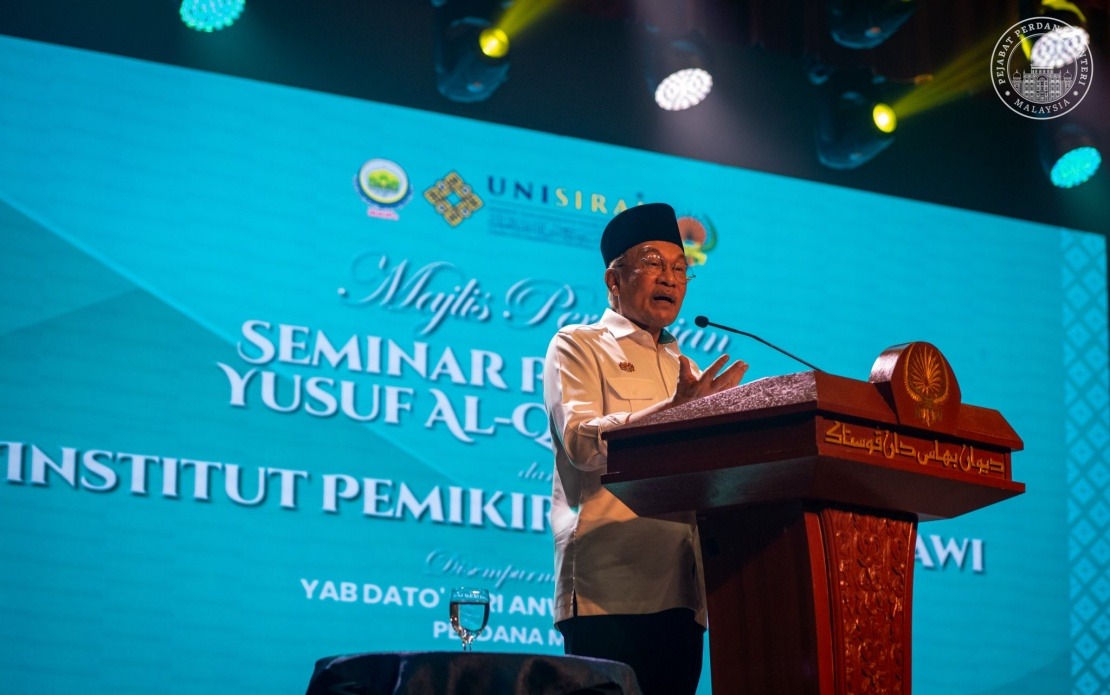
Prime Minister Datuk Seri Anwar Ibrahim has committed RM2 million in government funding towards the Al-Qaradawi Thought Institute, marking a significant investment in Islamic scholarship and research infrastructure. The announcement came during the formal opening of the institute and an accompanying seminar dedicated to exploring the intellectual contributions of Sheikh Dr Yusuf Al-Qaradawi at Wisma Dewan Bahasa dan Pustaka in Kuala Lumpur on July 21. This financial commitment underscores the MADANI Government's prioritisation of strengthening academic institutions focused on Islamic thought and advancing scholarly discourse within Malaysia's religious and intellectual landscape.
Through a statement posted on X, Anwar expressed profound personal gratitude towards Al-Qaradawi, acknowledging the scholar's influence across multiple dimensions—intellectual guidance, moral encouragement, and genuine friendship rooted in shared principles. The Prime Minister framed the institute's establishment as part of broader efforts to cultivate knowledge that will benefit the Islamic community globally. His remarks reflected a deeper philosophical alignment with Al-Qaradawi's approach to Islamic thought, characterising such initiatives as endeavours deserving divine blessings and capable of enriching the broader Muslim ummah.
Anwar's connection to Al-Qaradawi spans decades, tracing back to his formative years within the Malaysian Islamic Youth Movement (ABIM) during the 1980s. The Prime Minister recalled a pivotal moment when the renowned Egyptian-Qatari scholar offered counsel that would shape ABIM's ideological trajectory during a period of intense Islamic resurgence across the Muslim world. During this era of heightened religious enthusiasm and activism, Al-Qaradawi dispatched a significant treatise to ABIM's leadership advocating for intellectual openness and restraint from ideological extremism. This guidance proved instrumental in steering the movement towards wasatiyyah—the Islamic principle of moderation and balanced thinking—at a time when more rigid interpretations were gaining ground within activist circles.
Anwar characterised Al-Qaradawi as a transformative intellectual force, employing the German concept of zeitgeist to describe the scholar's role as a living embodiment of progressive Islamic thought attuned to contemporary realities. Rather than retreating into historical precedent or rejecting modern challenges, Al-Qaradawi exemplified an approach that reconciled Islamic principles with the demands of the present age. This philosophical stance proved particularly valuable during the 1980s when Islamic movements globally faced pressure to either accommodate Western secular frameworks entirely or adopt confrontational positions towards modernity. Al-Qaradawi's advocacy for wasatiyyah offered a middle path—one that rejected both wholesale westernisation and defensive obscurantism.
The Prime Minister emphasised that during the early stages of Islamic resurgence, when passionate advocacy and revolutionary sentiment dominated discourse, the advice to embrace moderation and intellectual pluralism was not merely prudent but essential. During this period, many Islamic movements grappled with the tension between preserving authentic Islamic teachings and engaging meaningfully with diverse viewpoints and secular governance structures. Anwar reflected that Al-Qaradawi's counsel helped ABIM navigate these treacherous intellectual waters by insisting on principled engagement with differing perspectives rather than the entrenchment that characterised many contemporary movements.
The establishment of the Al-Qaradawi Thought Institute represents Malaysia's formal recognition of the scholar's contributions to modern Islamic thought. The two-million-ringgit commitment will support research initiatives, scholarly publications, seminars, and academic programmes dedicated to documenting and advancing Al-Qaradawi's intellectual legacy. For Malaysian readers, this initiative carries particular significance given Malaysia's position as a Muslim-majority nation attempting to chart a course between religious authenticity and modern governance—a tension that Al-Qaradawi's philosophy directly addresses.
Beyond symbolic value, the institute promises to function as a hub for serious academic inquiry into Islamic jurisprudence, contemporary Islamic ethics, and the application of classical Islamic principles to modern social challenges. By institutionalising the study of Al-Qaradawi's works, Malaysia positions itself as a custodian of progressive Islamic thought in Southeast Asia, a region where questions about Islam's relationship with democracy, pluralism, and economic development remain contested and vital. The institute can contribute meaningfully to ongoing regional debates about how Islamic-majority societies balance religious conviction with inclusive governance and multiculturalism.
The timing of this announcement also reflects broader governmental priorities under the MADANI framework, which emphasises unity, prosperity, and people-centred governance. By investing in institutions that promote moderate, forward-thinking Islamic scholarship, the government signals its commitment to countering extremist narratives and fostering intellectual environments where diverse Muslim voices can engage in constructive dialogue. In a region where religious polarisation and ideological rigidity pose genuine social challenges, supporting scholarly centres dedicated to wasatiyyah represents a strategic investment in ideological counterbalance.
For Southeast Asian observers and policymakers, Malaysia's commitment to the Al-Qaradawi Thought Institute offers a potential model for how Muslim-majority nations can actively support intellectual institutions promoting moderate Islamic thought without appearing to compromise religious authenticity. The initiative acknowledges that Islam, like all major traditions, encompasses multiple schools of thought and interpretive frameworks, and that creating platforms for engaged scholarly debate strengthens rather than weakens faith communities. As other regional governments grapple with similar questions about Islam's role in modern nation-states, Malaysia's institutional investment in the study of Al-Qaradawi's moderatist philosophy may offer instructive examples worth studying and potentially adapting.

