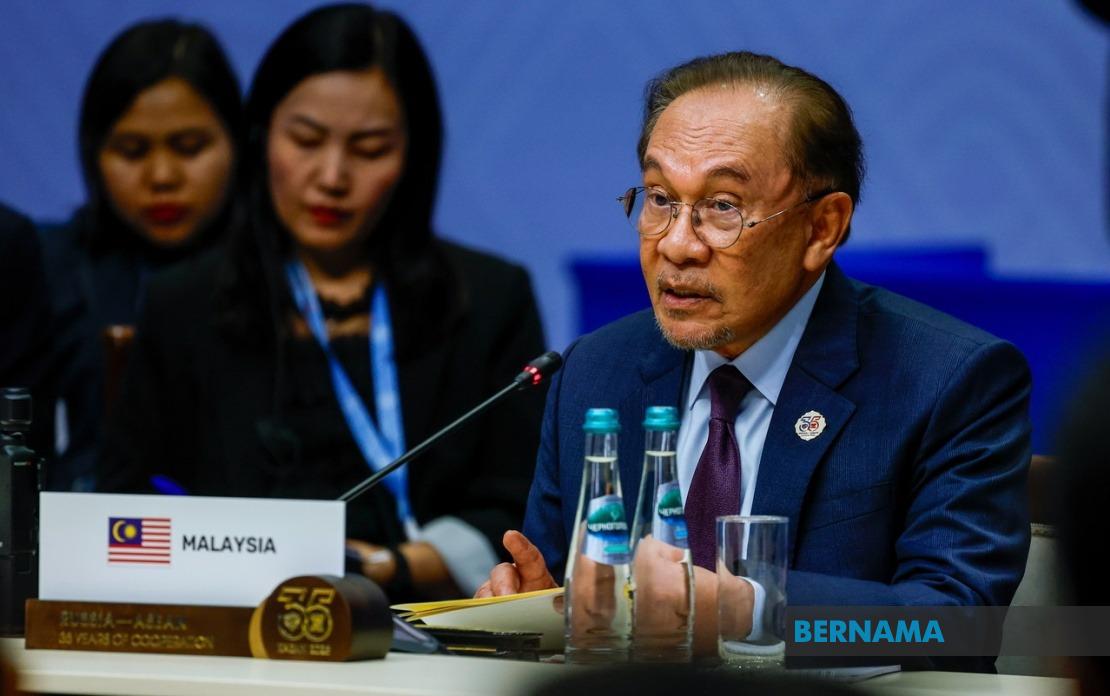
Prime Minister Datuk Seri Anwar Ibrahim has urged ASEAN and Russia to establish stronger strategic partnerships across a broad range of sectors, using a high-level summit in Kazan to reinforce Malaysia's commitment to multilateral engagement in an increasingly volatile global landscape. Speaking during the plenary session of the ASEAN-Russia Commemorative Summit on June 18, Anwar framed the gathering as a crucial opportunity for dialogue between the ten-member regional bloc and Moscow, particularly amid mounting geopolitical tensions that have reshaped international relations over the past few years.
The Prime Minister's intervention at the summit underscores Malaysia's diplomatic positioning as a bridge-builder within ASEAN, a role that has become increasingly important as the region navigates competing great power interests. By emphasising dialogue and international law as foundational principles, Anwar signalled that Malaysia continues to reject unilateral action and military solutions as viable approaches to resolving disputes. This message carries particular weight given Malaysia's economic dependencies and geographic exposure to supply chain disruptions and regional instability.
Anwar identified multiple domains where ASEAN and Russia could generate mutual benefits, extending beyond traditional bilateral trade and investment frameworks. The inclusion of digital infrastructure, artificial intelligence, and science and technology cooperation reflects recognition that contemporary geopolitical competition increasingly hinges on technological supremacy rather than military capacity alone. For Malaysia specifically, deeper partnerships in AI and digital sectors could accelerate the country's ambitions to become a regional technology hub, though this would require carefully managed intellectual property agreements and safeguards against technological dependence on external powers.
Energy cooperation featured prominently in Anwar's remarks, reflecting the practical imperatives facing both ASEAN and Russia as energy transition pressures mount globally. The region's reliance on hydrocarbon imports and its growing renewable energy aspirations create natural convergence points with Russia, a major energy supplier. Malaysia's own energy security challenges, including LNG supply considerations and long-term decarbonisation targets, make this partnership dimension strategically relevant for domestic policy planning.
The food security and halal industry cooperation initiatives carry particular significance for Muslim-majority nations within ASEAN and resonate with Malaysia's broader economic strategy. Russia's substantial agricultural capacity and Malaysia's established position as a halal certification authority could create valuable complementarities. Such partnerships might also help insulate regional food supplies from disruptions originating from other quarters, an increasingly pressing concern given recent global supply chain volatility.
Anwar's statement on the Palestinian-Israeli conflict and the situation in Lebanon reflected ASEAN's broader diplomatic stances while positioning Malaysia as consistent in its advocacy. The emphasis on humanitarian corridors into Gaza and condemnation of military expansion into Lebanese territory aligns with Malaysia's longstanding positions on regional conflicts, though such declarations at multilateral forums carry limited enforcement mechanisms. The explicit criticism of Israeli actions represents ASEAN consensus but also reflects the bloc's limited leverage in Middle Eastern affairs, a tension that has periodically tested ASEAN unity on similar issues.
The summit's timing coincides with the 35th anniversary of ASEAN-Russia relations, a milestone that permits both parties to retrospectively assess engagement patterns while charting future trajectories. The relationship has historically been characterised by moderate intensity compared to ASEAN's ties with Western powers, reflecting geopolitical asymmetries and differing strategic priorities. Russia's interest in maintaining relevance in Southeast Asian affairs, particularly as its relations with Western nations deteriorate, may be driving fresh emphasis on institutional engagement through frameworks like this summit.
The attendance of Philippines President Ferdinand Marcos Jr, who currently chairs ASEAN, alongside representatives from all ten member states, elevated the gathering to the bloc's highest diplomatic level. This configuration enabled substantive discussion of regional concerns while maintaining unified messaging, though ASEAN member states hold diverse perspectives on Russia and geopolitical alignment. The inclusive attendance format also provided individual nations with bilateral opportunities alongside multilateral engagement, maximising the value of such high-level convocations.
Four outcome documents emerged from the summit, including a declaration commemorating the 35-year relationship, joint statements on energy and cultural cooperation, and a comprehensive action plan spanning 2026 to 2030. These instruments provide concrete scaffolding for cooperative initiatives and establish timelines and accountability mechanisms that mere rhetorical commitments lack. For Malaysian stakeholders across government, business, and civil society, these documents will serve as reference points for identifying eligible partnership opportunities and navigating the bureaucratic processes that multilateral cooperation requires.
The ASEAN-Russia Strategic Partnership framework reflects both powers' interests in maintaining relevant roles within Asian regional architecture as geopolitical competition intensifies. For Malaysia and other Southeast Asian nations, the partnership offers potential economic and security benefits, though benefits must be weighed against risks associated with alignment dynamics and great power competition. The emphasis on dialogue and respect for international law, as articulated by Anwar, suggests ASEAN seeks to preserve strategic flexibility rather than embrace exclusive commitments that might undermine its traditional non-aligned positioning.
Looking ahead, the success of the 2026-2030 action plan will depend on execution capacity across diverse bureaucratic systems and genuine political will to allocate resources toward cooperative initiatives. Malaysia's role in facilitating consensus and implementation will be significant, given its diplomatic experience and the precedent of hosting the first ASEAN-Russia bilateral meeting three-and-a-half decades ago. The summit demonstrates that despite contemporary great power tensions and competing visions for regional order, multilateral institutions retain utility as forums for dialogue and incremental cooperation building.