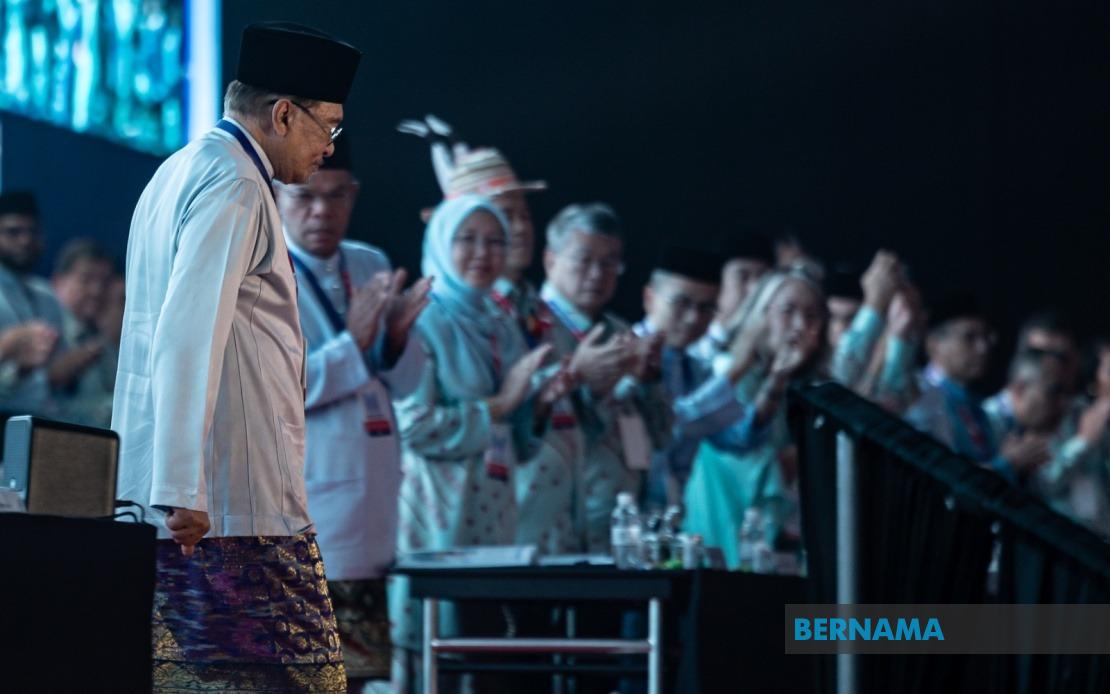
Prime Minister Datuk Seri Anwar Ibrahim has firmly rejected accusations that the MADANI Government is neglecting certain states, arguing instead that federal spending patterns reflect strategic priorities tailored to individual jurisdictions. Speaking at the 2026 PKR National Congress in Melaka on August 15, Anwar challenged critics to recognise the consistent upward trajectory of allocations across the federation, framing the narrative as a misrepresentation of his administration's commitment to equitable development.
The Prime Minister leveraged detailed budget figures to substantiate his position, presenting comparative data spanning his term in office. He highlighted that Sabah's expenditure has grown by 35 per cent over three years, a jump he suggested would have warranted greater public attention had previous administrations achieved equivalent results. This rhetorical move deflects the debate towards historical context, implying that earlier governments faced fewer accusations despite lower spending levels—a strategy designed to normalise incremental growth as evidence of governmental benevolence rather than mere fiscal responsibility.
Specific state-by-state comparisons formed the backbone of Anwar's defence. Terengganu's allocation expanded from RM6 billion in 2022 to RM8.1 billion in the current fiscal year, while Johor witnessed more dramatic growth, rising from RM10.2 billion to RM14.6 billion across the equivalent period. These examples were selected to demonstrate diversity in beneficiary states, suggesting that concerns about regional disparity lack empirical foundation. The inclusion of smaller states like Perlis alongside larger ones signals an attempt to portray the allocation increases as universal rather than concentrated within particular jurisdictions.
Sarawak emerged as a notable case study in Anwar's presentation, with federal allocations climbing from RM10.2 billion in 2022 to RM15.1 billion, representing a 48 per cent increase. For Malaysian observers tracking the complex relationship between federal and state governments, particularly in East Malaysia, such figures carry political weight. Sarawak's Chief Minister has historically advocated strongly for greater resource control, and these numbers may serve to preempt renewed calls for fiscal renegotiation or constitutional reform regarding state revenue-sharing arrangements.
Sabah's circumstances warrant particular scrutiny given the state's strategic importance in federal politics and its historical grievances regarding development parity with Peninsular Malaysia. The 35 per cent increase from RM13 billion in 2022 to RM17.6 billion in 2026 represents a tangible expansion of federal commitment, though observers might question whether such growth sufficiently addresses infrastructural deficits accumulated during decades of comparative underinvestment. For Sabah-based stakeholders, the absolute figures matter less than their trajectory relative to population growth and inflation, metrics conspicuously absent from Anwar's public remarks.
The Prime Minister's defence touches upon a recurring tension in Malaysian federalism: the opacity surrounding how allocations translate into measurable improvements for ordinary citizens. Budget increases announced at national congresses frequently fail to materialise as visible projects in local communities, particularly in rural areas. The MADANI Government's communication strategy relies heavily on headline figures while remaining largely silent about implementation mechanisms, project timelines, or accountability frameworks that would enable independent verification of spending efficacy.
Geographically, Anwar's examples span Peninsular Malaysia, Sabah, and Sarawak, reflecting an apparent effort to demonstrate geographic inclusivity. However, the notable absence of detailed figures for certain states—particularly those with different political leadership or longstanding factional tensions with the federal government—may invite further speculation about whether allocation patterns correspond to electoral considerations. The political economy of Malaysian federalism has long been characterised by resource distribution reflecting both development needs and electoral calculus; Anwar's selective presentation does little to dispel such suspicions.
The broader context of these allocation increases involves the fiscal constraints facing the Malaysian government as it manages economic recovery and debt servicing obligations. Budget expansion across multiple states simultaneously suggests either confidence in revenue projections or a political imperative to distribute resources widely before the next general election. For economically astute observers in Southeast Asia monitoring Malaysia's fiscal trajectory, the sustainability of such increases warrants careful monitoring, particularly if they outpace economic growth rates or rely on optimistic revenue assumptions.
Anwar's framing also reflects evolving political calculations regarding East Malaysian representation within the MADANI coalition. Both Sabah and Sarawak possess significant political leverage through their parliamentary seats, and federal generosity toward these states may partly reflect ongoing coalition maintenance rather than principled commitment to needs-based allocation. Understanding these dynamics is essential for observers seeking to distinguish between announcement effects—the political value of publicising increases—and substantive development impacts on communities facing infrastructure deficits and economic stagnation.
The Prime Minister's emphasis on allocation increases rather than per capita spending or developmental outcomes per unit of investment represents a deliberate communicative choice. Absolute figures generate impressive headlines; adjusted metrics might reveal a less compelling narrative regarding whether state residents are materially better served by additional federal resources. This communicative pattern characterises much of Malaysian political discourse, where nominal figures frequently substitute for rigorous impact assessment.
Looking forward, the credibility of Anwar's claims will ultimately depend on whether communities across Sabah, Sarawak, Terengganu, Johor, and other states experience tangible improvements in public infrastructure, service delivery, and economic opportunity. Budget speeches offer political theatre; sustained development requires implementation rigour and transparent accountability. The challenge facing the MADANI Government is transforming allocation announcements into constituency-level improvements that resonate beyond parliamentary speeches and national congress gatherings.

