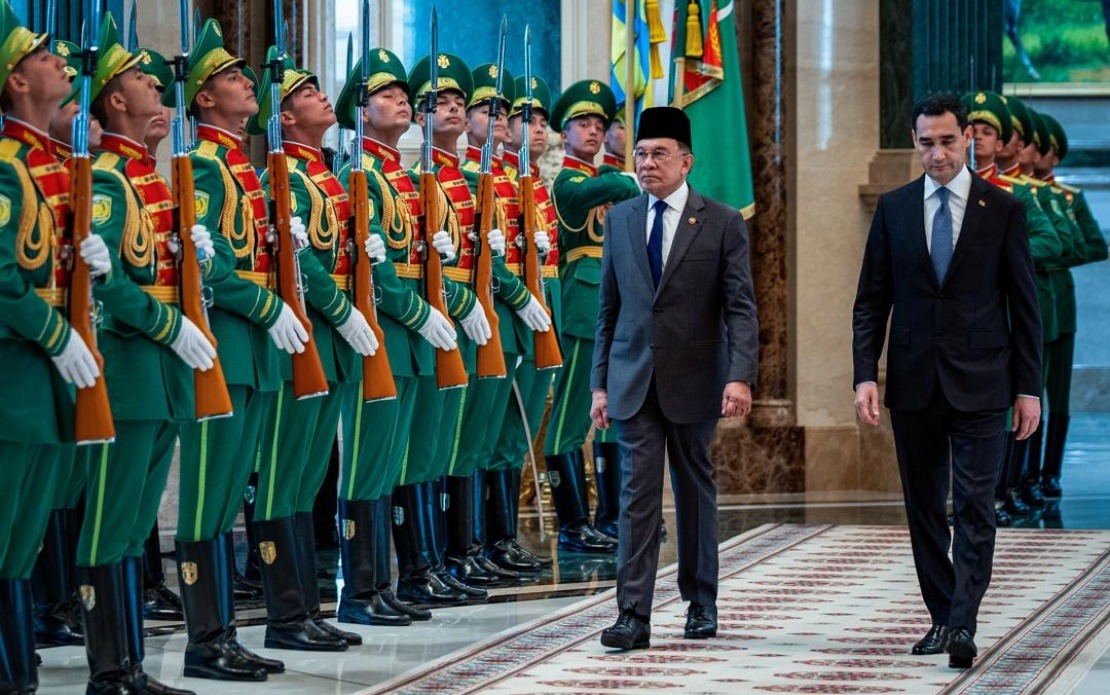
Prime Minister Datuk Seri Anwar Ibrahim was formally received with ceremonial honours at the Turkmenistan Presidential Palace in Ashgabat on June 19, underscoring Malaysia's commitment to deepening ties with Central Asia through high-level diplomatic engagement. The reception, featuring a full guard of honour and the playing of both nations' national anthems, marked a significant milestone as Anwar's first official state visit to Turkmenistan since assuming Malaysia's top political office in November 2022.
The ceremonial welcome, orchestrated at the presidential residence, reflects the diplomatic protocol typically reserved for state visits of strategic importance. Turkmenistan President Serdar Berdimuhamedov personally received the Malaysian premier, followed by introductions to senior cabinet ministers and government officials from the host nation. This sequence of formal presentations underscored the significance both capitals are placing on the bilateral relationship, signalling readiness for substantive engagement across multiple governmental levels.
Anwar's two-day visit, which commenced on June 18, was conducted at the explicit invitation of President Berdimuhamedov, representing a reciprocal gesture of diplomatic respect between Kuala Lumpur and Ashgabat. The timing and formal nature of the invitation suggest ongoing efforts by both nations to elevate their strategic partnership beyond traditional frameworks, particularly as Malaysia seeks to expand its presence and influence across the broader Central Asian region.
Following the ceremonial reception, both leaders engaged in a private bilateral session before convening for wider discussions involving their respective delegations. These closed-door discussions, often termed "four-eyed" meetings in diplomatic parlance, typically address sensitive matters requiring confidential dialogue before being brought before larger governmental teams. This format allows leaders to establish personal rapport and explore common ground on complex geopolitical issues before formalising positions through official channels.
The subsequent bilateral meeting provided a structured forum for both governments to identify areas of mutual interest and chart concrete pathways for enhanced cooperation. While the original dispatch does not detail the specific agenda items, such high-level visits typically encompass discussions on trade and investment opportunities, defence and security partnerships, cultural and educational exchanges, and alignment on regional and international issues of shared concern.
Malaysia's engagement with Central Asia has historically been modest compared to its focus on Southeast Asia and East Asia, making Anwar's visit a notable pivot in regional diplomacy. Turkmenistan, as a major energy producer controlling vast natural gas reserves and serving as a crucial transit hub along the ancient Silk Road trade corridors, represents significant economic and strategic value for Malaysian interests. The country's location at the intersection of Asian trade routes and its role in regional stability make it an increasingly important player in Malaysia's broader foreign policy calculations.
Anwar's ascension to the premiership in November 2022 coincided with broader efforts to recalibrate Malaysia's international engagement and strengthen bilateral relationships across diverse geographic regions. His visit to Turkmenistan demonstrates this commitment to diversifying Malaysia's diplomatic portfolio and exploring economic partnerships beyond traditional spheres of influence. For a nation heavily focused on Southeast Asian regionalism, the foray into Central Asia signals recognition of the region's growing importance in global geopolitics and economic reconfiguration.
The visit also carries implications for Malaysia's positioning within larger geopolitical currents affecting Central Asia. As regional powers and international actors vie for influence in this strategically located zone, Malaysia's engagement—while modest in scale compared to major powers—reflects an attempt to maintain constructive relationships across the regional ecosystem. This approach aligns with Malaysia's historical preference for pragmatic, non-aligned diplomacy that prioritises economic interests and peaceful coexistence.
From Turkmenistan's perspective, hosting a Malaysian premier represents an opportunity to strengthen ties with a significant Southeast Asian economy and player within regional organisations like ASEAN. Malaysia's diplomatic weight, particularly its leadership on matters affecting the Muslim world and its role as a bridge between Asia and the Middle East, may appeal to Turkmenistan's own international positioning efforts.
The bilateral agenda likely touched upon energy security, a matter of increasing relevance as Malaysia and other regional economies grapple with long-term energy transitions. Turkmenistan's significant hydrocarbon reserves and expertise in energy production could offer valuable partnerships or knowledge-sharing opportunities for Malaysian stakeholders navigating the path toward energy diversification and sustainability.
Cultural and people-to-people exchanges typically feature prominently in such diplomatic visits, with potential discussions on educational scholarships, tourism promotion, and cultural festivals that could enhance mutual understanding between Malaysian and Turkmenistani societies. These softer dimensions of diplomatic engagement often prove instrumental in building enduring relationships that transcend short-term political cycles.
Anwar's visit underscores Malaysia's broader strategy of maintaining an active, multidirectional foreign policy that engages partners across continents and political systems. This approach reflects Malaysia's self-positioning as a responsible international player capable of managing complex relationships while pursuing national economic and security interests in an increasingly interconnected world.

