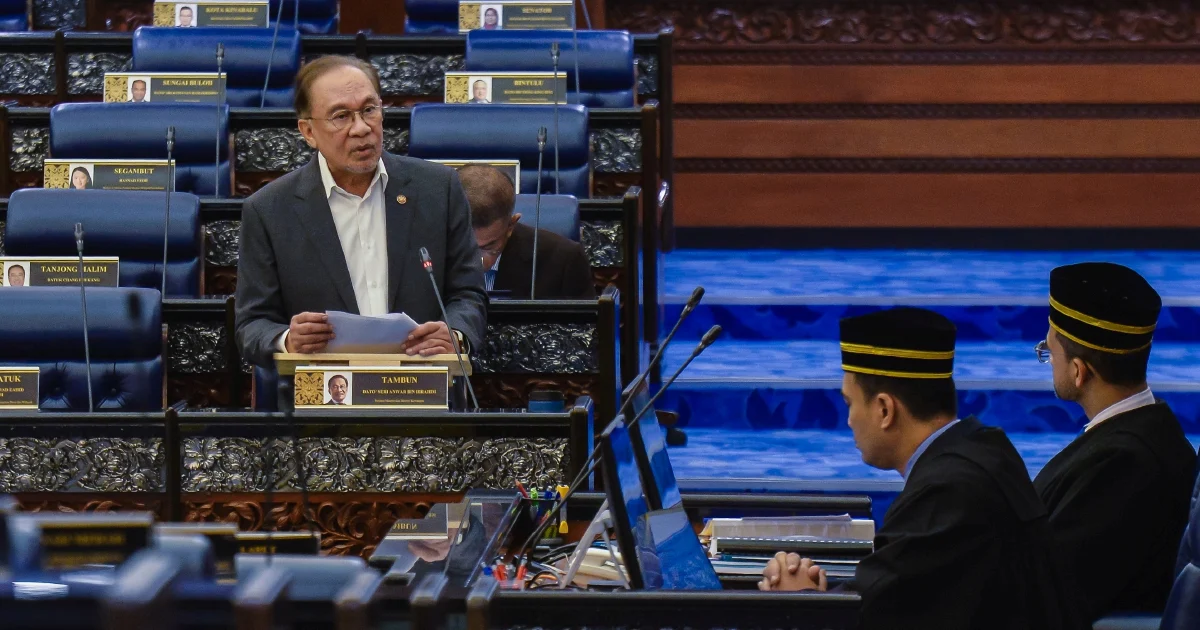
Prime Minister Datuk Seri Anwar Ibrahim has once again categorically denied ordering the cancellation of a Johor Felda Settlers Day event planned in Kluang, reaffirming his position during parliamentary proceedings in the Dewan Rakyat. The clarification came as the premier sought to dispel persistent claims linking him directly to the decision to call off the gathering, which had sparked controversy among settlers and observers in the state.
According to Anwar's parliamentary statement, the sole constraint placed on government activities during the period in question was a blanket restriction preventing the deployment of state resources and machinery for electoral campaigning. This measure, he emphasised, represented standard protocol implemented across all government departments and agencies to maintain impartiality during election cycles. The restriction applies universally and does not constitute selective targeting of any particular event or community.
The Kluang incident has drawn attention to the broader relationship between FELDA—the Federal Land Development Authority, which oversees tens of thousands of settler families across Malaysia—and the government apparatus. FELDA settlements represent significant political constituencies, particularly in Johor, where these communities have historically exercised considerable electoral influence. Any perceived government interference in settler-focused events inevitably triggers sensitivity among this demographic, given their historical reliance on state support and their voting strength in rural constituencies.
Anwar's repeated denials suggest that clarification on this matter has become necessary due to sustained questioning, possibly arising from opposition parties or concerned settler groups seeking to portray the government as heavy-handed. The specificity of the Kluang location and the focus on FELDA Settlers Day—an occasion designed to honour the contributions of land scheme participants—adds a cultural and symbolic dimension to what might otherwise be dismissed as routine administrative procedure.
For Malaysian readers, this controversy highlights the delicate balance governments must maintain between regulating campaign-related activities and demonstrating equitable treatment of all communities during election seasons. FELDA settlers, numbering over 100,000 families nationwide with substantial representation in Johor, form a constituency that demands transparent and fair governance. Any perception of unfair treatment risks alienating a voter block that has traditionally been receptive to government initiatives.
The incident also underscores ongoing tensions surrounding the use of government machinery during election periods—a persistent issue in Malaysian politics. While preventing state resources from being mobilised for partisan advantage is essential to electoral integrity, the practical application of such bans can be contentious, particularly when events not explicitly political in nature are affected. Settlers' day celebrations, which typically commemorate historical achievements and community bonds rather than promote specific parties, occupy an ambiguous space in this regulatory landscape.
Johor's political significance makes any controversy involving the state unusually consequential. As Malaysia's southernmost peninsular state and home to one of the country's largest FELDA populations, Johor represents crucial electoral terrain. The Kluang event, had it proceeded, would have assembled hundreds or thousands of settlers from the district and surrounding areas, creating an opportunity for government representatives to interact directly with an important voter demographic. The cancellation, therefore, carried political implications beyond the immediate community.
Anwar's parliamentary clarification represents an attempt to move beyond the controversy by grounding the explanation in policy rather than personal decision-making. By framing the restriction as a mechanical application of election rules rather than a targeted intervention, the Prime Minister seeks to deflate accusations of political vindictiveness. However, the need for multiple denials suggests that initial explanations failed to fully convince sceptics or that confusion about the decision's origins persisted among stakeholders.
The broader context of election-period governance in Malaysia reveals a persistent challenge: maintaining electoral integrity while minimising disruption to community life and cultural observances. Government agencies frequently organise or co-sponsor events celebrating various constituencies—settlers, veterans, indigenous communities, public employees—and election cycles inevitably create tensions around whether these events proceed normally or are suspended. The absence of clear, universally understood guidelines on such matters frequently generates dispute and speculation about political motives.
Looking forward, this incident may prompt stakeholders to seek clearer demarcation between genuinely political events and community celebrations that, while government-supported, are not inherently electoral in nature. FELDA settlers deserve transparent communication about event scheduling during election periods, and the government has an interest in preventing future controversies that unnecessarily alienate influential voter groups. For Southeast Asian observers, the episode demonstrates how electoral regulations intended to ensure fairness can inadvertently create perception problems if communicated poorly or applied inconsistently.
The Prime Minister's reiterated denial, delivered through parliament, represents his most formal response to date. Whether this clarification fully resolves the matter for settler communities and other stakeholders remains uncertain, as political controversies often persist beyond official explanations. Nonetheless, Anwar's emphasis on procedural regularity rather than targeted action suggests that future events affecting FELDA communities should proceed normally, provided they remain outside explicitly political territory.

