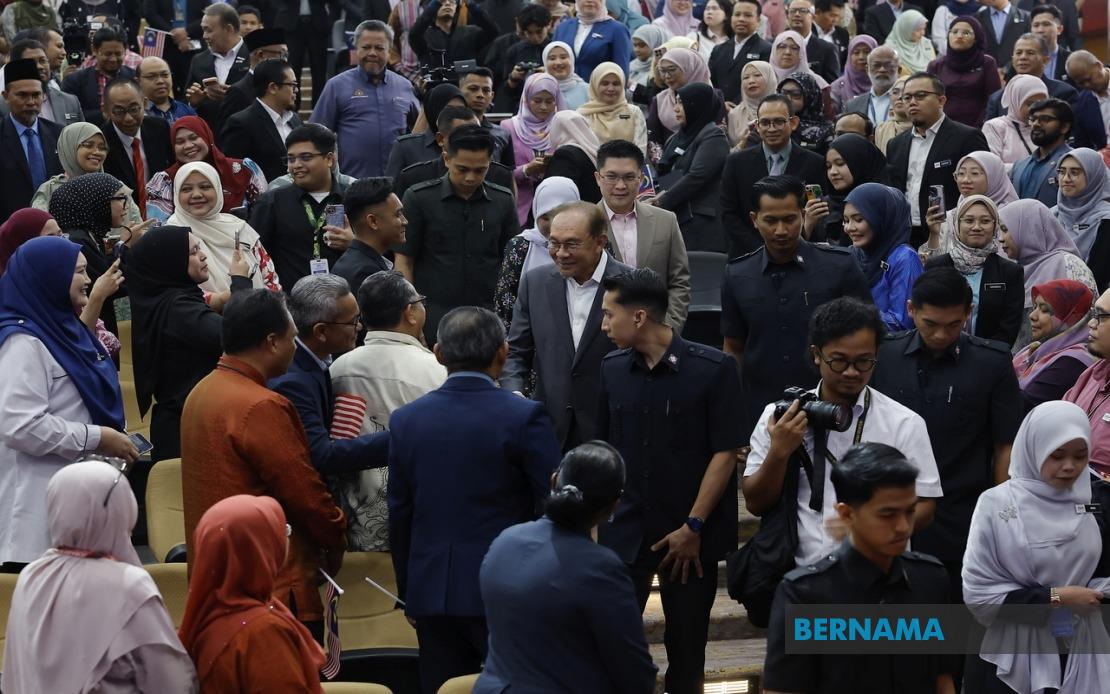
Prime Minister Datuk Seri Anwar Ibrahim has reaffirmed the government's commitment to bolstering proficiency in Bahasa Melayu as a foundational language of knowledge, while simultaneously encouraging students to develop competency in other languages that carry significant economic and international relevance. Speaking during an engagement with Education Ministry staff in Putrajaya on July 28, Anwar articulated a vision for language education that positions Bahasa Melayu as the unifying cornerstone of Malaysia's education system without creating artificial barriers to multilingual development.
The Prime Minister's remarks represent a deliberate attempt to navigate the often contentious debate surrounding language policy in Malaysian education. Rather than positioning language priorities as mutually exclusive, Anwar framed multilingual proficiency as a strategic advantage for the nation's long-term competitiveness. His comments suggest a recognition that in an increasingly interconnected global economy, students who master multiple languages—particularly those with widespread business and diplomatic applications—gain measurable advantages in international markets and cross-cultural engagement.
Central to Anwar's vision is the mandate he has given to the Education Minister over the past three years: ensuring that every Malaysian child, without exception, achieves substantive mastery of Bahasa Melayu as a functional language of knowledge. This formulation is significant because it distinguishes between basic communication competency and deeper literacy—the ability to engage with complex texts, academic concepts, and specialized vocabulary in the national language. The emphasis on "language of knowledge" suggests a focus on enabling students to access academic content, technical instruction, and intellectual discourse in Bahasa Melayu.
Crucially, Anwar explicitly stated that this strengthening of Bahasa Melayu should encompass all educational streams without exception. This directive carries particular weight given Malaysia's diverse schooling landscape. National schools, religious schools operating under different curricular frameworks, international schools following overseas examination systems, and vernacular schools conducting instruction primarily in Chinese or Tamil all fall within his scope. The uniformity of this expectation suggests a deliberate effort to ensure that language of knowledge competency does not become a dividing factor between student cohorts from different educational backgrounds.
The Prime Minister's framing deliberately resists the zero-sum conceptualization of language education that has sometimes characterized public discourse in Malaysia. By emphasizing that strengthening Bahasa Melayu does not constitute a rejection of other languages, Anwar addresses longstanding sensitivities among communities concerned about preserving their heritage languages. He specifically highlighted English, Mandarin, Tamil, and Arabic as languages of economic and cultural value that merit serious study alongside the national language.
This multilingual approach aligns with practical realities facing Malaysian students entering the workforce. Proficiency in English remains essential for accessing international business, technology, and academic sectors. Mandarin competency provides competitive advantages in regional commerce given China's economic significance. Tamil and Arabic represent cultural continuities for Malaysian communities with heritage links to South Asia and the Arab world, while also offering practical communication pathways in those regions. By validating this linguistic breadth while insisting on robust Bahasa Melayu foundations, Anwar positions language education as serving both national cohesion and individual opportunity.
The government's approach carries implications for curriculum design and resource allocation within the Education Ministry. Strengthening Bahasa Melayu across all school streams requires investment in teacher training, development of higher-level academic materials in the national language, and assessment frameworks that genuinely test knowledge-based proficiency rather than basic conversational ability. Simultaneously, maintaining quality instruction in other languages demands equivalent attention to teacher quality and curriculum development. Balancing these priorities presents genuine logistical and fiscal challenges that the Ministry must navigate.
For international schools operating in Malaysia, Anwar's directive creates interesting tensions. These institutions typically conduct primary instruction in English to serve expatriate communities and students preparing for overseas examinations. The requirement that Bahasa Melayu mastery be achieved "without exception" even in this stream may necessitate curriculum adjustments or enhanced language programming to ensure that international school graduates meet national standards in the national language. This could reshape how these institutions structure their academic programs.
The Prime Minister's comments also implicitly address concerns among some Malaysian educators and policymakers about whether previous initiatives to strengthen Bahasa Melayu had been implemented with sufficient consistency and rigor. By characterizing the strengthening of national language competency as an ongoing focus requiring three years of deliberate ministerial effort, Anwar acknowledges that achieving universal proficiency across a diverse, multi-stream education system presents genuine challenges requiring sustained commitment.
From a regional perspective, Malaysia's approach to language policy carries significance for other Southeast Asian nations navigating similar tensions between national language priorities, heritage language preservation, and international economic pressures. Countries like Indonesia, Thailand, and Vietnam face comparable challenges in designing education systems that serve nationalist objectives while preparing citizens for global engagement. Malaysia's attempt to articulate a both-and framework—robust national language instruction alongside multilingual opportunity—offers a model that other policymakers may observe with interest.
The practical implementation of Anwar's vision will likely face questions about definition and measurement. What constitutes genuine "mastery" of Bahasa Melayu as a language of knowledge? How will proficiency be assessed consistently across different school types? Will vernacular and international schools receive additional support to help students simultaneously achieve national language standards while maintaining instruction in their primary languages? These operational questions will substantially shape whether the Prime Minister's vision translates into concrete educational improvement.
Looking forward, the success of this language education framework depends critically on the Education Ministry's ability to develop coherent standards, train qualified educators, and create assessment mechanisms that serve all student populations fairly. The emphasis on inclusive language development, rather than competitive hierarchies among languages, offers Malaysian education a potentially unifying principle—one that acknowledges both the national importance of Bahasa Melayu and the global realities that make multilingual competency increasingly essential for individual and national prosperity.

