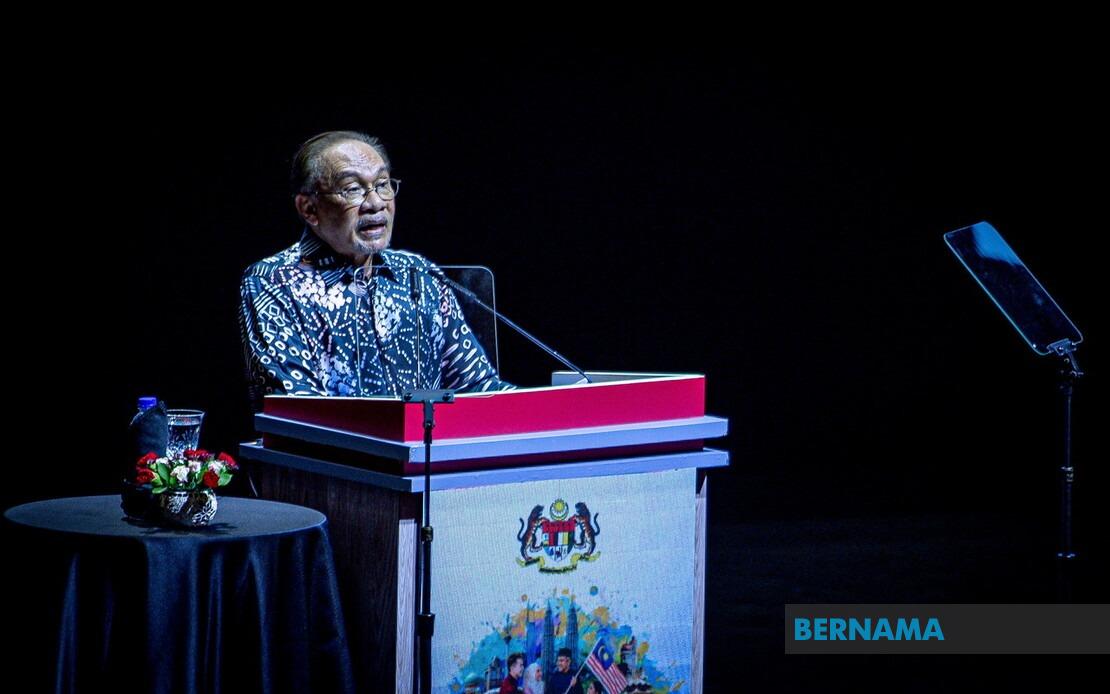
Prime Minister Datuk Seri Anwar Ibrahim rolled out a six-pronged policy initiative during his National Day address, signalling the government's determination to tackle mounting cost-of-living pressures that have become a flashpoint for public discontent across Malaysia. The package, which takes effect on September 1, represents an attempt to provide tangible relief to households, students and small entrepreneurs struggling with everyday expenses and reduced purchasing power.
Delivering his remarks at the Putrajaya International Convention Centre (PICC) on August 30, Anwar framed the measures as an acknowledgement that prior interventions, whilst significant, have not fully resolved the financial anxieties gripping ordinary Malaysians. The package encompasses fuel subsidies alongside targeted support for school maintenance—a particularly sensitive area given the direct impact on educational infrastructure and student welfare. Beyond these traditional relief mechanisms, the government is pivoting towards modernisation initiatives including artificial intelligence deployment, healthcare system digitalisation, e-Invoicing infrastructure and expanded microfinancing access.
The fuel subsidy component addresses what remains a politically sensitive and economically significant policy area in Malaysia. Fuel costs ripple through the entire economy, affecting transport, logistics and manufacturing sectors whilst also hitting household budgets directly. By maintaining or adjusting subsidy mechanisms as part of this package, the government appears to be rejecting calls for further reductions that might have accelerated inflation pressures, particularly for those dependent on personal vehicles for work.
School maintenance funding carries symbolic weight beyond its budgetary impact. Educational infrastructure directly influences learning outcomes and reflects the government's commitment to quality education. Deteriorating school facilities have been a recurring complaint from parents and educators, making this announcement a visible gesture addressing grassroots concerns about public service delivery. This element likely resonates most strongly with middle and lower-income families whose children depend entirely on the public education system.
The inclusion of artificial intelligence and healthcare digitalisation represents a forward-looking dimension to the relief package that extends beyond immediate subsidy provision. These initiatives promise long-term efficiency gains and cost reductions within critical sectors. AI applications across government services could streamline processes and reduce bureaucratic inefficiencies, whilst healthcare digitalisation addresses growing healthcare costs by improving system efficiency, reducing duplicate testing and enabling better preventive care management. For a population increasingly concerned about healthcare affordability, particularly among retirees and those with chronic conditions, these digital transformation measures offer promise of sustainable cost containment.
E-Invoicing infrastructure and microfinancing provisions target economic actors rather than consumers directly. E-Invoicing simplification reduces compliance burdens for small and medium enterprises, lowering operational costs that might otherwise be passed to consumers. Microfinancing expansion supports informal sector entrepreneurs and small traders who form the backbone of many Malaysian communities, particularly in rural areas and secondary towns where formal credit access remains limited. By reducing financial barriers to entrepreneurship and small business operation, the government aims to stimulate grassroots economic activity and income generation.
Anwar's framing emphasised that these measures represent temporary relief rather than permanent solutions, a candid acknowledgement of the structural nature of cost-of-living challenges. This positioning suggests the government recognises that affordability pressures stem from multiple sources including global commodity prices, exchange rate fluctuations and structural economic imbalances that cannot be rapidly resolved through policy announcements alone. The National Day timing also carries political symbolism—presenting relief measures during the eve of Malaysia's national celebration positions the government as responsive to citizen welfare and invested in national well-being.
Deputy Prime Minister Datuk Seri Dr Ahmad Zahid Hamidi and Communications Minister Datuk Seri Fahmi Fadzil attended the address, underscoring the whole-of-government approach to implementation. Their presence signals that multiple cabinet portfolios will coordinate to deliver these measures effectively, suggesting this is not merely a rhetorical exercise but a commitment requiring cross-ministerial execution and resource allocation.
For Malaysian households already stretched by inflation and reduced real wages, the September 1 implementation date offers a concrete timeframe for expectation-setting. The question facing policymakers is whether these measures will generate sufficient tangible relief to meaningfully alter public perception of government performance on economic management, a crucial issue heading towards inevitable electoral reckonings. The package's effectiveness will ultimately be judged not by its conception but by its real-world impact on household finances, school infrastructure, healthcare access and small business viability across the country.

