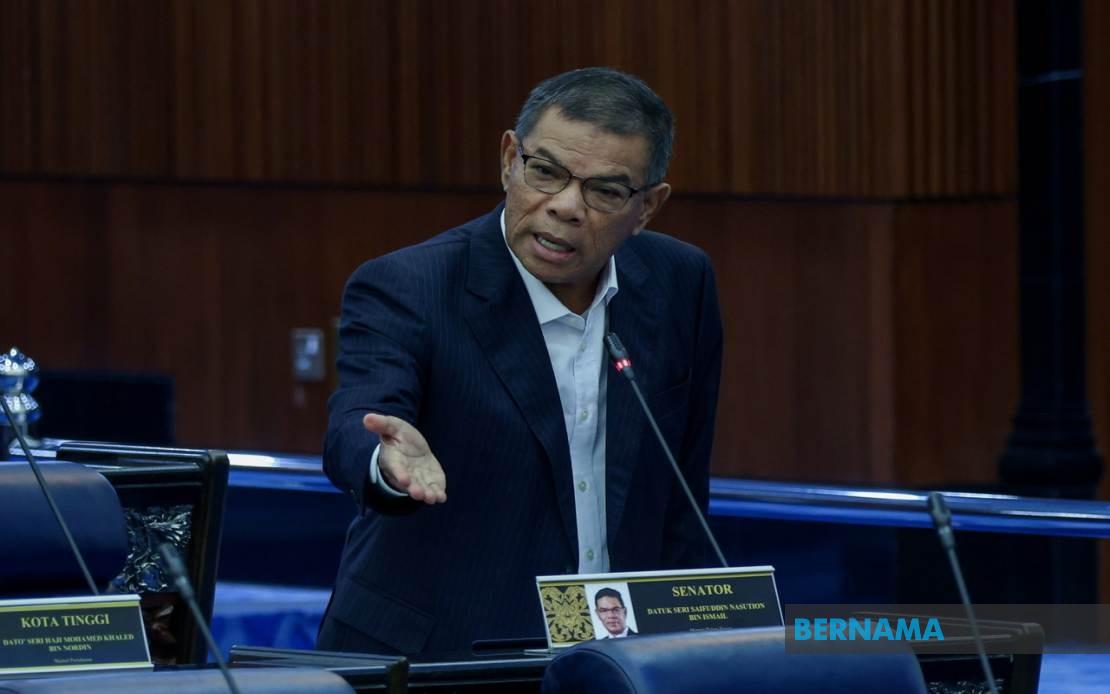
Prime Minister Datuk Seri Anwar Ibrahim has cleared RM22 million in budget allocation to equip the Border Control and Protection Agency (AKPS) with firearms and essential protective equipment, according to Home Minister Datuk Seri Saifuddin Nasution Ismail. The decision represents a significant step in strengthening operational capacity at Malaysia's borders, addressing longstanding concerns about personnel safety that escalated following a violent incident in Kedah earlier this year.
The funding approval came in direct response to a February shooting incident in Bukit Kayu Hitam, Kedah, involving a vehicle carrying one of AKPS's senior commanders. That incident highlighted vulnerability gaps within the agency's operational framework and prompted Home Minister Saifuddin Nasution to escalate the matter to the Prime Minister's office. The subsequent approval reflects the government's commitment to protecting its border personnel against emerging security threats, while acknowledging the practical limitations of deploying unarmed officials in high-risk zones.
During parliamentary questioning, Saifuddin Nasution clarified that the RM22 million package would be distributed strategically among AKPS personnel deemed appropriately trained to handle firearms. This distinction matters considerably, as AKPS draws its workforce from multiple government agencies, including the Ministry of Health, whose staff typically lack firearms certification. The minister emphasized that only certain cadres—particularly personnel seconded from the police force—possess the requisite qualifications to carry and deploy weapons responsibly. This targeted approach aims to balance security enhancement with proper training protocols and accountability measures.
The arming of AKPS personnel also addresses a practical operational question that has confronted border agencies throughout Southeast Asia: how to equip enforcement teams with tools matching the sophistication of modern smuggling and transnational crime networks. By providing appropriate armaments, the government signals recognition that border control has evolved beyond mere documentation and administrative processes into a security-intensive function requiring defensive capabilities. The equipment allocation sits within a broader strategy to modernize Malaysia's border infrastructure and personnel capacity.
Saifuddin Nasution used the parliamentary session to contextualize AKPS's formation within a larger institutional consolidation agenda. Previously, Malaysia's border control responsibilities fragmented across more than 20 separate agencies, creating inefficiencies, coordination failures, and integrity vulnerabilities. The Home Minister argued that consolidating these functions under a single entity dramatically streamlines operations while reducing opportunities for corruption and bureaucratic obstruction. This argument addresses long-standing concerns among anti-corruption advocates and efficiency specialists about the risks inherent in distributed governance structures.
Since commencing operations, AKPS has registered notable achievements that underscore the consolidation model's effectiveness. The agency coordinated a substantial drug seizure worth tens of millions of ringgit at Penang International Airport and successfully detected sophisticated e-waste smuggling operations at major ports. These successes provide empirical evidence supporting the government's institutional restructuring rationale, demonstrating that unified command structures can generate faster intelligence sharing and more coordinated enforcement responses than fragmented agency arrangements.
The RM22 million approval also carries constitutional and federalism implications requiring careful navigation. Sabah and Sarawak legislators raised concerns about whether AKPS operations might infringe upon constitutional protections and rights guaranteed under the Malaysia Agreement 1963. Saifuddin Nasution addressed these concerns by confirming that AKPS establishment respects both constitutional frameworks and MA63 provisions. The minister indicated that these issues had been thoroughly debated and resolved during the legislative process, transitioning the discussion from policy principle to operational implementation questions.
Parallels to existing agencies demonstrate institutional precedent for AKPS's integrated model. The Eastern Sabah Security Command (ESSCOM) and Malaysian Maritime Enforcement Agency (MMEA) both successfully consolidate multiple agencies into unified operational structures while maintaining effectiveness in specialized security domains. These examples provide governance models suggesting that Malaysia can effectively manage sophisticated border functions through coordinated agency fusion rather than traditional compartmentalized approaches. The precedent strengthens arguments that AKPS represents evolutionary institutional development rather than radical departure from proven practice.
For Malaysian businesses and traders, the firearms authorization carries both practical and symbolic significance. The equipment allocation signals government determination to maintain border integrity and security at commercial entry points where contraband and unauthorized goods represent persistent problems. Enhanced agency capability may reduce trafficking incidents that disrupt legitimate commerce and inflate transaction costs through compliance requirements. Simultaneously, the move represents confidence in AKPS's capacity to balance security imperatives with facilitation of legitimate cross-border movement.
The Home Minister's parliamentary statements frame border control as a multifaceted challenge demanding security, revenue, and facilitation capabilities simultaneously. The RM22 million allocation addresses one dimension—personnel safety and enforcement capacity—within this broader institutional framework. National revenue enhancement occurs through preventing smuggling and duty evasion, streamlined movement of legitimate goods reduces trader friction, and strengthened security at entry points protects national interests. These overlapping objectives explain why border agency modernization features prominently in the government's governance agenda.
Regionally, Malaysia's border modernization reflects broader Southeast Asian patterns of upgrading frontier control capabilities amid rising transnational crime, migration pressures, and security concerns. Neighboring countries similarly invest in consolidated border agencies and enhanced personnel equipment, suggesting AKPS development aligns with regional security trends. As Malaysia increasingly integrates with ASEAN frameworks requiring coordinated border management, domestic agency capacity directly impacts international cooperation effectiveness and national representation in regional security architecture.
The RM22 million commitment represents tangible government response to frontline personnel concerns that had accumulated over years of fragmented institutional arrangements. By approving modern protective equipment and appropriate armaments, the administration acknowledges that border work involves genuine occupational hazards requiring corresponding resource allocation. This practical recognition contrasts with historical underinvestment in border personnel welfare and reinforces the government's stated commitment to civil service modernization and professional improvement across enforcement agencies.

