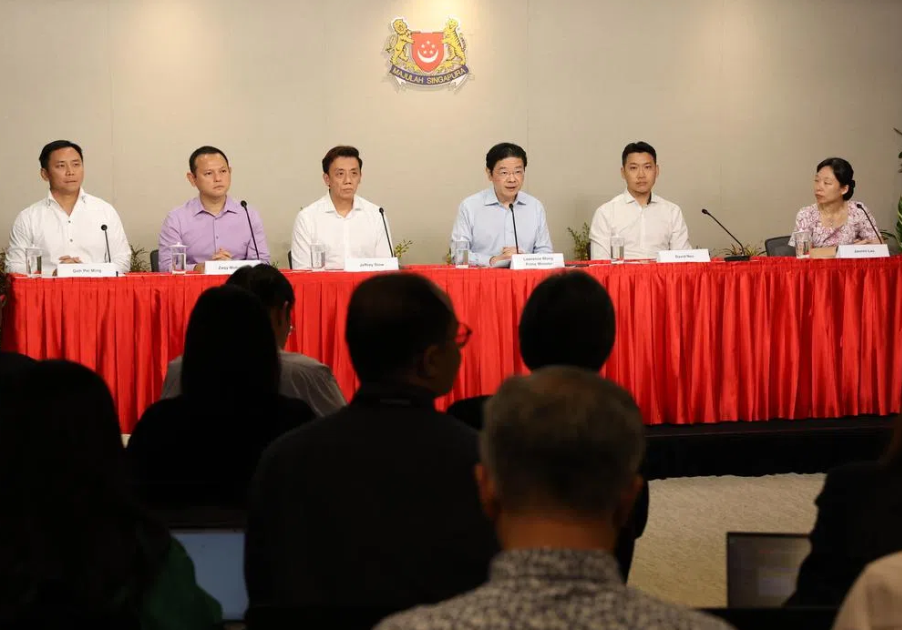
Prime Minister Lawrence Wong has accelerated Singapore's political succession plan with a significant Cabinet reshuffle that combines the promotion of newer parliamentarians with the strategic retention of veteran leaders. The restructuring, announced on July 22, reflects the ruling People's Action Party's deliberate strategy of managing generational change while maintaining governmental continuity through periods of transition. The move comes in the wake of two unexpected political departures that forced the Government to reconsider its Cabinet composition earlier than typically scheduled.
Two General Election 2025 newcomers have been elevated to full ministerial rank under the reshuffle. Jeffrey Siow, who has been serving as Acting Transport Minister since May 2025, and David Neo, leading the Culture, Community and Youth portfolio in an acting capacity, will now assume these ministerial positions permanently. Alongside them, Sim Ann, another first-term politician, moves to become Second Minister overseeing both Foreign Affairs and Home Affairs—a dual appointment that underscores her emerging significance within the Cabinet hierarchy. These promotions signal the Government's confidence that the newer cohort has adapted successfully to their responsibilities and demonstrated readiness for expanded influence.
The reshuffle also effects notable lateral movements and new appointments across the administrative machinery. Jasmin Lau, a first-term MP, will assume the role of acting minister for the Manpower Ministry, taking over from Tan See Leng, who transitions to become Minister for Trade and Industry with a specific focus on energy and industrial sectors. Meanwhile, labour movement chief Ng Chee Meng returns to the Cabinet as Minister in the Prime Minister's Office, expanding the coordinating function around the PM. These adjustments reflect a deliberate reshuffling of portfolios designed to test politicians in fresh domains while leveraging their accumulated experience.
Two backbench MPs with backgrounds in senior civil service—Foo Cexiang and Shawn Loh—have been appointed as Ministers of State, joining the second-tier ministerial layer that handles substantial legislative and administrative work. Their elevation from the backbenches demonstrates the Government's pattern of identifying capable individuals and gradually exposing them to greater responsibility. This approach contrasts with more dramatic political systems where sudden jumps to prominence are common; Singapore's model favours incremental advancement tested through performance in progressively demanding roles.
K. Shanmugam's elevation to Senior Minister marks a strategic decision to preserve institutional continuity and accumulated wisdom within the Cabinet's highest echelon. Alongside Senior Minister Lee Hsien Loong, Shanmugam represents the cohort of longest-serving and most experienced political operators within the Government. Prime Minister Wong explicitly noted that as Singapore undergoes systematic leadership renewal, the counsel and mentorship of these senior figures becomes increasingly valuable for developing the next generation of leaders. This arrangement allows the PM to maintain access to deep expertise while creating space for younger politicians to assume greater operational responsibilities.
The timing of this reshuffle was precipitated by two unexpected political exits that disrupted the Government's normal annual Cabinet review cycle. Faishal Ibrahim, who held the position of Acting Minister-in-charge of Muslim Affairs alongside his role as Senior Minister of State for Home Affairs, resigned on July 20 following what he described as a lapse of judgment in his personal interactions. Prior to that, Senior Minister of State Koh Poh Koon stepped down on June 1, citing family reasons. These departures necessitated accelerated planning to ensure ministerial portfolios remained adequately staffed and supervised.
Prime Minister Wong acknowledged during his press conference that the Cabinet composition undergoes systematic annual review, but unexpected resignations occasionally force the Government to adapt its timeline and strategy. He framed the reshuffle as part of the broader ongoing process of building what he termed a "strong pipeline" of political talent—not merely at the ministerial level but across the full spectrum of parliamentary and administrative ranks. This conceptualisation reflects Singapore's approach to governance as requiring sustained institutional capacity development rather than reactive appointments to immediate vacancies.
On the question of deputy prime ministerial succession, Wong indicated that the current structure featuring Deputy Prime Minister Gan Kim Yong operates effectively without a second deputy. However, he suggested this arrangement remains under continuous review as leadership renewal progresses. The Government currently maintains three coordinating ministers—Shanmugam holding the national security portfolio alongside Chan Chun Sing and Ong Ye Kung, who oversee other governmental domains. This distributed coordinating structure provides checks and balance while reducing dependency on any single second-tier leader.
Wong also addressed his continued tenure as Finance Minister, a portfolio he has held since 2021. He characterised his search for a successor as an ongoing "work in progress," acknowledging that potential candidates develop at varying paces and require demonstrated readiness before assuming such economically sensitive responsibilities. The PM's philosophy, as articulated during questioning, emphasises matching individuals to positions where they can optimally contribute rather than promoting according to timeline considerations alone. This reflects a merit-based approach that Singapore has traditionally emphasised, though it also highlights the challenge of identifying and developing finance ministry-ready talent within the current parliamentary cohort.
For Malaysian observers and Southeast Asian analysts monitoring Singapore's governance evolution, this reshuffle illustrates the sophisticated mechanisms through which the PAP manages institutional reproduction and prevents leadership crises. Unlike neighbouring systems where factional politics or sudden generational conflicts occasionally destabilise administrations, Singapore's methodical succession planning distributes risk and builds redundancy. The elevation of multiple first-term MPs simultaneously reduces the burden of unrealistic expectations on any single rising politician while creating a cohort of roughly peer-level ministers who can develop relationships of mutual accountability.
The reshuffle also reflects practical realities within Singapore's compact political system. With limited parliamentary seats and a dominant-party structure, the pool of potential ministerial talent necessarily remains smaller than in larger democracies. This makes the identification and cultivation of capable individuals from diverse backgrounds—including civil service backgrounds, as demonstrated by Foo Cexiang and Shawn Loh—strategically important for maintaining representative legitimacy and administrative competence. The deliberate promotion of politicians holding ministerial responsibility across different ethnic and religious communities underscores the continuing importance Singapore places on multicultural representation at decision-making levels.
The changes taking effect progressively from July 27 onwards maintain administrative stability by avoiding simultaneous transitions across multiple critical ministries. This measured implementation approach reflects lessons learned from previous reshuffles and demonstrates institutional maturity in managing political transitions without disrupting service delivery. For regional economies watching Singapore's trajectory, the Cabinet reshuffle provides another data point regarding how the city-state manages the perpetual tension between continuity and renewal—a challenge increasingly relevant as Southeast Asian nations grapple with their own generational political transitions.

