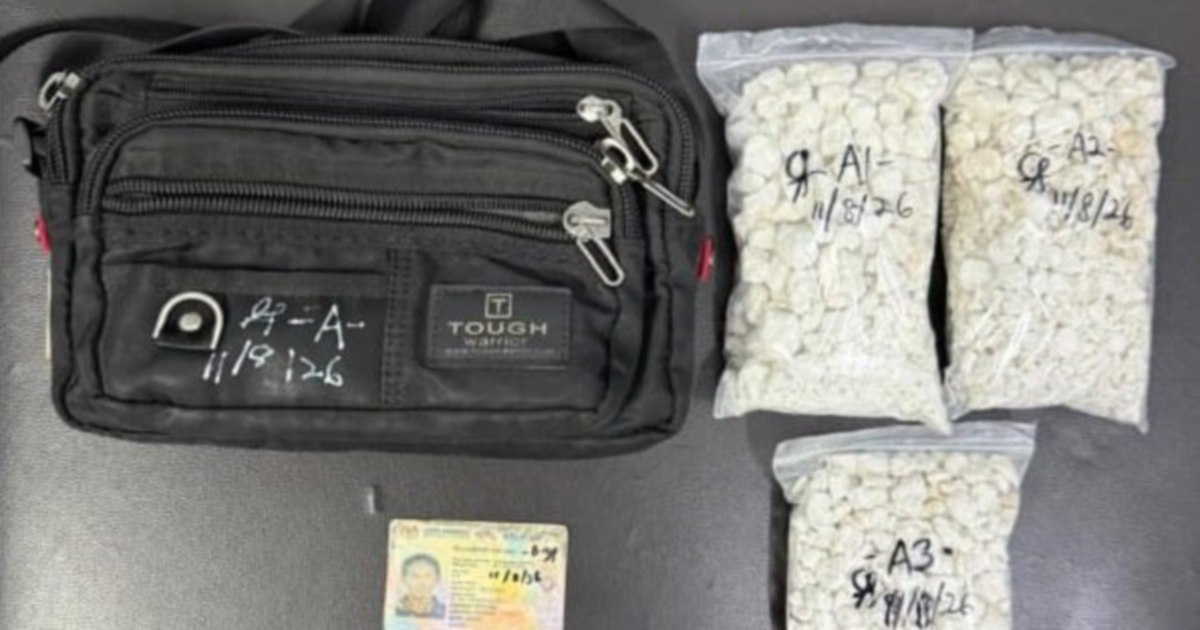
Law enforcement authorities in Kluang conducted a pre-dawn narcotics operation that culminated in the apprehension of a middle-aged male suspect and the confiscation of a substantial quantity of illicit drugs in the Simpang Renggam locality. The suspect, identified as a 42-year-old individual, was detained during the targeted raid as officers discovered controlled substances believed to constitute heroin weighing approximately 1.055 kilograms.
The seized contraband carries an estimated street value of RM10,128, underscoring the economic significance of the narcotics trade that continues to flourish in districts across Malaysia. Drug enforcement operations of this calibre highlight the persistent challenge posed by heroin trafficking networks that distribute product throughout communities despite intensified police surveillance and intelligence gathering. The timing of the early morning intervention suggests coordinated planning by officers who likely established the suspect's location and activity patterns through prior investigative work.
Simpang Renggam, situated within the Kluang administrative district in southern Johor, has historically been vulnerable to organised drug movements owing to its geographic positioning along transportation corridors and relative proximity to urban centres. The locality's strategic location facilitates logistical operations for trafficking syndicates seeking to distribute narcotics across the peninsula and potentially into neighbouring regions. This particular bust reflects broader national anti-drug initiatives that have intensified throughout 2024, with various state and federal police contingents escalating enforcement activities to disrupt supply chains and apprehend key operatives.
The arrest of the individual represents a critical intervention within what investigators presumably assessed as an active trafficking network. While the confiscation of 1.055 kilograms is substantial by street-level standards, it likely represents only one transaction or segment of a larger distribution operation. Malaysian police frequently observe that apprehended suspects maintain connections to upstream producers and downstream retailers, suggesting the necessity of comprehensive investigation beyond the individual custody to dismantle networks systematically.
Heroin remains among the most problematic illicit substances circulating throughout Malaysia, driving addiction rates that impose considerable burdens on public health infrastructure and social services. The drug's potency and highly addictive properties generate persistent demand despite government interdiction efforts, creating commercial incentives for criminal enterprises to maintain supply channels. Enforcement agencies acknowledge this structural challenge and recognise that isolated arrests, whilst symbolically significant, require complementary approaches encompassing rehabilitation, harm reduction, and community intervention to address underlying demand factors.
The investigation and prosecution process that will follow this seizure remains subject to Malaysia's comprehensive narcotics legislation, principally the Dangerous Drugs Act 1952. Possession of heroin in quantities exceeding specified thresholds triggers enhanced criminal provisions, and prosecutors will likely seek conviction under offences carrying substantial custodial sentences. The gravity of heroin-related prosecutions reflects national policy positioning illicit opioids as particularly corrosive to social stability and public order.
Beyond the immediate legal consequences for the arrested individual, the operation contributes to the broader intelligence architecture that Malaysian law enforcement utilises to map trafficking patterns and identify significant nodes within distribution networks. Information derived from this incident—including the suspect's associations, transaction records, and distribution methods—feeds into databases and analytical frameworks that guide subsequent operations. Successive interdictions gradually erode criminal operational capacity, though supply lines demonstrate remarkable resilience in response to enforcement pressure.
The Johor police contingent's capacity to execute coordinated narcotics operations reflects ongoing investment in specialist training, investigative resources, and inter-agency cooperation. Modern drug enforcement increasingly demands technical proficiency, including financial investigations, digital surveillance, and chemical analysis, alongside traditional detection methodologies. The successful recovery and proper documentation of 1.055 kilograms demonstrates institutional competence in chain-of-custody procedures and forensic protocols essential to prosecution viability.
Regional considerations amplify the significance of this Simpang Renggam operation. Johor's geographical positioning as Malaysia's southernmost peninsula state creates particular susceptibility to trafficking movements originating from or transiting through Singapore and linked to transnational criminal networks. The Strait of Malacca and overland border corridors facilitate movement of narcotics between jurisdictions, necessitating intensive domestic enforcement supplemented by cross-border intelligence sharing and coordinated regional initiatives.

