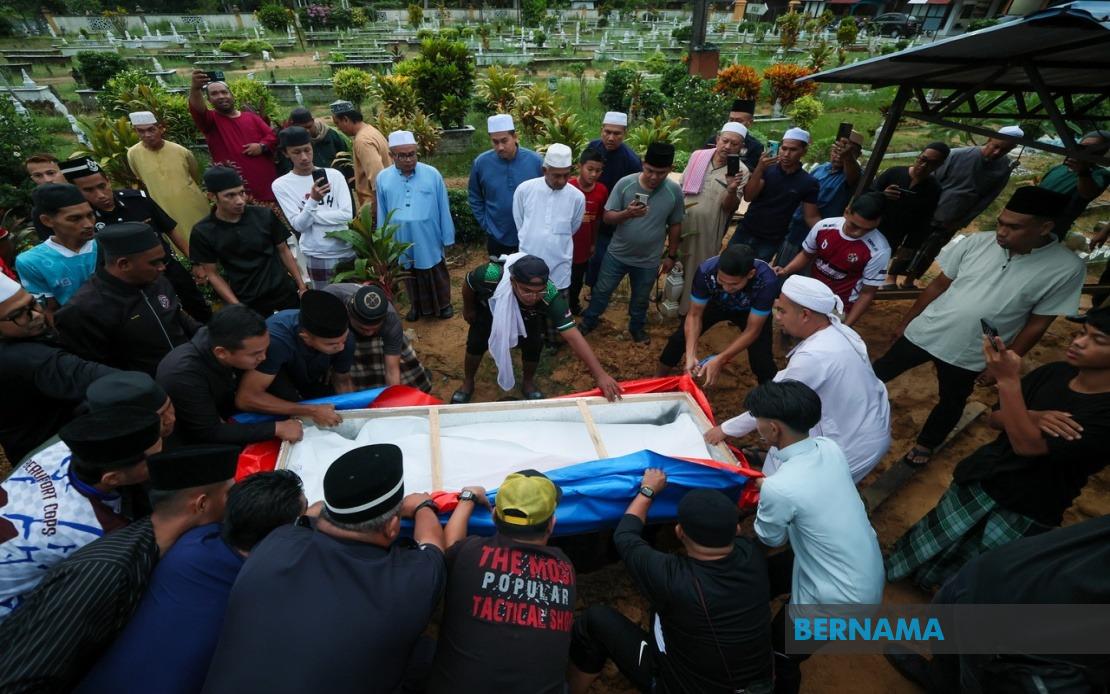
The funeral of Corporal Mohamad Nur Hafiz Rahim, a 29-year-old Royal Malaysia Police officer who died in an electrocution incident, took place on Thursday morning in his hometown of Kota Bharu, Kelantan. After prayers at his family residence in Kampung Hutan Pasir, he was laid to rest at Kampung Pangkal Kuang Muslim Cemetery in Ketereh. The ceremony marked the conclusion of a brief but emotionally significant chapter in a tragedy that has drawn national attention to workplace safety protocols within law enforcement agencies.
The fatal incident occurred on Wednesday at 5.50 pm outside Weston Police Station in Beaufort, Sabah, when Mohamad Nur Hafiz and two colleagues were handling a 29-foot metal pole designed for harvesting coconuts. The pole made contact with electrical lines, resulting in all three officers being electrocuted. In addition to Mohamad Nur Hafiz, the victims included Corporal Chiu Teck Siong, 40, from Sarawak, and Constable Muhammad Raimi Ismarubee, 26, from Terengganu. The incident has raised critical questions about operational safety measures and risk assessment procedures at police installations across Malaysia and Sabah specifically.
During a statement at the cemetery, Mohamad Nur Hafiz's eldest sister Nurlella Rahim, 34, expressed the family's gratitude toward the Royal Malaysia Police for coordinating the logistical arrangements that enabled her brother's remains to be transported home from Sabah. The vehicle carrying his body arrived in Kota Bharu at 4.45 am, facilitating the morning funeral observance. This gesture of institutional support underscores the traditions of solidarity within law enforcement ranks, though it also highlights the human cost of operational procedures that may require reassessment.
Nurlella provided insight into the close-knit nature of her family, describing daily video calls among the five siblings despite geographical separation. While she is based in Ipoh, Perak, and her late brother was stationed in Sabah, the family maintained regular virtual contact through video messaging and a shared WhatsApp group. This routine communication pattern made the sudden loss particularly acute, as the family had spoken to Mohamad Nur Hafiz only days before the incident. The last interaction with their mother occurred on Thursday afternoon, with Nurlella noting that her brother appeared fatigued during that exchange but remained engaged and affectionate, even as he prepared to leave for his work shift.
The final video call between Nurlella and her brother took place on Sunday, when he shared images and moments from a family outing to the beach with his wife Fatimah Shahira and their child. These routine domestic activities underscore the ordinary nature of his life outside the police station—a husband and father balancing family responsibilities with professional duties. Such details, while personal, serve to humanize the tragedy and contextualize the broader implications of occupational hazards within the security sector.
The incident has triggered immediate governmental attention. Prime Minister Datuk Seri Anwar Ibrahim ordered a comprehensive, transparent, and expedited investigation into the circumstances surrounding the electrocution. In a statement posted on Facebook, Anwar emphasized that such an inquiry is essential not only to establish the precise cause of the tragedy but also to identify systemic vulnerabilities that could be remedied to prevent future occurrences. This directive signals political commitment to workplace safety accountability within public security institutions.
The investigation will likely focus on several operational dimensions. These include the adequacy of risk assessments for tasks involving extended metal implements in proximity to overhead power lines, the availability and condition of personal protective equipment, the training protocols for handling potentially hazardous equipment, and the supervision structures in place at the Weston station. Given that the incident involved a routine task—harvesting coconuts for use at the police station—the findings may expose gaps between established safety standards and their practical implementation at field installations.
For Malaysian readers and regional observers, this incident underscores broader concerns about occupational safety in Southeast Asia. Police forces across the region frequently operate with limited resources and infrastructure, particularly at remote or rural stations. The Weston station incident may serve as a catalyst for wider safety audits across Malaysia's police infrastructure, potentially benefiting not only law enforcement personnel but also raising awareness about electrical hazards in general.
The tragedy also illuminates the human dimension of public service. The three deceased officers were engaged in unglamorous but necessary station maintenance when the incident occurred. Their deaths represent not only individual family losses but also the removal of experienced personnel from the police workforce. Mohamad Nur Hafiz's family, along with those of his two colleagues, now face the dual burden of grief and the institutional processes that follow line-of-duty deaths.
Moving forward, the government's investigation and any resulting policy reforms will be closely observed by police unions, worker safety advocates, and the broader public. The thoroughness and transparency of the inquiry, as promised by Prime Minister Anwar, will likely influence public confidence in the government's commitment to protecting those who serve in law enforcement. For the families involved, including Nurlella and her siblings, the investigation offers a pathway toward understanding the preventable factors that contributed to the tragedy, though no findings can restore what has been lost.

