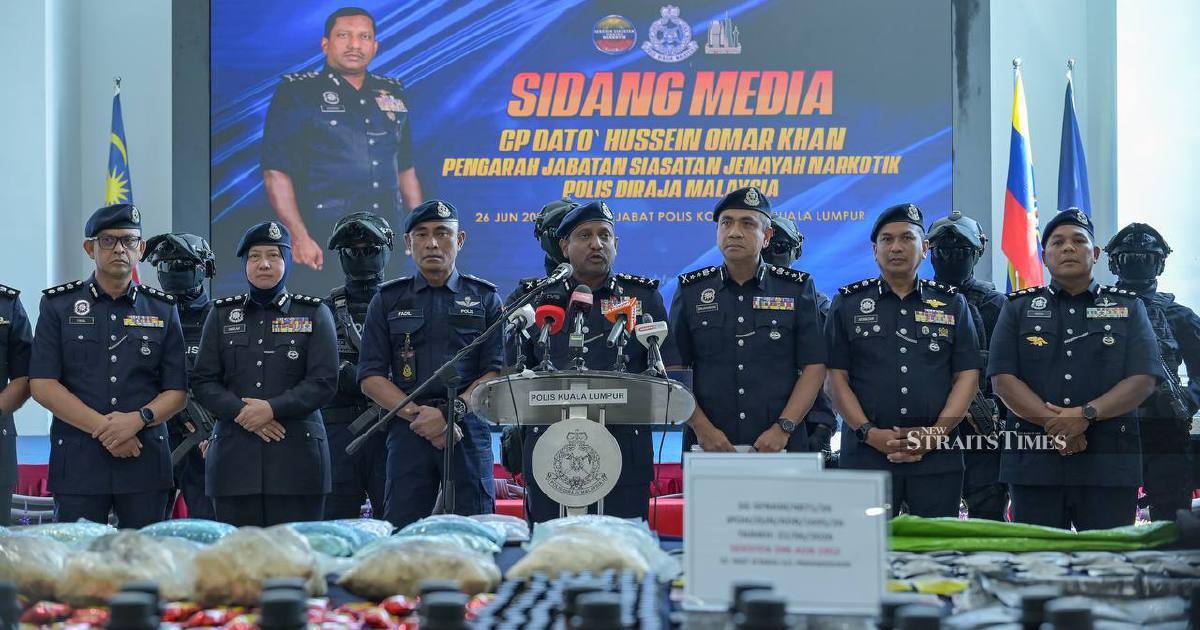
Malaysian law enforcement has struck a major blow against organised drug trafficking, confiscating narcotics with an estimated street value of RM135.63 million during a series of coordinated raids in Cheras on June 20. The operation resulted in the arrest of seven individuals suspected of involvement in large-scale distribution activities intended to saturate the domestic market. The seizure underscores intensifying police efforts to dismantle trafficking networks that have been expanding their operations across the Klang Valley region.
The three simultaneous raids, coordinated by federal and state police units, appear designed to prevent the suspects from alerting associates or destroying evidence. Intelligence gathered over preceding weeks identified the Cheras location as a key logistical hub where drugs were being processed and packaged for wider distribution. Law enforcement officials have indicated that the operation targeted networks with connections extending beyond Selangor, suggesting a larger territorial distribution scheme was in motion. The timing and scale of the seizure indicates this was not a routine street-level bust but rather an operation targeting mid-tier traffickers with wholesale supply relationships.
The magnitude of the confiscation places this bust among the more significant drug seizures recorded in recent months. For context, such large caches typically indicate traffickers attempting to establish or maintain market dominance by flooding supply channels, a strategy that keeps prices artificially low and addiction rates elevated across user communities. The RM135.63 million valuation reflects estimated retail equivalent rather than wholesale cost, a distinction that matters when assessing the profitability motive behind such operations. Even at reduced wholesale figures, the financial scale involved suggests organised syndicates capable of generating substantial profit and sustaining operations through corruption and intimidation.
The arrest of seven individuals represents progress in identifying the operational structure of the trafficking network. Police investigations typically reveal hierarchical organisational models, with some suspects occupying roles as street distributors while others manage inventory, finance, or logistics. Understanding the relationships between these seven individuals will provide investigators with crucial intelligence about the network's broader composition. Malaysian authorities have demonstrated increased sophistication in mapping these criminal ecosystems, recognising that street-level arrests prove ineffective without simultaneously targeting supply chain vulnerabilities.
Cheras has emerged as a focal point for drug-related law enforcement activity, reflecting both the area's demographic composition and its geographic utility for distribution networks. The district's strategic location relative to transport corridors and its socioeconomic characteristics have reportedly made it attractive to traffickers seeking to establish regional distribution franchises. Neighbours and residents have frequently reported heightened drug activity, suggesting public support for aggressive police intervention. The police action signals recognition that prevention requires proactive targeting of known trafficking zones rather than reactive enforcement.
This operation aligns with the Royal Malaysian Police's stated priority to combat organised trafficking networks rather than pursuing individual users or low-level dealers. The strategic shift reflects research demonstrating that dismantling supply infrastructure proves more effective at reducing availability and market saturation than mass incarceration of consumers. By targeting organised suppliers and the financial ecosystems supporting them, enforcement agencies aim to raise operational costs for traffickers and reduce profit margins that motivate expansion. The coordination required to execute three simultaneous raids demonstrates institutional capacity for executing complex operations.
The drugs seized will undergo laboratory analysis to determine precise composition and purity levels. Such testing serves dual purposes: confirming substance identity and potency for prosecution purposes while providing intelligence about source regions and manufacturing methods. Analysis often reveals trafficking networks' preferred supply chains and production partners, information valuable for regional law enforcement cooperation. Drug forensics databases maintained by the Narcotics Directorate contribute to understanding broader trafficking patterns and emerging threats like novel synthetic substances.
The charges anticipated against the seven suspects will likely carry substantial prison sentences given the quantities involved. Malaysia's drug trafficking laws impose mandatory minimum penalties for possession exceeding specified thresholds, with aggravating factors like conspiracy and intent to distribute triggering enhanced sentences. Prosecution will build cases demonstrating each suspect's role and individual culpability. Cooperation from some suspects through plea negotiations potentially provides investigators with additional intelligence regarding upstream suppliers and downstream distribution networks.
International drug trafficking dynamics increasingly influence Malaysian operations, as regional networks integrate with broader Southeast Asian smuggling corridors. Precursor chemicals originating from India and China, combined with local production capacity, fuel methamphetamine manufacturing. Heroin trafficking from the Golden Triangle continues competing with synthetic alternatives. This particular seizure's composition—while not specified in initial reports—likely reflects Malaysia's position as a transshipment and consumption market for multiple drug categories. Regional trafficking patterns suggest increasingly sophisticated money laundering infrastructure supporting these operations.
The seizure's impact on street availability remains uncertain, dependent on the network's financial reserves and replacement capacity. Larger organised syndicates maintain surplus inventory and can absorb single losses by reallocating existing stocks. However, repeated sequential operations can eventually degrade operational capability and increase operational costs. Police enforcement efficacy ultimately depends on sustaining pressure through continuous intelligence gathering and coordinated operations rather than relying on isolated successes. The June 20 operation represents one component of broader drug control strategy requiring sustained resource commitment and inter-agency coordination to achieve meaningful impact on market availability and trafficking patterns.

