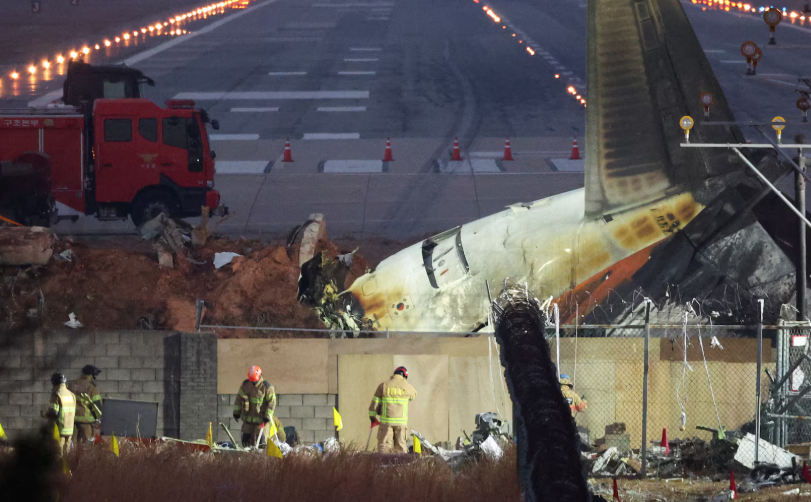
South Korean law enforcement has intensified its investigation into the Jeju Air disaster by raiding the Korea Airports Corporation and related government agencies, marking a significant escalation in the probe into the aviation catastrophe that claimed 179 lives last December. The coordinated searches, conducted on Tuesday, represent a fresh push to uncover documentary evidence and materials that investigators believe may establish criminal culpability among officials and operators responsible for airport safety and flight operations on the day of the tragedy.
The raids targeted three distinct entities central to South Korea's aviation oversight infrastructure. Police investigators descended on the Korea Airports Corporation, which manages most of the country's major domestic airports with the notable exception of Incheon International Airport; the transport ministry; and the Busan Regional Office of Aviation. The breadth of the operation underscores the multi-institutional nature of the investigation and suggests that authorities believe responsibility for the disaster extends across several organizational boundaries rather than residing with a single entity.
According to investigation team officials, the primary focus of the raids centres on allegations of professional negligence resulting in death or injury—charges already levelled against 74 suspects. This legal framework allows investigators to examine whether officials and employees at these institutions failed in their duties in ways that directly contributed to the catastrophe. The scope of culpable parties suggests that negligence may span multiple decision-making points, from airport operational procedures to maintenance protocols and potentially emergency response coordination.
The transport ministry has now been searched on three separate occasions since the investigation commenced, indicating that prosecutors regard it as a repository of crucial evidence. Each successive search likely targets different document categories or follows new investigative leads. The repeated visits suggest frustration with the ministry's initial cooperation or the emergence of fresh lines of inquiry requiring verification through official records.
Beyond the established negligence charges, prosecutors are considering whether to apply additional accusations of causing a serious public disaster. Such charges would represent a more serious classification of criminal liability, potentially subjecting conviction to harsher sentencing guidelines. The consideration of elevated charges reflects the magnitude of the loss of life and the cascade of consequences that rippled through South Korean society following the incident.
The Jeju Air flight crashed at Muan International Airport on December 29, 2024, under circumstances that remain a subject of intensive forensic and administrative examination. The incident has prompted fundamental questions about airport safety protocols, aircraft maintenance standards, and the adequacy of emergency procedures. For Southeast Asian observers and aviation industry stakeholders, the South Korean investigation carries particular significance given the region's heavy reliance on air transport and the need to identify systematic vulnerabilities that might exist in comparable facilities.
The investigation's dual mandate—determining what caused the aircraft to crash whilst simultaneously evaluating whether responsible agencies responded appropriately—creates a complex prosecutorial challenge. These two dimensions interact substantially: even if mechanical or pilot factors contributed to the accident, official bodies might have failed to implement safety measures, conduct proper maintenance, or execute emergency protocols that could have prevented or mitigated the disaster. This framework explains why multiple agencies face scrutiny rather than focusing narrowly on the airline operator.
South Korea's approach to the investigation reflects broader international trends toward holding governmental and corporate institutions accountable for aviation safety. Unlike investigations that conclude with technical reports and regulatory recommendations, the criminal probe seeks to establish individual and institutional responsibility through the courts. This parallel process ensures that administrative findings are reinforced by legal consequences, potentially strengthening future compliance with safety standards.
The involvement of 74 suspects indicates that investigators have cast a relatively wide net across organizational hierarchies. This approach differs from investigations that concentrate solely on senior decision-makers, instead examining the chain of accountability from frontline airport workers through supervisory staff to ministerial officials. The breadth of the investigation suggests that prosecutors believe systemic failures rather than isolated individual errors led to the tragedy.
For Malaysia and other ASEAN nations, the rigorous pursuit of criminal accountability in the Jeju Air case serves as a cautionary reminder of the consequences of lapses in aviation safety oversight. The region has built an impressive safety record in recent years, yet incidents at lesser-scrutinized regional airports periodically reveal gaps in protocol implementation or maintenance standards. The South Korean investigation demonstrates that both technical investigation and legal accountability represent essential components of any comprehensive response to major aviation disasters.
The ongoing nature of these raids and investigations suggests that the criminal process will extend considerably longer. As evidence accumulates and technical findings crystallize, prosecutors will construct cases against identified suspects with specificity regarding what negligent actions or omissions they committed and how those failures connected causally to the deaths and injuries sustained. The investigation team's expansion of raids indicates that critical documents or witnesses remain uninterviewed, and key institutional records have not yet been fully examined.
The timing and sequence of raids reveal an investigative strategy that likely involves building pressure on institutional defendants whilst gathering corroborating evidence. By executing simultaneous searches across related agencies, investigators prevent coordinated destruction of evidence and demonstrate the seriousness of the allegations. For South Korean aviation sector participants and international observers monitoring the response to this tragedy, the intensifying investigation signals that accountability will be pursued comprehensively across all institutional actors.

