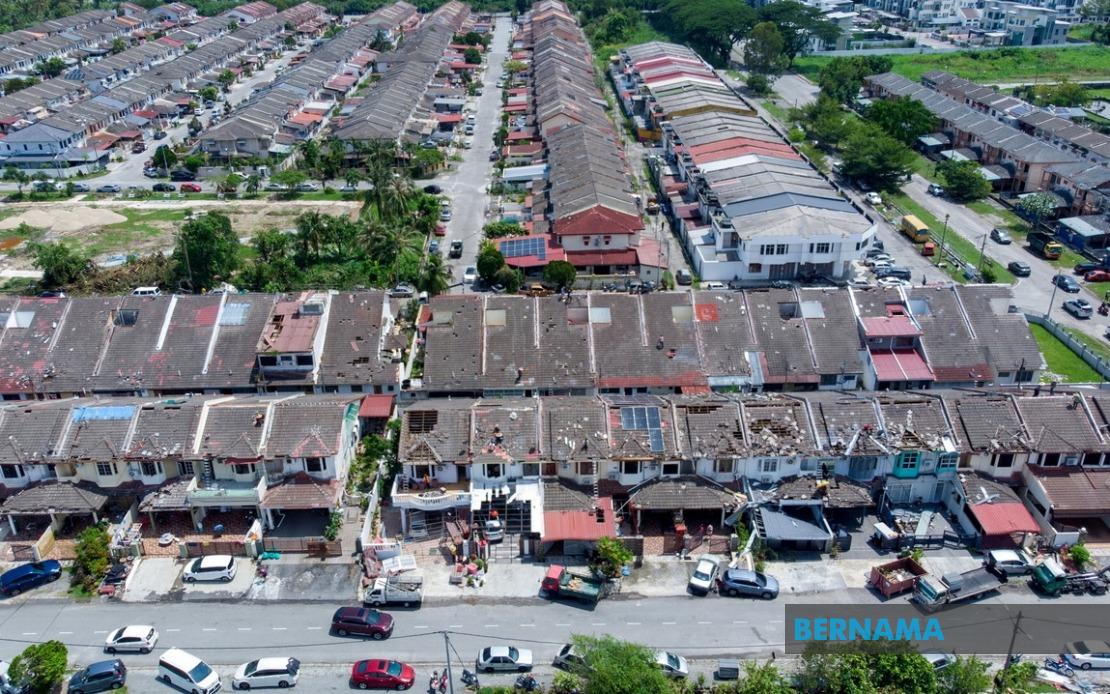
In the aftermath of a severe storm that battered the Bercham district in Ipoh, police have implemented comprehensive security measures by cordoning off five affected zones and strictly controlling entry and exit points. The move comes as authorities seek to safeguard properties and valuables in areas still recovering from widespread damage caused by what is believed to be a rare landspout phenomenon that struck on Friday.
Ipoh district police chief ACP Muhammad Najib Hamzah outlined the strategy during a press conference at Bercham police station, emphasizing that while some flexibility exists for residents needing to access their homes for cleanup and salvage operations, nighttime restrictions will be considerably tighter. The dual approach attempts to balance legitimate recovery activities with security concerns in neighbourhoods where power outages remain widespread, creating vulnerable conditions for criminal exploitation.
The enforcement becomes particularly stringent after dark, with officers stationed to verify whether individuals entering cordoned areas actually own the properties they claim to be cleaning. This verification protocol reflects growing concerns that criminals may exploit the chaos of disaster recovery by masquerading as residents undertaking cleanup work. The widespread darkness in affected zones like Anjung Bercham, where electricity supply has not been restored, significantly heightens these security vulnerabilities and necessitates the enhanced presence of uniformed personnel.
Up to 8 am on the day of the briefing, police had documented 492 storm-related reports through Op Bencana, the government's disaster response mechanism. Authorities have indicated that victims face no deadline restrictions for submitting additional claims, recognizing that the full extent of damage may only become apparent as residents continue assessing their properties. This open-ended reporting window accommodates the reality that many affected households are still in the immediate aftermath of the disaster, with some priorities focused on personal safety and temporary shelter rather than formal documentation.
The economic impact assessment remains incomplete at this stage. While preliminary figures will emerge as municipal authorities and insurance companies conduct their surveys, the full calculation of losses across residential, commercial, and public infrastructure in the affected zones has not yet been determined. Such assessments typically require weeks or even months to finalize, particularly when damage involves multiple categories of property and disputes over compensation arise.
Ipoh Barat Member of Parliament M. Kulasegaran, who also serves as Deputy Minister in the Prime Minister's Department (Law and Institutional Reform), characterized the meteorological event as extraordinary and unprecedented in its local impact. His assessment that the storm affected more than 200 houses underscores the scale of destruction in what many residents described as the most severe weather event they had experienced. The classification of the phenomenon as a landspout—a rare rotating column of air that forms over land rather than water—distinguishes this incident from typical tropical storms and suggests the extreme nature of atmospheric conditions that converged over the Bercham area.
The storm's impact was geographically concentrated but severe. Neighbourhoods bearing the brunt of the damage include Anjung Bercham Utara, Taman Mujur, Kampung Bercham, Kampung Tersusun Tasek, Taman Pusat Bercham, and Taman Indah Sakti. Residents in these areas reported structural damage to homes, uprooted trees, torn roofing, and displaced household contents scattered across properties and neighbouring yards. Such concentrated damage patterns are characteristic of landspout activity, where extreme wind speeds focused in a narrow path create devastation comparable to weak tornadoes.
The police response reflects broader disaster management protocols increasingly implemented across Malaysian states in the aftermath of severe weather events. By establishing cordoned zones and implementing movement controls, authorities aim to prevent the secondary victimization that sometimes occurs when disaster-affected communities fall prey to opportunistic crime. Communities already dealing with property damage, displacement, and financial loss become particularly vulnerable to theft if security frameworks are not rapidly established.
For residents of affected neighbourhoods, the restrictions represent a necessary trade-off between liberty and security. While movement limitations may frustrate those desperate to retrieve belongings or assess damage, the police presence provides protection against looters who specifically target disaster zones. The system's flexibility, allowing supervised nighttime access for legitimate purposes, acknowledges that residents' recovery needs cannot wait for business hours and daylight, particularly when homes lack electricity.
The incident highlights Malaysia's vulnerability to extreme weather phenomena that exceed the severity of standard monsoon patterns. Climate scientists have noted increasing instances of localized severe weather events including landspouts and microbursts across Southeast Asia, potentially linked to changing atmospheric conditions. Such events present challenges for disaster preparedness systems designed primarily around predictable seasonal hazards rather than rare, high-impact occurrences.
Beyond immediate police operations, the Bercham disaster will likely prompt reviews of building codes, early warning systems, and community preparedness measures. Whether future development in Ipoh incorporates enhanced wind resistance standards or whether meteorological monitoring capabilities require upgrading remains to be determined through post-incident evaluations conducted by relevant authorities.

