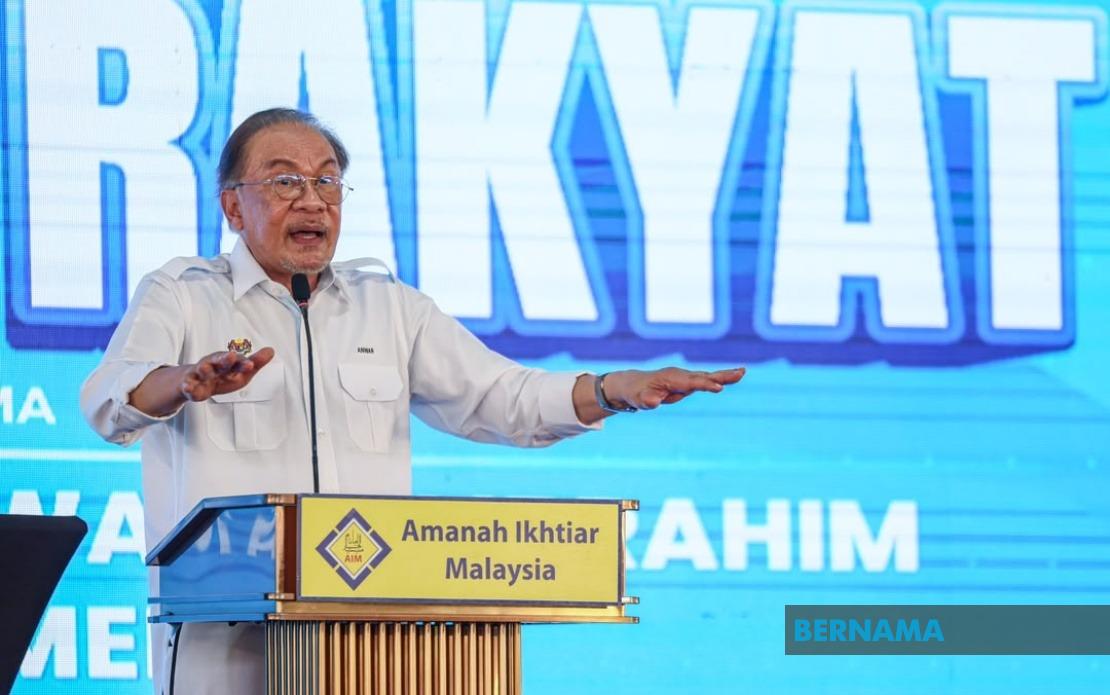
Prime Minister Datuk Seri Anwar Ibrahim has struck back at what he characterises as a coordinated political assault, attributing the pressure to his government's unflinching commitment to tackling corruption and misuse of public office. Speaking at a Pakatan Harapan campaign event in Senggarang during Johor's state election campaign, Anwar argued that rival factions have consolidated their efforts precisely because they recognise the MADANI administration's zero-tolerance approach toward those who pilfer state funds or exploit their positions for personal enrichment.
The Prime Minister's comments arrive at a particularly fraught moment in Malaysian politics, with the Johor state election—scheduled for July 11—serving as a crucial test of public confidence in PH's governance model. Anwar's framing of opposition coordination as evidence of his government's integrity represents a tactical rhetorical move common in electoral campaigns, yet it also reflects genuine tensions within the Malaysian political establishment over accountability mechanisms. By positioning anti-corruption efforts as the central grievance animating opposition parties, Anwar seeks to redefine the electoral contest around institutional probity rather than ethnic or religious concerns that have traditionally dominated state politics.
Central to Anwar's narrative is a stark personal claim: despite numerous visits to Johor as Prime Minister, he has declined to acquire land, secure contracts, or accumulate shareholdings in the state. This assertion carries considerable symbolic weight in a political culture where patronage networks and asset accumulation by political figures have long normalised the blurring of private gain and public service. Anwar's repeated emphasis on his own restraint functions simultaneously as self-vindication and as an implicit critique of predecessors and rivals who, he suggests, operated under fundamentally different ethical frameworks. The appeal is fundamentally about establishing leadership credentials centred on institutional discipline rather than personal advancement.
Yet Anwar's argument extends beyond personal conduct to encompass systemic governance philosophy. He contends that elected representatives must internalise a principle of restraint—that power should not be weaponised to accumulate land, projects, or wealth. This framing aligns with the MADANI administration's broader reform agenda, though it also raises questions about the effectiveness of voluntary compliance among elected officials. Whether institutional culture can be shifted through rhetoric alone, or whether structural mechanisms including independent accountability bodies are necessary, remains contested among Malaysian governance observers.
The Prime Minister's emphasis on alignment between federal and state governments carries particular resonance for Johor, historically one of Malaysia's wealthiest and most developed states. Anwar argues that despite billions of ringgit in development investment, fundamental welfare issues persist—unaffordable housing, inadequate infrastructure, insufficient places of worship, and insufficient targeted assistance for vulnerable populations. This diagnostic framing positions PH as the vehicle through which concentrated development benefits can be redistributed more equitably, transforming Johor from a state where a narrow elite prospers into one characterised by broader-based prosperity. Whether this distributive agenda can survive the fiscal constraints and institutional fragmentation that have historically limited state governments' capacity for progressive redistribution remains to be determined.
Anwar's defence of Pakatan Harapan's coalition with the Democratic Action Party (DAP) addresses a persistent vulnerability in the ruling alliance's political legitimacy, particularly among Malay-Muslim voters who have expressed concerns about non-Malay, non-Muslim participation in government. Over three and a half years as Prime Minister, Anwar asserts, DAP ministers have never opposed programmes benefiting Malays or Islam, thereby challenging the opposition's narrative that PH governance compromises Malay-Muslim interests. This claim warrants scrutiny, as it presents absence of formal opposition as equivalent to substantive support, yet it does highlight the practical reality that Malaysia's multiethnic cabinet has operated without the kind of systematic obstruction of particular communities' interests that opposition narratives have suggested.
The rally's atmosphere—described as exceptionally enthusiastic despite extreme heat—furnishes Anwar with grassroots validation for his political positioning. Large, energetic turnouts serve multiple functions: they provide visual spectacle for media coverage, energise volunteer networks crucial for ground mobilisation, and offer psychological reinforcement to campaign teams. The Prime Minister's observation that few ceramah achieve such sustained engagement despite oppressive conditions tacitly positions PH supporters as more genuinely motivated than rivals', introducing an implicit question about the organic versus manufactured character of political enthusiasm across Malaysia's competing coalitions.
The Johor state election itself, featuring 172 candidates contesting 56 seats with early voting on July 7 and main polling on July 11, represents a significant inflection point for PH's trajectory. Should the coalition secure decisive victory, it would vindicate Anwar's framing of electoral contests as referenda on anti-corruption governance. Conversely, should opposition coalitions perform unexpectedly well, it might suggest that Malaysian voters weigh alternative concerns—economic management, religious symbolism, or ethnic representation—more heavily than institutional integrity. For Malaysian observers and regional analysts monitoring democratic performance in Southeast Asia, the outcome will signal whether constituencies can be mobilised primarily around governance quality or whether traditional ethnic and religious axes continue to dominate political competition.
Anwar's willingness to engage directly with the corruption narrative contrasts with political communication strategies elsewhere in the region, where incumbents often avoid antagonising rivals explicitly. His framing treats anti-corruption as sufficiently popular that opposition to such measures becomes itself politically damaging, thereby inverting the traditional dynamic where corruption allegations threaten incumbents. This rhetorical strategy depends, however, on the administration's capacity to demonstrate tangible results—prosecutions of high-profile figures, recovery of misappropriated assets, and institutional reforms that reduce opportunities for future malfeasance. Without such visible achievements, the anti-corruption message risks devolving into mere campaign rhetoric, ultimately discrediting rather than enhancing Anwar's political brand.
The broader implications extend beyond Johor's electoral contest to encompass Malaysia's institutional future. If Anwar's vision of government centred on restraint, transparency, and equitable distribution gains electoral validation, it might catalyse structural reforms—strengthened integrity commissions, reformed procurement processes, enhanced parliamentary oversight mechanisms—that reshape how Malaysian institutions function. Conversely, if voters prove indifferent to anti-corruption messaging when it competes with bread-and-butter concerns or ethnic representation anxieties, the MADANI administration may face pressure to deprioritise reform initiatives in favour of more immediate patronage networks, reverting Malaysian politics toward historical patterns of institutionalised opportunism.

