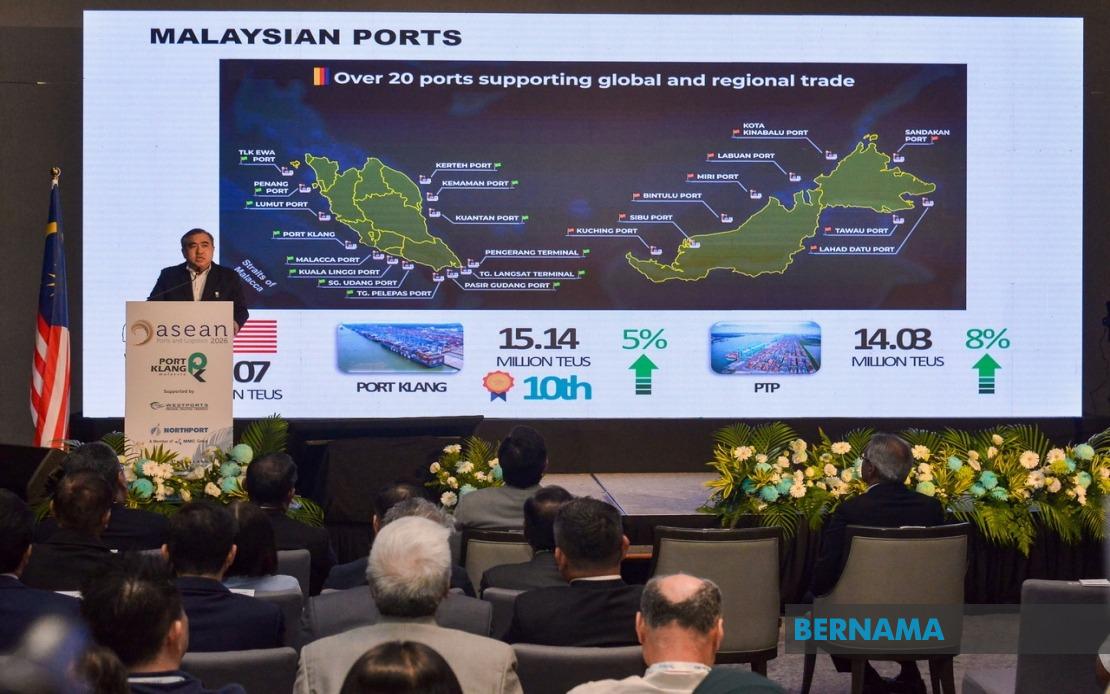
Transport Minister Anthony Loke has unveiled an ambitious blueprint to establish Malaysia as Southeast Asia's preeminent maritime hub through the development of Port Klang's Third Terminal on Carey Island, a mega-infrastructure project expected to unfold across nearly two decades. Speaking at the ASEAN Ports and Logistics Conference and Exhibition in Kuala Lumpur, Loke framed the initiative as essential to maintaining the nation's competitive edge in global shipping and trade over the next three decades, reflecting growing regional rivalries in the lucrative maritime sector.
The scale of Malaysia's ambition becomes apparent when compared against regional benchmarks. Port Klang's current capacity stands at approximately 20 million twenty-foot equivalent units annually—a respectable figure by most standards—yet Singapore's Tuas Port dwarfs this capacity by handling up to 60 million TEUs annually. This threefold disparity underscores why Malaysian policymakers view expansion as strategically imperative rather than merely aspirational. Without substantial investment in new infrastructure, Malaysia risks losing transshipment business and economic benefits to competitors who can accommodate larger container volumes and modern mega-vessel operations.
The Carey Island development represents more than simple capacity expansion; it signals Malaysia's determination to evolve Port Klang into a world-class facility capable of handling unprecedented cargo volumes. Such transformation requires integrated infrastructure planning that accounts not only for container terminals but also supporting logistics networks, port facilities, and hinterland connections. The multi-phase implementation strategy suggests realistic acknowledgment that constructing a facility of this magnitude cannot occur overnight, and that staged development allows for technological adaptation and market adjustments across two decades.
Cabinet approval has already been granted on an in-principle basis, and feasibility studies initiated in 2018 have now concluded. However, the project's trajectory remains subject to practical constraints. Land acquisition issues with the Selangor state government currently require resolution before construction can commence. These bureaucratic and administrative hurdles, while sometimes frustrating, are commonplace in Malaysian infrastructure projects involving multiple jurisdictions and stakeholder interests. Loke's indication that commencement will occur "very soon" following settlement of these matters suggests government determination to overcome impediments and move into implementation phase.
The chosen public-private partnership model reflects contemporary Malaysian infrastructure strategy. Rather than bearing the entire financial burden through government coffers, PPP arrangements distribute costs and operational responsibilities between the public sector and commercial operators. This approach potentially accelerates project execution, introduces private-sector efficiency incentives, and leverages commercial expertise in port operations. However, PPP structures also require careful structuring to protect public interest and ensure that private operators balance profit motivations with service quality and accessibility standards.
Beyond immediate capacity considerations, geopolitical developments are creating unexpected opportunities for Malaysian ports. Ongoing tensions in West Asia have prompted shipping companies and logistics operators to reassess maritime routes and transshipment hubs based on security considerations. Malaysia's strategic location along the Strait of Melaka—one of the world's most critical waterways—combined with its relative political stability, positions the nation as an increasingly attractive alternative to ports in more turbulent regions. Port Klang and Port Tanjung Pelepas have already captured positive cargo growth during the first quarter of this year, indicating that regional tensions are channeling business toward Malaysian facilities.
This phenomenon reveals how geopolitical uncertainty, while presenting broad global challenges, can paradoxically generate commercial opportunities for well-positioned nations. As international businesses prioritize safety and supply-chain reliability over marginal cost savings, they increasingly consider Malaysian ports as preferred alternatives. The Third Terminal project, therefore, arrives at a propitious moment when regional demand for additional capacity may be strengthening precisely because regional competitors face security or reputational challenges.
The timing also reflects Malaysia's strategic interest in consolidating regional leadership before competitors expand capacity or new facilities emerge. Vietnam and Thailand possess developing port infrastructure with growth potential, while Singapore maintains its dominant position through continuous modernization. Malaysia's expansion plans represent an assertion of regional ambition grounded in geographical advantage and economic necessity. Success requires not merely constructing physical infrastructure but also developing supporting logistics ecosystems, regulatory frameworks, and human capital that make Port Klang an attractive nexus for global shipping networks.
Loke's emphasis on ASEAN cooperation regarding the Strait of Melaka underscores recognition that Malaysia's maritime prosperity depends partly on regional stability and collective security arrangements. The world's busiest shipping corridor cannot function effectively amid conflict or piracy, yet it also cannot be militarized in ways that disrupt commerce. Maintaining neutrality while ensuring freedom of navigation requires sophisticated diplomacy among ASEAN members with varying interests and capabilities. Malaysia's call for coordinated regional stewardship of this vital waterway complements its commercial ambitions by advocating for the stable operating environment upon which port development depends.
The Third Terminal project simultaneously represents both local and regional implications. Domestically, successful implementation will generate employment in construction, port operations, and supporting sectors, while enhancing Malaysia's role in global trade networks and potentially increasing government revenue through port-related activities. Regionally, the facility would create competitive dynamics that benefit shippers through improved service options and potentially lower costs, while also elevating ASEAN's overall maritime standing relative to non-regional competitors.
Implementation success will require sustained political commitment across multiple government administrations, effective coordination between federal and state authorities, successful PPP partner selection, and adaptation to evolving technological and market conditions. The twenty-year timeline acknowledges these complexities while establishing ambitious yet achievable targets. For Malaysia's maritime aspirations to materialize, the initial phases—particularly land acquisition and early construction—must proceed without significant delays or cost overruns that could undermine subsequent stages.

