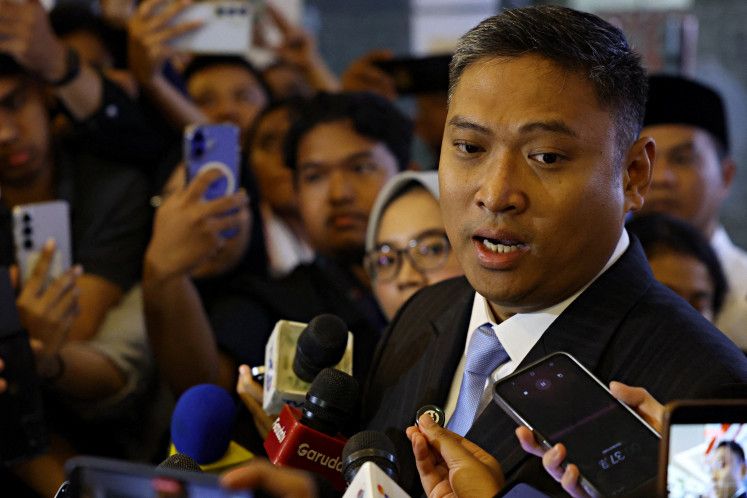
President Prabowo Subianto's signature free nutritious meals programme has been jolted by yet another leadership crisis, with the National Nutrition Agency's head Nanik Sudaryati Deyang announcing her resignation after less than two months in the post. Her departure, which came after she disclosed suffering a heart blockage partly attributed to the stress of overseeing the programme's massive budget, represents the latest governance failure to undermine what was conceived as a cornerstone initiative in the President's administration. The rapid succession of leadership changes and operational disruptions since the programme's 2025 rollout has raised uncomfortable questions about institutional readiness and the gap between political aspiration and administrative capacity in Southeast Asia's largest economy.
Nanik's exit marks the second high-profile departure from the agency within mere weeks. Her predecessor, Dadan Hindayana, was dismissed and subsequently arrested in June alongside two deputies following allegations of corruption and financial irregularities tied to procurement processes. Nanik had initially been promoted from her position as Dadan's deputy, seemingly positioned to restore credibility following the Attorney General's Office investigation into the multitrillion-rupiah scheme. Her inability to sustain that restorative mission underscores the profound institutional challenges plaguing the initiative rather than any individual failing.
The circumstances surrounding Nanik's resignation reveal the psychological and professional toll of managing one of Indonesia's most visible public expenditure programmes. In Facebook posts released before stepping down, she described experiencing acute trauma from handling the substantial budgetary responsibility, comparing the weight of safeguarding public resources to standing precariously atop a cliff edge. The vivid metaphor captures something fundamental about the administrative environment she inherited: an agency operating under intense public scrutiny, burdened by predecessor corruption allegations, and lacking the procedural maturity and institutional trust necessary to function effectively. Nanik's insistence on questioning every policy decision and refusing to sign off on matters unilaterally reflected defensive decision-making driven by apprehension rather than confident governance.
Within hours of accepting Nanik's resignation, Prabowo moved to fill the vacuum by appointing Deputy Agriculture Minister Sudaryono, a Gerindra Party politician who served as a presidential aide during the 2010s. The swift installation of a loyalist to lead a crisis-affected agency signals Prabowo's intention to reassert direct control over an initiative that has become politically vulnerable. Sudaryono's background as an insider to the free meals programme design from its inception suggests a deliberate choice to anchor leadership in ideological commitment to the project rather than technical expertise in agency management. His inauguration at the State Palace underscored the political significance attached to stabilising this particular portfolio.
Sudaryono's immediate pledges to enhance transparency and eliminate opaque decision-making processes acknowledge the fundamental trust deficit afflicting the National Nutrition Agency. His commitment to digitalising manual workflows and ensuring comprehensive documentation represents recognition that the programme's credibility depends not merely on leadership personality but on creating systems resistant to the discretionary practices that enabled his predecessor's alleged misconduct. However, such assurances must be evaluated against a broader pattern of governance shortcomings that predate Dadan's arrest and extend to the programme's structural design and implementation architecture.
The free meals initiative has been beleaguered by operational complications beyond mere leadership instability. Mass poisoning incidents have periodically erupted across participating schools and facilities, triggering public health concerns and parental anxieties. These food safety failures, combined with ongoing questions about meal quality and nutritional standards, have substantially eroded the programme's reputation among beneficiaries and their families. The reputational damage compounds the institutional credibility gap created by corruption allegations, creating a two-front challenge of simultaneously restoring public confidence and administrative integrity.
In response to accumulating criticisms, the National Nutrition Agency implemented a moratorium on approving new kitchen facilities while conducting comprehensive audits of nearly 28,000 existing installations nationwide. Though operationally necessary, this defensive measure sparked fierce protests from thousands of prospective kitchen operators who had invested substantial capital in setting up facilities expecting government approval. The collision between pandemic-style restrictions and economic interests illustrates the political friction generated when a high-profile programme encounters implementation obstacles, creating constituencies actively opposed to administrative caution.
The government has substantially recalibrated the free meals programme's ambitions and financial footprint for 2026, signalling a strategic retreat from original expansion plans. The provisional budget has been reduced from Rp268 trillion to Rp229 trillion, while the beneficiary target has been scaled back to 62.7 million people from an initial projection of 82.9 million. This represents a fundamental recalibration of scope, with Deputy Chief Agustina Arumsari articulating a new philosophy prioritising service quality over numerical reach. The shift acknowledges that the existing apparatus cannot credibly deliver simultaneously on ambitious coverage targets and operational excellence.
The accumulated difficulties confronting this flagship initiative carry important implications for Malaysian and broader Southeast Asian policymaking. The Indonesian experience demonstrates how programmes serving politically significant purposes but lacking robust preparatory groundwork during design phases can generate governance crises that consume administrative attention and political capital. The free meals scheme illustrates the distinction between politically attractive policy concepts and institutionally sustainable implementation frameworks, a lesson relevant as governments across the region contemplate ambitious social support expansions.
Political analysts have identified systemic planning deficiencies rather than individual administrative failures as the core problem. Wasisto Raharjo Jati, a leading observer of Indonesian governance, characterised the recurring troubles as reflecting "shortcomings in its planning" despite elevated political priority. His assessment suggests the programme was engineered primarily to fulfil campaign commitments rather than being subjected to rigorous technical preparation and institutional capacity assessments. This represents a governance pathology where electoral mandates drive policy acceleration without adequate administrative maturity, a dynamic observers across Southeast Asia should monitor carefully.
The persistent instability afflicting the National Nutrition Agency and its parent programme reflects broader questions about how newly inaugurated administrations balance urgency in delivering campaign promises against the technical prerequisites for sustainable implementation. Prabowo's decision to install a political loyalist as recovery specialist, rather than recruiting externally-sourced technical expertise, suggests confidence in ideological commitment to programme survival. Yet the fundamental architecture issues and capacity shortfalls that generated the current crisis remain unaddressed by this personnel shuffle alone, suggesting the latest leadership transition may prove another temporary expedient rather than a systemic solution.

