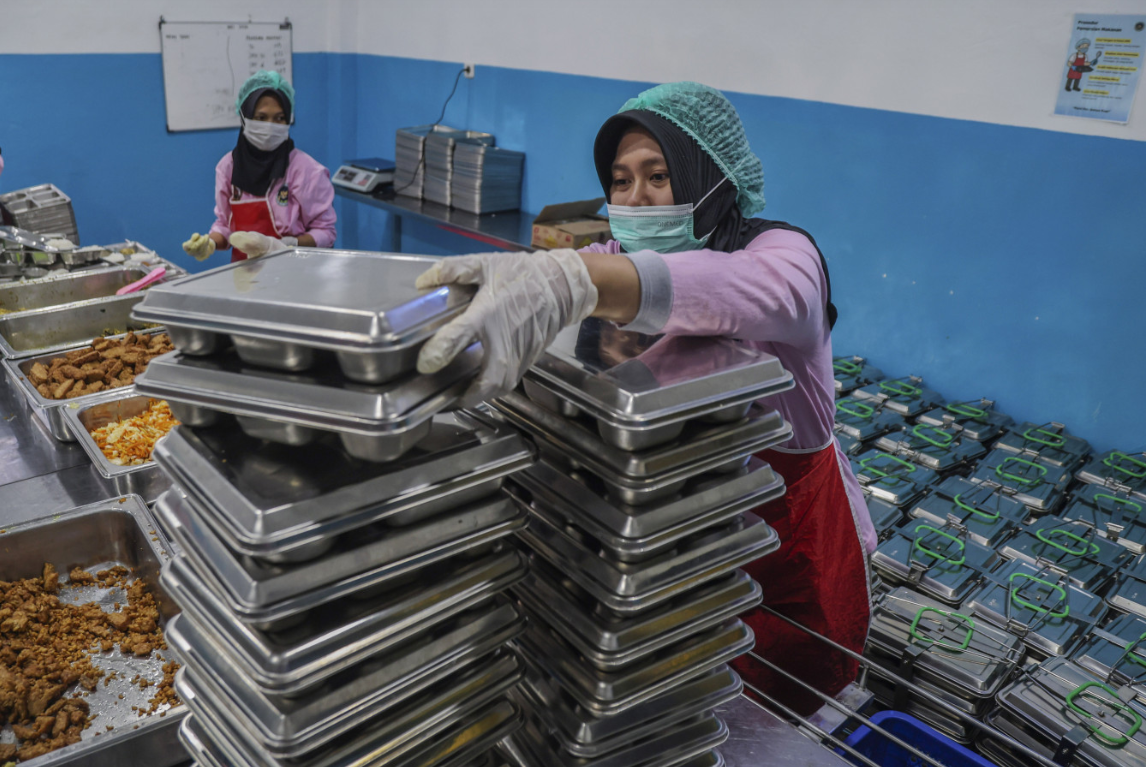
President Prabowo Subianto is undertaking a significant reassessment of two centrepiece initiatives within his administration, marking a potential recalibration of flagship programmes that have become flashpoints for public debate and political scrutiny. The decision to review both the free nutritious meal scheme and the Red and White cooperative programme emerged during a four-hour closed-door meeting on Wednesday, July 15, at the presidential palace, where senior cabinet officials responsible for programme implementation gathered to discuss the path forward.
The free meals initiative, budgeted at approximately Rp 268 trillion (US$19.5 billion) for 2026, aims to serve around 83 million beneficiaries including schoolchildren and pregnant women as part of a broader strategy to combat malnutrition and childhood stunting—longstanding public health challenges across Indonesia. However, despite its ambitious scope and considerable financial commitment, the programme has encountered significant headwinds, including waves of street protests last month demanding suspension, escalating concerns over fiscal sustainability, documented food safety incidents, and an ongoing corruption investigation involving senior figures from the National Police and Indonesian Military.
National Nutrition Agency (BGN) deputy chief Agustina Arumsari disclosed that President Prabowo has directed the agency to undertake an exhaustive evaluation of the free meals programme's school-based implementation, with completion required within one month. The directive reflects presidential concern that policy adjustments must be approached methodically rather than hastily implemented. Agustina emphasised that the President prioritised thoroughness and fairness in the review process, indicating that any modifications would undergo careful deliberation before finalisation.
The reassessment will concentrate on recalibrating eligibility frameworks for programme participants, with government consideration given to potentially limiting participation among higher-income households and examining practical implications for mixed-income school environments. This represents a conceptual shift toward more precisely targeted assistance concentrated on Indonesia's most economically vulnerable populations. The eligibility question carries particular sensitivity in school settings, where income-based differentiation in meal provision could create psychological and social complications among students in the same classroom.
Beyond eligibility restructuring, Indonesian authorities are exploring alternative delivery mechanisms that could fundamentally reshape programme operations. Officials are examining whether school canteens could absorb meal provision functions currently handled by dedicated free meal kitchens, potentially reducing infrastructure costs and operational complexity. Such modifications would represent movement away from the present centralised model toward decentralised, school-based implementation structures that could prove more adaptable to local conditions while reducing overhead expenditure.
Agustina acknowledged the delicate psychological and social dimensions inherent in any restructuring. The government remains acutely aware that visible differentiation in meal access between students sharing classrooms could generate unintended social stigmatisation and educational complications. This awareness reflects broader recognition that poverty-targeted assistance programmes require careful attention to dignity and social cohesion alongside material delivery of benefits.
Parallel to the free meals review, the government has announced plans to expand the scope and functions of Red and White cooperatives, transforming them into primary channels for distributing various governmental assistance initiatives including social welfare payments and subsidised commodities. Coordinating Food Minister Zulhas Hasan indicated that these cooperatives would additionally acquire agricultural products such as rice and corn when market prices dip below government-established reference levels, functioning as government-backed purchasers to stabilise farmer incomes and support rural producers facing market volatility.
The cooperative programme itself has faced significant controversy following the implementation of mandatory military-style training for cooperative managers, an initiative that resulted in at least four documented deaths and generated substantial public opposition. This tragedy has intensified pressure on the administration to fundamentally reconsider implementation approaches while preserving the cooperative concept's underlying objectives of rural economic development and agricultural support.
For Malaysian and broader Southeast Asian observers, these developments illustrate the substantial political and administrative challenges confronting large-scale social assistance programmes in developing economies. President Prabowo's willingness to pause and recalibrate costly initiatives suggests recognition that programme sustainability depends not merely on financial allocation but on public legitimacy, operational effectiveness, and careful institutional design. The reviews underscore tensions between ambitious social policy objectives and the practical realities of implementation in heterogeneous communities with diverse economic circumstances.
The emphasis on targeting, psychological impact assessment, and decentralised delivery mechanisms reflects contemporary thinking about social protection in developing countries, where universal programmes face criticism regarding fiscal efficiency while narrowly targeted approaches raise concerns about stigmatisation and administrative complexity. Indonesia's experience offers instructive lessons for policymakers throughout Southeast Asia grappling with similar tradeoffs between programme scope, cost, and social acceptability.
These reassessments carry implications extending beyond programme mechanics. They signal that the Prabowo administration, despite championing these initiatives during its transition to office, recognises that political sustainability requires responsiveness to documented implementation problems and public concerns. Whether the pending reviews result in substantive restructuring or more modest adjustments will significantly influence public confidence in the administration's capacity to execute its development agenda effectively and maintain its political coalition amid competing demands for fiscal responsibility and social protection.

