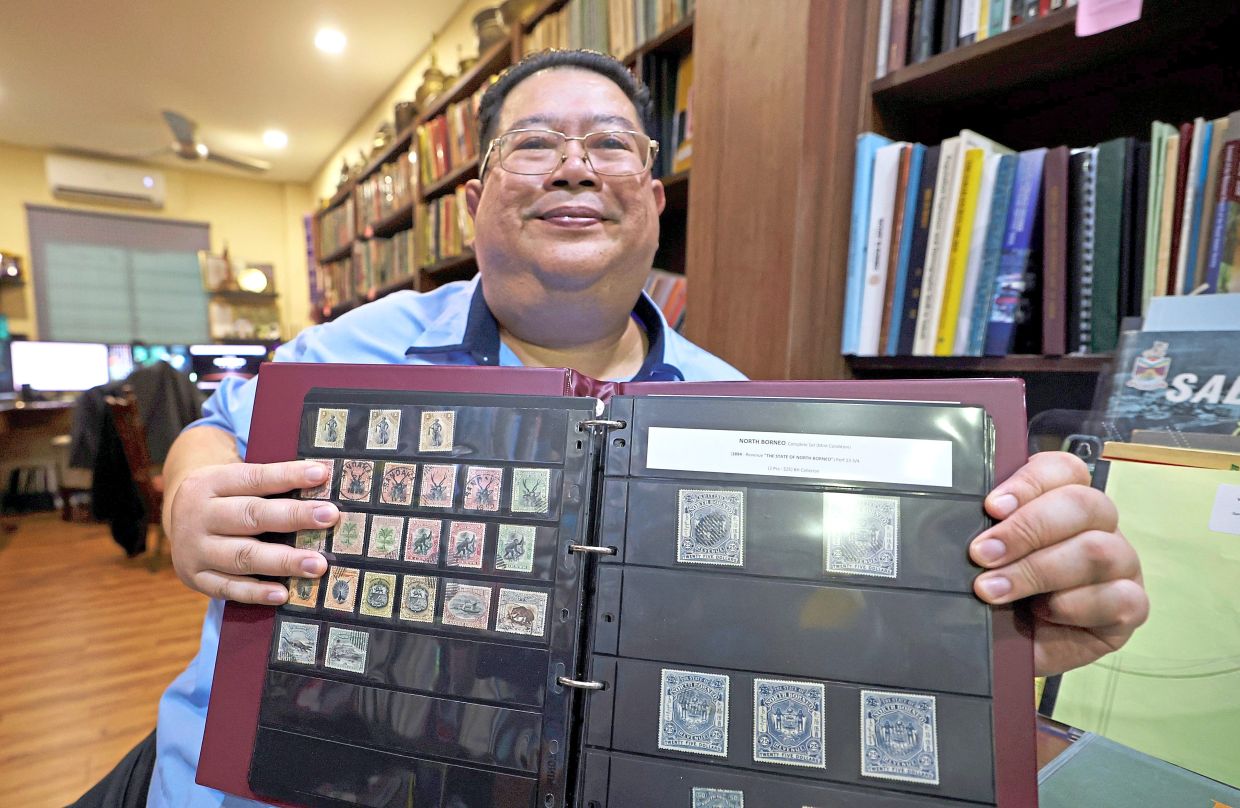
The vintage stamps of North Borneo, many now over a century old, stand as fragile repositories of a state's colonial and early-modern history, yet an alarming decline in philatelic interest threatens their preservation and the knowledge they contain. As physical letters have surrendered to emails and instant messaging, these postage stamps—once mundane commodities—have metamorphosed into historical artefacts whose designs, markings, and provenance chronicle Sabah's transformation. The challenge of safeguarding this collection has become increasingly urgent, prompting historians and dedicated enthusiasts to sound alarms about the dwindling community of stamp collectors and the real risk that irreplaceable pieces of material culture could be lost or dispersed beyond recovery.
Dr Shari Jeffri, the 56-year-old founder and president of the Borneo History Association, has emerged as a leading voice in this preservation movement. He characterises the North Borneo stamps issued between 1883 and 1963 as a "living archive"—documents that must be actively conserved and consciously transmitted to successive generations if their historical value is to endure. His assessment reflects a broader concern among regional historians: that contemporary society, particularly younger Malaysians who came of age in the digital era, lacks the cultural anchors and recreational habits that once made stamp collecting a widespread pastime. The philatelic community today is markedly smaller than in previous decades, with genuine enthusiasts becoming proportionally rarer and the collective knowledge about these stamps increasingly concentrated among ageing collectors whose eventual passing could precipitate significant losses.
A systematic survey conducted by Bernama of antique dealers across Kota Kinabalu unveiled the stark reality of the market: North Borneo stamps have become genuinely difficult to locate. Their scarcity fluctuates based on multiple variables including age, physical condition, and rarity of the particular issue. Among the specimens uncovered during this market research were particularly notable examples: an album housing a six-cent stamp from the 1954–1961 series depicting Queen Elizabeth II alongside a Dusun woman, and a ten-cent denomination portraying logging operations—both powerfully evocative of the region's cultural composition and economic activities during that transformative postwar period. The very difficulty in locating these items underscores how quickly philatelic materials can vanish from circulation as collectors age and their heirs, often unaware of historical or monetary value, discard or donate collections without proper documentation.
Shari's personal journey into philately reflects patterns familiar to many serious collectors: inheritance and mentorship across generations. His grandfather, employed at the Recreation Club Jesselton during the 1920s, observed British colonial officers engaging in stamp collecting and adopted the hobby himself, harbouring hopes of kindling similar enthusiasm in descendants. This intergenerational transmission of knowledge and passion proves crucial to the preservation enterprise, yet represents precisely the kind of social practice that modernisation and lifestyle shifts have eroded. Though introduced to stamps at age seven, Shari only developed into an active collector during his secondary school years, an interval suggesting that passive childhood exposure alone is insufficient without sustained engagement and mentorship. Since then, he has meticulously maintained his family's inherited collection, an exercise that deepened his scholarly curiosity about the historical narratives embedded within stamp design and postal circulation patterns.
Among Shari's most treasured holdings are two two-cent stamps from the foundational 1883 issue, featuring a brown sailing boat rendered with complete postmarks still visible. For serious philatelists, possessing examples from this inaugural series represents a non-negotiable benchmark of a respectable collection. These are not mere postage vouchers; each stamp functions as a documentary portal into its era, encoding information about technology, commerce, imperial ideology, and territorial identity. The 1883 North Borneo stamps were issued by the British North Borneo Chartered Company and remained in active postal circulation for approximately 52 years, a lifespan that witnessed dramatic changes in global geopolitics, technological advancement, and Sabah's internal development trajectory.
The aesthetic and symbolic evolution of these stamps over five decades mirrors the territory's own transformation and changing self-presentation to the wider world. Early designs incorporated emblematic imagery—lions, boats, tigers—coupled with the Latin phrase Pergo et Perago, "I undertake and I achieve," a motto intended to project the Chartered Company's ambitions and competence to international audiences and investors. Beginning in 1894, designers shifted toward representations of Borneo's natural wealth: indigenous flora, fauna, and distinctive wildlife. By the 1935 series, stamp designs had crystallised into a more confident expression of regional identity, appearing in denominations spanning from two cents to one dollar, thereby documenting the breadth of postal services and commercial transactions occurring within Sabah's economy. This progression from generic imperial symbols toward locally rooted imagery tells a story about evolving colonial attitudes toward territory and the gradual emergence of distinct regional consciousness.
The technical preservation of these stamps presents challenges that extend beyond merely storing them in boxes. Shari emphasises the critical importance of acid-free albums in preventing chemical degradation and chromatic fading—a requirement that many casual collectors and inherited collections fail to meet. Beyond physical stability, the stamps' informational value depends partly on the completeness and clarity of their postal cancellations. Specimens bearing full, legible postmarks are considerably more valuable to scholars and serious collectors because the cancellations supply precise data: mailing dates, originating post offices, processing times, and geographic origins. These details, when aggregated across multiple stamps, allow historians to reconstruct postal networks, communication patterns, trade routes, and the administrative geography of colonial Sabah. The paper composition and adhesive formulations also serve as authentication markers, with variations indicating different printing runs, changes in supplier, or alterations to production processes that can be dated and contextualised.
To establish himself as an authoritative voice in North Borneo philately, Shari pursued systematic training under renowned Singaporean experts Voon Kyam Foh and Tan Chun Lim, while simultaneously immersing himself in specialised reference materials including the Commonwealth & British Empire Stamps catalogue. This combination of direct mentorship and scholarly resource consultation exemplifies the intellectual discipline required to move beyond casual collecting into genuine historical expertise. The expertise he has cultivated makes him an invaluable resource for institutions, researchers, and fellow collectors navigating the complex landscape of Borneo's postal history. Yet his knowledge remains distributed across individual people rather than systematically archived, meaning that without deliberate documentation efforts and institutional support, significant understanding could be lost when current experts pass away.
The disappearance of letter writing as a primary communication medium has fundamentally altered the cultural meaning of stamps in modern societies. What once constituted ordinary, disposable commercial goods has retroactively acquired the status of historical artefact precisely because the social practices that generated them have become obsolete. This temporal distance creates both opportunity and vulnerability: opportunity because stamps now attract academic and curatorial interest they previously lacked, yet vulnerability because the knowledge systems and communities that sustained stamp collecting as an active practice continue to erode. The North Borneo issues occupy a particularly significant position within regional history, documenting a 52-year window encompassing the Chartered Company era, the transition to Crown Colony status, World War Two, and the movement toward self-governance. Their designs and postal routes illuminated Sabah's identity during formative decades when that identity was still being contested and constructed through colonial administration, commercial networks, and indigenous responses to external impositions.

