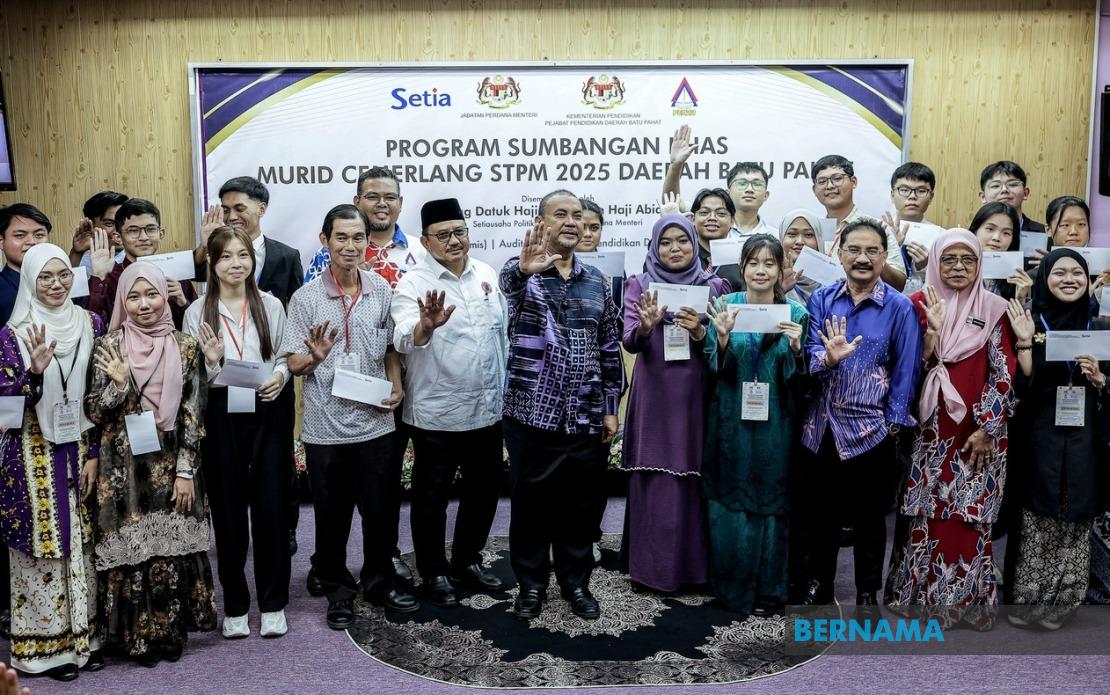
The Prime Minister's Office has distributed special contributions to 214 outstanding Sijil Tinggi Persekolahan Malaysia (STPM) students from across Batu Pahat district in recognition of their superior academic performance. The award ceremony, held at the Batu Pahat District Education Office auditorium, brought together successful students from 16 secondary institutions in the area, marking a significant government initiative aimed at celebrating educational achievement and encouraging continued academic pursuits.
Datuk Azman Abidin, who serves as Political Secretary to the Prime Minister, oversaw the distribution and outlined the broader purpose behind the programme. He emphasised that the contribution scheme represents more than simply acknowledging past performance; rather, it functions as a strategic tool designed to inspire recipients to maintain their high standards and pursue tertiary education with renewed confidence and determination. The initiative reflects broader government ambitions to create a culture of academic excellence among Malaysian students.
The programme's design reveals government thinking about educational motivation at the post-secondary level. By providing material support alongside symbolic recognition, policymakers aim to address both the practical barriers and psychological dimensions of educational advancement. The timing of the awards, immediately following STPM results, capitalises on the momentum of achievement and positions the contributions as endorsements from the highest levels of government, lending added prestige to academic success.
Azman indicated that this represents an ongoing commitment rather than a one-off gesture, though continuation depends on securing sufficient budgetary allocation. More significantly, he outlined plans to extend the programme beyond Batu Pahat to other districts and regions, suggesting a scaling-up of the initiative depending on resource availability. This phased expansion approach allows the government to demonstrate commitment to recognising academic excellence nationwide while managing financial constraints pragmatically.
The contributions carry symbolic weight beyond their immediate monetary value. By channelling support through the Prime Minister's Office rather than through conventional education ministry mechanisms, the government elevates the status of academic achievement and signals that educational excellence merits recognition at the highest political level. This messaging proves particularly important in a competitive educational landscape where students increasingly make choices about further study based on encouragement and validation from authority figures.
Afida Auni Airulnizam, a 20-year-old recipient from Sekolah Menengah Kebangsaan Tun Sardon in Rengit, articulated the dual impact the contribution delivers. She described receiving the award as both a tangible acknowledgement of her efforts and a source of motivation for pursuing future studies. Her aspirations toward sports science at the tertiary level, should she secure admission, reflect the programme's intended outcome—channelling high-achieving students toward specialised degree pathways that contribute to Malaysia's professional workforce development.
Family dynamics shape many recipients' educational trajectories, as evidenced by Afida's reference to her older brother already pursuing university studies. The existence of an elder sibling in tertiary education influences younger students' educational aspirations and provides both role modelling and practical understanding of university life. The Prime Minister's contribution, in this context, acts as additional affirmation that the family's commitment to education aligns with national priorities and receives official recognition.
Muhd Ammar Firdaus Mohd Fadzil, another award recipient from SMK Tun Ismail, highlighted the practical dimension of financial support. His emphasis on the contribution easing the burden of preparing for higher education underscores an important reality for Malaysian families—the genuine costs associated with tertiary education applications, entrance examinations, and preparatory expenses create genuine barriers even for academically qualified students. The Prime Minister's contribution addresses this equity concern by ensuring that financial constraints do not prevent capable students from pursuing advancement.
The concentration of recipients across 16 schools demonstrates the breadth of academic excellence within the Batu Pahat district. Rather than focusing resources on a handful of elite institutions, the distribution across multiple schools reflects democratic principles in recognising achievement and suggests that capable students emerge from diverse educational settings. This approach validates investment in comprehensive secondary education systems rather than concentrating resources on selective institutions alone.
For Malaysian readers tracking educational policy trends, this initiative signals government priorities around skills development and youth empowerment. The emphasis on higher education pursuit aligns with Malaysia's stated ambitions to develop a high-skilled workforce capable of supporting advanced economic sectors. By providing recognition and material support to top STPM performers, the government attempts to steer exceptional talent toward degree programmes in fields deemed strategically important for national development.
The programme also reflects evolving approaches to educational motivation in Southeast Asia. Across the region, governments increasingly recognise that academic achievement requires not merely institutional quality but also psychological affirmation and material support that validates the sacrifices students and families make. Malaysia's initiative joins similar programmes in other regional countries attempting to identify and nurture talent early while removing practical barriers to educational advancement.
Looking forward, the scalability question becomes crucial. Whether the programme can expand meaningfully to encompass top achievers across Malaysia's diverse states and school systems depends on sustained budgetary commitment and effective implementation structures. The willingness of recipients and their families to embrace the awards enthusiastically suggests strong demand for such recognition, providing political impetus for expansion despite fiscal constraints.
Ultimately, the distribution of contributions to these 214 students represents an intersection of educational policy, resource allocation, and national human capital development strategy. By recognising excellence at the crucial juncture between secondary and tertiary education, the Prime Minister's Office attempts to shape pathways toward higher qualification and professional contribution to the economy.

