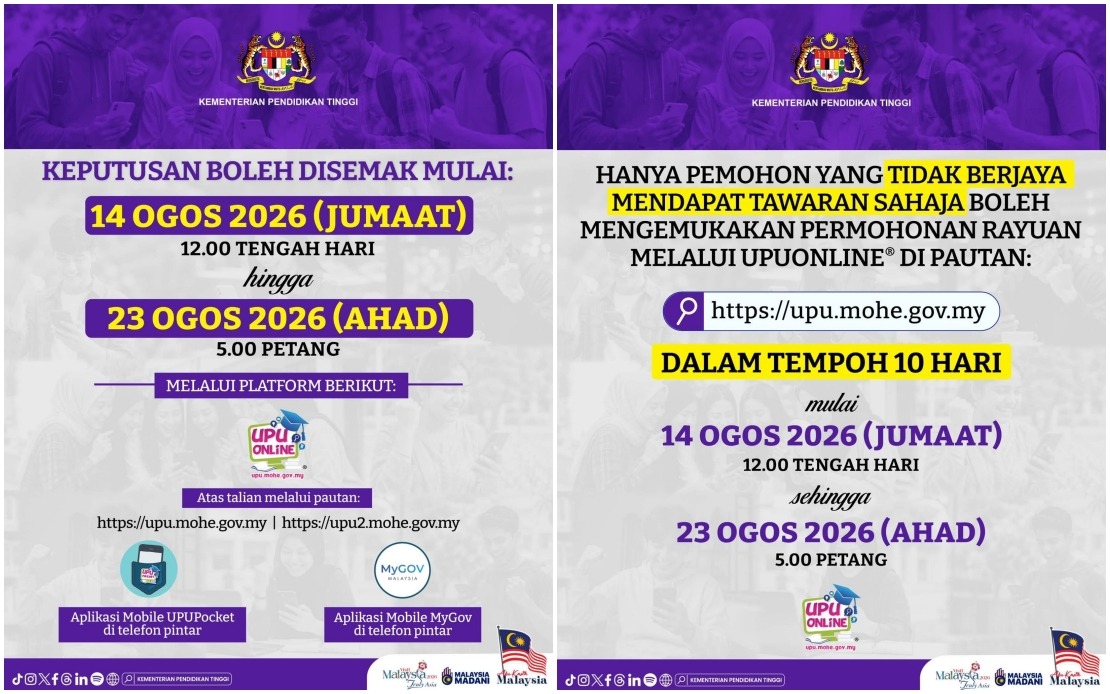
The Ministry of Higher Education has confirmed that admission results for public university bachelor's degree programmes will be made available on August 14 for the 2026/2027 academic session. The announcement applies to holders of the Sijil Tinggi Persekolahan Malaysia (STPM) and equivalent qualifications who applied through the UPUOnline® system. This represents a critical juncture for tens of thousands of Malaysian secondary school graduates transitioning into higher education, as the outcome will determine their university placement and field of study for the coming academic year.
Applicants can access their results beginning at noon on August 14 through three digital channels: the main UPU portal at https://upu.mohe.gov.my, the secondary portal at https://upu2.mohe.gov.my, and the dedicated UPUPocket mobile application or the MyGov app on smartphones. This multi-platform approach reflects the government's commitment to ensuring accessibility across varying technological capabilities among the student population. The results window remains open until 5 pm on August 23, providing a ten-day period for students to review their outcomes without time pressure. For Malaysian families in rural areas or those with limited broadband connectivity, the mobile app option offers a more flexible alternative than relying solely on desktop computers.
The confirmation process represents the next critical phase, running concurrently from August 15 to August 23 across individual university websites. Students who receive offers must formally confirm their acceptance or rejection within this nine-day window. This immediate response requirement means families must be prepared to make binding decisions quickly, as delays could result in forfeiture of placement opportunities. The Ministry of Higher Education emphasised that this confirmation period is non-negotiable, and universities will begin issuing official offer letters to students who accept their places starting August 15. This staggered approach—confirmation followed by official letter issuance—creates a buffer that allows universities to manage capacity and course allocation based on actual acceptance rates.
For the substantial proportion of applicants who do not receive initial offers, an appeal mechanism exists but comes with significant limitations. Unsuccessful candidates may submit appeal applications exclusively through UPUOnline® at https://upu.mohe.gov.my during the same August 14 to 23 window. However, the appeal selection process depends entirely on available vacancies that emerge after new student registration is completed—meaning appeal success is contingent on other students declining their offers or universities identifying surplus capacity in particular programmes. This design creates uncertainty for appellants, as placement cannot be guaranteed regardless of academic merit. The ten-day appeal window is compressed into the same confirmation period, requiring applicants to simultaneously manage initial decisions while potentially preparing appeals.
A significant restriction imposed by the Ministry of Higher Education concerns programme and institution changes. Once an offer is made and accepted, students may not request transfers to different study programmes or different universities. This permanence underscores the importance of careful consideration during the original application phase. For students who selected programmes strategically but hoped to switch after results were announced—perhaps to move between similar courses at different institutions—this policy closes that avenue entirely. Malaysian education observers have noted that this inflexibility, while administratively efficient, can disadvantage students whose preferences shift after secondary school completion or who wish to pursue alternatives if their first choice becomes unaffordable or logistically difficult.
The appeal selection policy introduces another layer of complexity by making approval conditional on the specific vacancy landscape. Universities will only offer positions to successful appellants if places remain available in the requested programme after all newly admitted students have registered. This approach prevents over-enrolment and ensures resource alignment but creates a two-tier admission outcome. Students who appeal face a genuinely uncertain process without visibility into how many seats might open up. Consequently, families should not assume that appeals offer a reliable fallback—instead treating the initial results window as the primary opportunity to secure placement.
For Malaysian parents and students navigating this system, several practical considerations emerge. The August 14 to 23 period is operationally intensive, requiring immediate access to digital platforms, careful review of offer letters, and swift decision-making. Families with limited prior experience in higher education navigation may benefit from school counsellor support or institutional guidance provided by secondary schools. The Ministry's provision of multiple access channels—web portals and mobile apps—acknowledges that digital inclusion varies across the country, though technical literacy remains an implicit requirement. Students should begin registering for accounts and familiarising themselves with platform navigation well before August 14 to avoid delays when results become available at noon.
The 2026/2027 cohort represents the continuing evolution of Malaysia's higher education selection infrastructure. The UPUOnline® system has substantially reduced administrative burden compared to previous paper-based processes and provides real-time visibility that earlier generations of students never enjoyed. However, the rigid timelines and limited appeal pathways reflect systemic constraints within public university capacity. With demand chronically exceeding available places, the architecture necessarily prioritises swift processing and prevents infinite requests for reconsideration. Students whose results disappoint should view the appeal window realistically rather than as a comprehensive second chance.
Beyond individual student outcomes, this admission cycle affects broader Malaysian higher education trends. Public university intake patterns help determine fields of specialisation across the cohort, indirectly shaping Malaysia's skilled workforce composition. When particular programmes consistently receive high demand while others struggle to fill places, this signals market realities about career prospects that secondary schools and career guidance systems must interpret. The STPM cohort remains the primary pathway into public universities, and their distribution across institutions and programmes carries implications for research capacity, industry alignment, and equity in access to premium educational credentials.
Looking ahead, students should prepare psychologically for the possibility that results may not match initial expectations. Malaysia's competitive higher education environment means many qualified applicants do not receive immediate offers at their preferred institutions. Those facing disappointing outcomes should move quickly to explore appeal options during the August 14 to 23 window, but simultaneously prepare contingency plans involving private universities, vocational education, or alternative career pathways. The system functions efficiently for those who receive offers matching their preferences, but creates extended uncertainty for the marginal cohort caught between initial rejection and appeal outcomes. Families would be wise to gather relevant contact information for their local universities and school counsellors before August 14 to enable rapid consultation if results require rapid response decisions.

