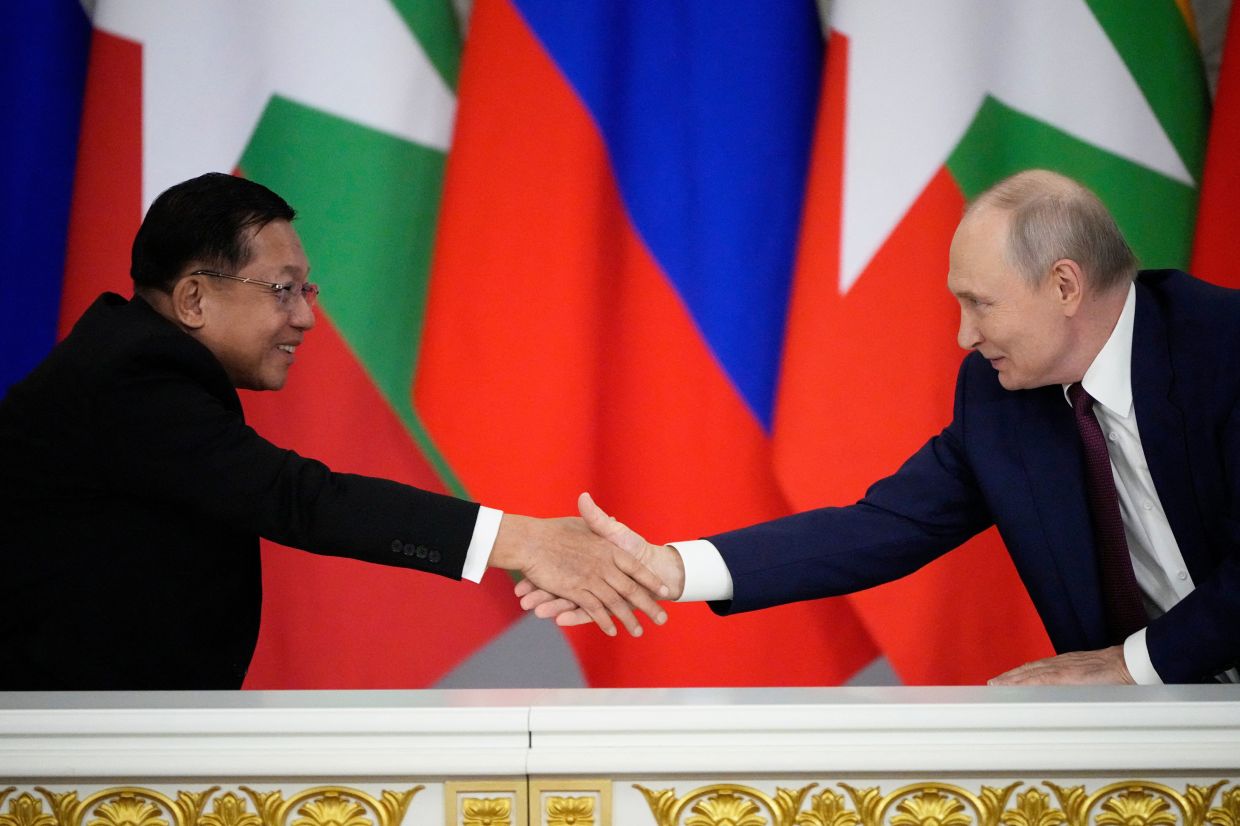
Russian President Vladimir Putin received Myanmar's Min Aung Hlaing in Moscow this week, underscoring deepening bilateral relations at a moment when much of the Western world has turned its back on Myanmar's military leadership. The visit marked the first time the Myanmar leader has journeyed to Russia since formally assuming the presidency in August following a controversial election that international observers widely criticised. Putin characterised the relationship as having become "especially trusting" in recent years, a description that reflects Russia's strategic commitment to maintaining influence in Myanmar even as geopolitical isolation has limited Moscow's options elsewhere.
The Kremlin talks revealed ambitious plans for expanding Russian investment in Myanmar's energy sector and broader economy. Putin outlined intentions to construct a power generation facility and petroleum refinery in southern Myanmar, alongside involvement in geological surveys and hydrocarbon extraction operations. These infrastructure ambitions speak to Russia's eagerness to secure access to Myanmar's natural resources whilst simultaneously deepening economic interdependence between the two nations. The emphasis on liquefied natural gas cooperation also signals Moscow's interest in accessing new export markets as traditional European customers distance themselves due to sanctions.
The composition of attendees at the Moscow meeting illustrated the multifaceted nature of Russian-Myanmar ties. Alongside Putin, high-level officials responsible for foreign relations, finance, energy and defence participated in the discussions, demonstrating that cooperation spans far beyond diplomatic pleasantries. This institutional breadth suggests both governments view their partnership as foundational to their respective strategic interests in an increasingly multipolar world. For Myanmar, such engagement provides access to technological expertise and military hardware that Western nations refuse to supply. For Russia, Myanmar represents one of the few remaining significant partnerships in Asia outside of China.
Military cooperation remains the bedrock of Russian-Myanmar relations, with Moscow establishing what Putin described as "close military and military-technical cooperation" with Naypyidaw. Russia has supplied Myanmar's armed forces with advanced weaponry exceeding US$400 million in value since the 2021 coup, according to a United Nations assessment from May 2023. This weaponry underpins Myanmar's military dominance domestically at a time when the junta faces persistent armed resistance from opposition militias and ethnic armed organisations. The flow of Russian military hardware continues uninterrupted despite international pressure, positioning Moscow as an indispensable security guarantor for Myanmar's leadership.
Nuclear technology represents another pillar of deepening cooperation. Myanmar is collaborating with Russia's Rosatom State Corporation to develop a small-scale nuclear power facility, representing the initial phase of introducing atomic energy applications across healthcare, agricultural production and industrial sectors. Such collaboration carries profound long-term implications, potentially binding Myanmar into Russia's technological orbit whilst addressing genuine energy needs. For Malaysia and other Southeast Asian nations concerned about regional stability, Myanmar's nuclear trajectory warrants attention, particularly given the uncertain governance environment and ongoing internal conflicts.
The timing of Min Aung Hlaing's Moscow visit reflects broader diplomatic positioning following the August 2023 election that Myanmar's military-backed parliament conducted. Myanmar's leader has embarked on an intensive international tour since formalising his presidency, visiting China, India, Laos and Thailand in efforts to rehabilitate his government's international standing. This diplomatic offensive attempts to demonstrate that Myanmar remains an engaged member of the international community despite Western criticism of electoral legitimacy. The Moscow leg of this journey carries symbolic weight, affirming that Myanmar has reliable partners willing to provide political cover and material support.
Russia's strategic interest in Myanmar reflects broader calculations about Asian geopolitics and Western sanctions regimes. As a permanent UN Security Council member facing unprecedented isolation in Europe, Russia has intensified focus on Asian partnerships offering both economic opportunity and political support. Myanmar's geographic position along major shipping lanes, its natural resource wealth, and its proximity to Bangladesh and India make it strategically valuable. Additionally, Myanmar's military government shares Russia's authoritarian governance model and scepticism towards Western-led international norms, creating ideological alignment beyond mere transactional interest.
The relationship has deepened substantially since Russia's February 2022 invasion of Ukraine. Min Aung Hlaing and Putin have met at least four times since that military operation began, with each encounter advancing cooperation in defence, energy and economic sectors. This pattern suggests neither nation views their partnership as temporary or circumstantial. Rather, both appear committed to building institutional linkages that can withstand international pressure and shifting geopolitical circumstances. For Myanmar, alignment with Russia provides ballast against potential isolation. For Russia, Myanmar offers a foothold in Southeast Asia and an alternative market as Western sanctions narrow traditional opportunities.
The broader regional implications of intensifying Russian-Myanmar ties merit consideration for Malaysia and other ASEAN members. Myanmar's position within the regional bloc has become increasingly complicated given the military junta's international isolation, yet strengthening ties with Russia could further entrench the military government whilst reducing incentives for democratic reform. ASEAN's consensus-based decision-making processes have struggled to respond coherently to Myanmar's internal crisis, with Russia's increasing engagement potentially complicating diplomatic efforts. Additionally, enhanced Russian military presence in Myanmar through arms sales and technology transfers introduces additional geopolitical complexity to an already delicate regional balance.
Min Aung Hlaing's delegation to Moscow included high-ranking officials spanning multiple government sectors, including the head of Myanmar's Space Agency, reflecting the comprehensive nature of bilateral engagement. Beyond Putin's talks, the Myanmar leader met Prime Minister Mikhail Mishustin and Vyacheslav Volodin, speaker of Russia's lower chamber, whilst his delegation participated in a Myanmar-Russia Business Forum designed to facilitate commercial connections. This multi-level engagement approach maximises exposure to Russian decision-makers across government and business communities, potentially expanding cooperation opportunities beyond formal bilateral channels.
The broader context of Myanmar's foreign policy reveals an administration attempting to simultaneously strengthen ties with Russia and China while signalling openness to improved relations with the United States and ASEAN. This balancing act reflects Min Aung Hlaing's awareness that long-term sustainability of Myanmar's military government may require some degree of international legitimacy. However, actions speak louder than diplomatic overtures; continued military repression, the detention of ousted civilian leader Aung San Suu Kyi, and ongoing internal conflicts undermine such diplomatic positioning. Russia's willingness to engage unconditionally despite these concerns provides valuable political cover whilst sending signals to Myanmar's military that strategic alignment with Moscow offers viable alternatives to Western engagement.
As Myanmar navigates its complex geopolitical position, the deepening Russian partnership reflects broader trends of authoritarian nations clustering together whilst democratic states maintain distance. For Myanmar's people suffering under military rule and ongoing conflict, this realignment offers little prospect for improved governance or humanitarian outcomes. For the wider Southeast Asian region, including Malaysia, the consolidation of Russian-Myanmar ties introduces additional strategic uncertainty at a time when regional stability remains precarious. The implications will likely extend beyond bilateral relations, influencing ASEAN cohesion, regional security calculations, and the broader competition between authoritarian and democratic models unfolding across Asia.

