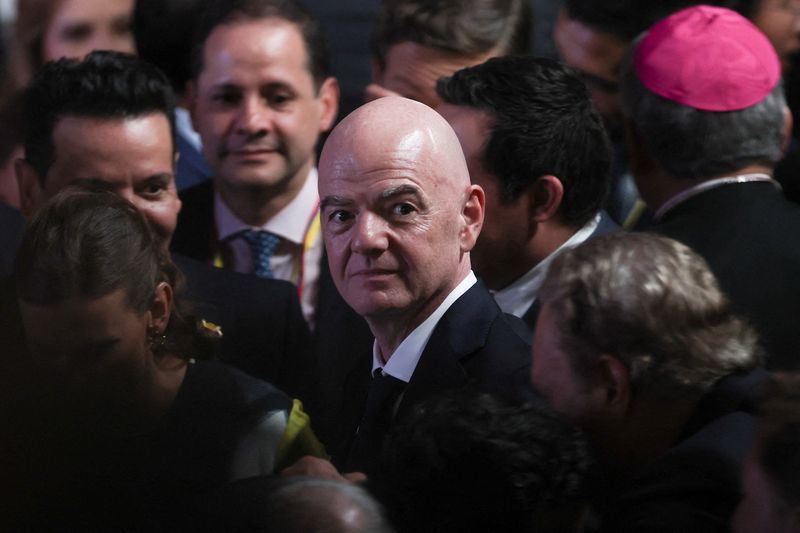
The unity that three continental football confederations sought to demonstrate against FIFA President Gianni Infantino has fractured almost immediately, with Qatar publicly questioning the Asian Football Confederation's authority to represent all its members. The intervention marks a significant moment in what has become an increasingly divisive debate over the leadership of world soccer's governing body, exposing fault lines within Asian football at a moment when consensus appears more elusive than ever.
Qatar Football Association President Hamad bin Khalifa Al-Thani delivered a pointed rebuke to AFC President Sheikh Salman bin Ibrahim Al Khalifa through a formal letter, questioning the consultation process that preceded the confederations' open letter released on Monday. Al-Thani, who holds influential positions as both an AFC Executive Committee member and FIFA Council member, made clear that neither he nor the QFA had any advance knowledge of the statement before it was publicly released in the AFC's name.
The complaint centres on a procedural argument with significant implications for how continental confederations are expected to operate. Al-Thani contended that a collective position cannot simply be declared into existence; rather, it must be built through genuine consultation among member associations. He demanded clarification from the AFC about what consultation process, if any, had actually taken place, and on what legal or procedural basis the confederation considered itself authorised to speak on behalf of all 47 member associations without their explicit agreement.
The timing of Qatar's challenge carries particular weight given recent developments in the broader dispute over Infantino's future. Just days before the AFC's open letter, a coalition of Arab football federation leaders, including Al-Thani himself, had publicly expressed support for Infantino and praised his efforts to develop football across different regions. That statement of support from six Arab heads of associations, which included Morocco as a co-host of the 2030 World Cup, suggested that consensus within Asian soccer was far from unanimous regarding Infantino's position.
Infantino's position has become increasingly precarious following his failed proposal to commercialise the World Cup in unprecedented ways. His scheme involved carving off commercial rights to the tournament and selling a 20 percent stake to private investors, a move that would have generated approximately $4.2 billion in revenue. The backlash to this proposal was swift and severe, prompting him to reverse course entirely and setting off the current wave of criticism from major confederations.
When UEFA, the AFC, and CONCACAF jointly released their open letter, they represented themselves as voicing collective concerns about Infantino's conduct and his handling of the private investment proposal. The three confederations effectively called for his departure ahead of his planned reelection next year. However, the AFC's decision to participate in this collective statement, apparently without securing buy-in from all member associations, has now been exposed as premature and potentially unrepresentative of the continental body's true position.
The AFC's silence in response to Reuters' inquiries about the consultation process compounds the controversy. The confederation has offered no explanation of how it determined that joining UEFA and CONCACAF's attack on Infantino represented the authentic voice of Asian football. This reluctance to address Al-Thani's specific questions about procedure suggests internal discomfort within the AFC about whether its actions truly reflected member consensus.
For Malaysian and other Southeast Asian football federations, this dispute highlights the complex and sometimes contentious dynamics that characterise continental governance in sport. The notion that an AFC president can unilaterally commit the confederation to a major political position without consulting all members raises serious questions about democratic accountability and the proper exercise of institutional authority. Similar concerns have emerged in other continental sports bodies, making this moment a potential catalyst for broader reforms in how these organisations function.
The backing that Infantino secured from Arab leaders demonstrates that significant segments of Asian soccer remain unconvinced by the case against him. Four of the six Arab federation heads who supported the FIFA president hold positions on the FIFA Council, giving their views considerable weight in internal governance matters. Their public endorsement of Infantino, issued amid what they characterised as his crisis, directly contradicts the message conveyed by the AFC's joint letter with UEFA and CONCACAF.
This fracture within Asian football creates a complex strategic situation as Infantino navigates the challenge to his authority. He can now point to Qatar's challenge as evidence that significant elements within Asia dispute the AFC's claim to speak for the entire confederation. The dispute also raises uncomfortable questions about whether the AFC acted hastily in joining what appeared to be a coordinated assault on the FIFA president orchestrated by UEFA and CONCACAF.
For observers of Asian football politics, the incident illustrates how questions about proper procedure and legitimate representation can become weapons in larger battles over power and direction. Al-Thani's careful emphasis on the absence of consultation before the statement was issued shifts the debate from Infantino's fitness for office to whether the AFC itself acted appropriately in claiming to represent all members without securing their agreement.
Looking forward, this episode may prompt Asian football associations to reassess how they approach continental governance matters. The principle that Al-Thani articulated—that collective positions must be genuinely ascertained rather than merely declared—could reshape expectations about consultation and consent within the AFC. Whether this leads to more inclusive decision-making processes or simply reflects deeper divisions within Asian soccer remains to be seen, but the damage to the impression of continental unity has clearly already been inflicted.

