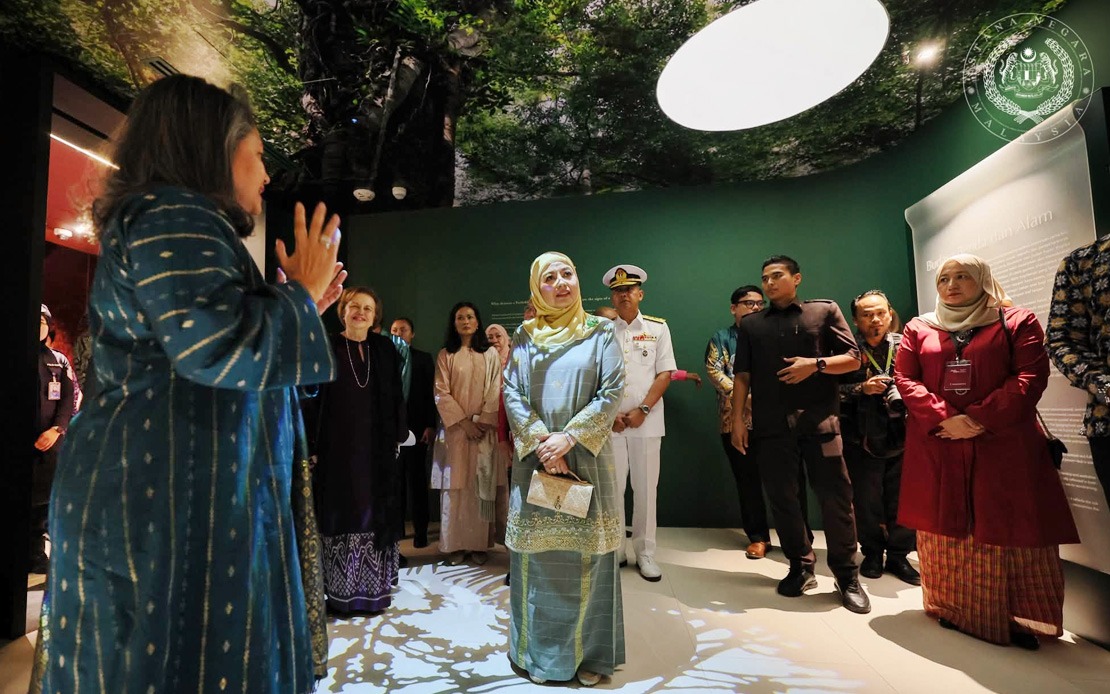
Her Majesty Raja Zarith Sofiah, Queen of Malaysia, officially opened the Merdeka Textile Museum in the Menara Merdeka Maybank complex in Kuala Lumpur on August 21, marking a significant milestone in the country's efforts to preserve its rich textile traditions and cultural identity.
Established by PNB Merdeka Ventures Sdn Bhd, a subsidiary of Permodalan Nasional Berhad (PNB), the museum represents a comprehensive approach to safeguarding the textile heritage of the Malay world. Rather than serving merely as a repository of historical artefacts, the institution has been designed to facilitate deep engagement with cultural narratives through immersive storytelling techniques and participatory experiences that connect contemporary audiences to their ancestral traditions.
During the inauguration ceremony, the Queen emphasised the universal imperative for nations to recognise, protect, and transmit their heritage across generations. She underscored that cultural traditions function as tangible expressions of a society's core identity and fundamental values, acting as custodians of the principles that have historically shaped community bonds and social structures. Her remarks stressed that without deliberate preservation efforts, such knowledge risks permanent loss, particularly as younger populations become increasingly disconnected from traditional practices.
The Queen expressed hope that the museum would establish itself as a vital hub for learning and cultural exploration, accessible to all Malaysians regardless of background. She articulated particular optimism regarding the institution's potential to inspire contemporary Malaysian women while simultaneously encouraging younger generations to value and appreciate the nation's cultural patrimony. These sentiments, shared via an official statement on the Facebook page of Yang di-Pertuan Agong Sultan Ibrahim Sultan Iskandar, reflect growing institutional recognition of heritage conservation's importance to national identity and social cohesion.
At the museum's foundation lies a remarkable personal collection assembled by Sharifah Azah Syed Mohammed Alsagoff, commonly known as Azah Aziz, whose life intersected significantly with Malaysia's institutional development. The widow of the late Prof Diraja Ungku Abdul Aziz Abdul Hamid and mother of former Bank Negara Malaysia governor Tan Sri Dr Ungku Zeti Akhtar Aziz, Azah Aziz accumulated an extraordinary array of textiles and ornamental pieces throughout her lifetime. Following her passing, her family donated these artefacts to establish the museum's core collection, ensuring that her scholarly interests and cultural passion would benefit broader public understanding.
The donated assemblage comprises 240 garments and 69 traditional jewellery pieces, encompassing iconic Malaysian textile traditions. These holdings include intricately patterned songket sarongs, the elegant Limar Baju Kurung associated with ceremonial occasions, and gold-embroidered Tekat Emas pieces that represent the pinnacle of traditional needlework craftsmanship. Each category of textile reflects distinct regional traditions, weaving techniques, and aesthetic philosophies developed across centuries of cultural evolution throughout the Malay archipelago.
The architectural and operational design of the Merdeka Textile Museum extends considerably beyond conventional exhibition spaces. The institution encompasses eight thematic galleries that guide visitors through various dimensions of textile heritage, from production techniques to social significance to contemporary reinterpretation. Complementing these public galleries is a comprehensive study facility incorporating a conservation laboratory where specialist technicians undertake preservation work, a textile library housing reference materials and historical documentation, and a dedicated knowledge centre facilitating scholarly research into historical practices and contemporary textile innovation.
This multi-layered infrastructure demonstrates institutional commitment to serving audiences at different engagement levels. While casual visitors can appreciate aesthetic and cultural dimensions through curated exhibitions, researchers and students gain access to technical resources necessary for advanced study. The conservation laboratory particularly serves national interests by developing local expertise in heritage preservation methodology, reducing dependence on foreign conservation specialists for maintaining the nation's cultural collections.
The significance of this museum extends beyond Kuala Lumpur's cultural landscape, carrying implications for how Malaysia approaches heritage preservation amid rapid modernisation pressures. Textile traditions have historically held central importance across Southeast Asian societies, serving simultaneously as economic products, social markers, ceremonial objects, and artistic expressions. Yet globalisation and industrial homogenisation have displaced traditional production in many regions, threatening transmission of specialised knowledge to younger practitioners. By establishing an institution that validates these traditions through scholarly attention and public investment, Malaysia signals commitment to preserving pre-industrial cultural knowledge systems alongside contemporary development.
The opening ceremony drew attendance from senior government figures, including Minister in the Prime Minister's Department (Federal Territories) Hannah Yeoh, Chief Secretary to the Government Tan Sri Shamsul Azri Abu Bakar, and PNB group chairman Raja Tan Sri Arshad Raja Tun Uda. This high-level participation underscores the museum's positioning as a state-endorsed cultural initiative rather than a merely private collecting endeavour, suggesting potential for future governmental support in similar preservation initiatives across other cultural domains.
For Malaysian audiences, the museum's opening arrives at a moment when balancing heritage preservation with forward-looking development has become an increasingly urgent consideration. Urban youth frequently encounter traditional textiles only through commercialised contexts or tourist-oriented presentations, lacking meaningful understanding of the technical expertise, historical contexts, and social functions these artefacts originally served. The Merdeka Textile Museum's emphasis on interactive learning and scholarly resources offers a model for reconstructing connections between contemporary Malaysians and their cultural inheritance, demonstrating how well-designed institutions can make heritage accessible and meaningful rather than relegating it to museum shelves as historical curiosity.
The institution's location within the Menara Merdeka Maybank complex also carries symbolic weight, positioning textile heritage preservation within proximity to commercial and civic institutions. This siting suggests an aspiration to integrate cultural knowledge into mainstream public consciousness, moving beyond marginalisation of heritage studies to positioning them as central to national identity narratives that inform policy discussions and social development priorities.

