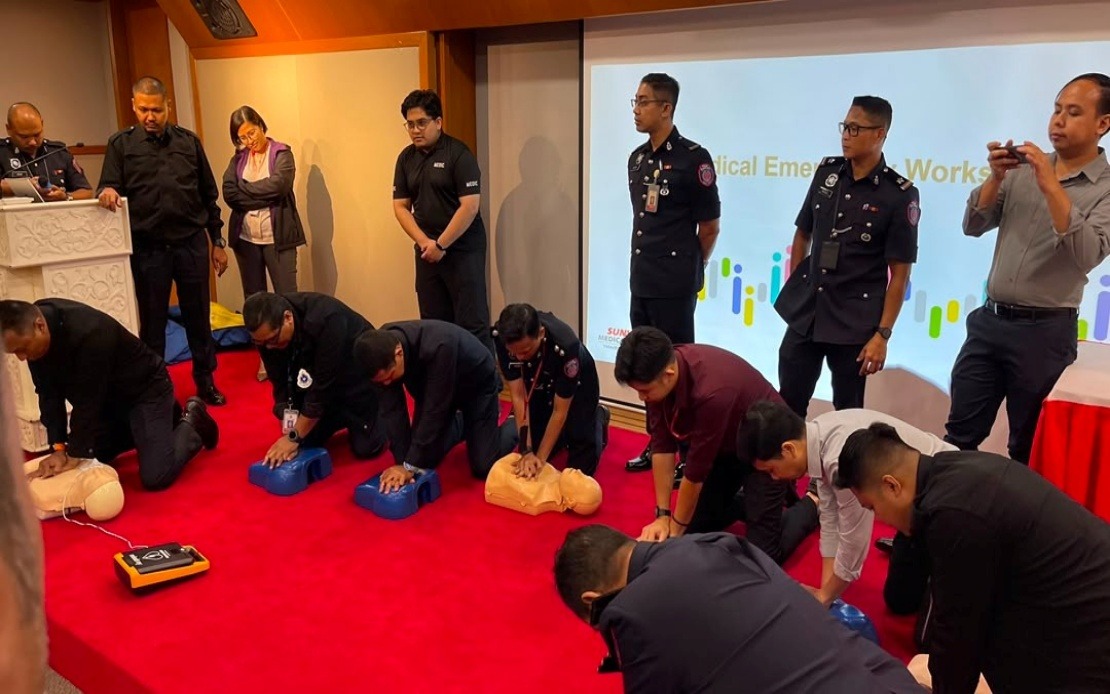
Malaysia faces a persistent public health challenge: sudden cardiac arrest claims lives at rates significantly lower than developed nations, with survival figures languishing between 0.5 and 8.5 per cent. The gap stems largely from two interconnected failures—the scarcity of accessible Automated External Defibrillators and the critical delays that occur before CPR training is initiated. Sunway Medical Centre Velocity has launched an ambitious response, expanding the placement of life-saving defibrillators across Kuala Lumpur's busiest zones while simultaneously strengthening community education on emergency response. The project represents a recognition that medical emergencies demand infrastructure and preparedness working in tandem.
The mathematics of cardiac arrest survival are brutal and unforgiving. Without immediate cardiopulmonary resuscitation, a patient's chances of recovery plummet with each passing minute. Beyond the eight to ten minute window, the likelihood of meaningful survival becomes vanishingly small. This timeline is not abstract for Malaysians—it reflects the harsh reality that bystander response and equipment access often determine outcomes more decisively than hospital capability itself. The hospital's initiative, anchored within its corporate social responsibility framework, builds directly on previous community campaigns by positioning defibrillators where they will matter most: in the commercial and transport arteries where cardiac events are statistically more likely to occur.
The physical rollout encompasses a carefully considered geography. Tun Razak Exchange, the Bukit Bintang district, Ampang Park station, and the Muzium Negara MRT station will receive units, reflecting an understanding of where foot traffic concentrates. Aquaria KLCC, Menara Public Bank, and related office towers anchor the initiative in Malaysia's business districts. The National Heritage Building within Merdeka 118 and the Public Bank-ITTC facility extend coverage into cultural and institutional spaces. This distribution strategy avoids scattering resources randomly; instead, it targets the precise locations where sudden cardiac arrest victims are most likely to collapse and require immediate intervention.
Dr Wee Tong Ming, the hospital's Medical Director and Emergency Physician consultant, frames the challenge with clarity: lives are frequently lost not because help is absent, but because response is delayed and equipment is inaccessible. Every second compounds the tragedy. This observation carries profound implications for Malaysian urban planning and corporate governance. If public health outcomes hinge on reaction time measured in minutes, then the absence of defibrillators in high-density spaces represents an unforced error. The hospital's initiative implicitly argues that building owners, transit authorities, and municipal planners bear responsibility for closing this gap.
Equipment alone, however, tells only half the story. Sunway Medical Centre is pairing physical installation with systematic training, recognising that a defibrillator gathering dust because no one knows its function is merely a monument to good intentions. The hospital has conducted on-site training sessions and accident and emergency awareness talks, teaching the public to recognise cardiac arrest symptoms, perform CPR correctly, and operate defibrillators with confidence. This two-pronged approach—access combined with knowledge—addresses the psychological barrier that often prevents bystanders from acting. Fear of causing harm, uncertainty about technique, and panic can paralyse witnesses. Education transforms potential victims' best chance for survival from lottery into skilled intervention.
The visibility and design of each installation matter operationally. Clear standees accompany each defibrillator unit, ensuring they cannot be missed or dismissed as ordinary equipment. QR code stickers link users and passers-by to the hospital's "Save A Number, Save A Life" campaign webpage, offering immediate access to emergency guidance and additional resources. This detail reflects sophisticated thinking about behavioural readiness. In a crisis, people do not search websites methodically; they respond to clear signals and accessible information. The integration of physical placement, visual prominence, and digital connection creates multiple pathways to life-saving action.
Susan Cheow, the hospital's Chief Executive Officer, articulates an broader vision: no person should face a medical emergency feeling helpless because they lack knowledge or equipment. This statement touches on equity and dignity. The cardiac arrest survival disparity in Malaysia has class dimensions—wealthy individuals with access to private medical facilities and trained household members fare better than those in underserved areas. By targeting public transit stations and commercial hubs, Sunway Medical Centre is attempting to democratise access to this critical intervention. The effort acknowledges that sudden cardiac arrest does not discriminate by income; infrastructure and preparedness should not either.
The initiative also reflects shifting thinking about where responsibility for public health resides. For decades, the assumption was that emergency response belonged exclusively to ambulances and hospitals. This project insists on a distributed model in which building management, transit operators, corporate employers, and trained bystanders form a chain of survival. From the moment collapse occurs until paramedics arrive, the nearest defibrillator and the quickest passerby become more consequential than the ambulance's speed. This reframing carries implications for building codes, corporate liability exposure, and urban design standards across the region.
Dr Wee emphasises that installing defibrillators is only the beginning. Equally critical is ensuring the public possesses the technique, knowledge, and confidence to deploy them correctly when seconds determine life outcomes. This emphasis on competence reflects a mature understanding of implementation challenges. Many initiatives falter because they install equipment without building the human capacity to use it. By committing to ongoing training and awareness, Sunway Medical Centre is creating the conditions under which these devices will actually save lives rather than serving as expensive symbols of corporate concern.
For Malaysian readers and regional observers, the initiative carries broader significance. It demonstrates how a single healthcare institution can mobilise corporate resources to address systemic public health gaps. At the same time, it exposes the fragmentation of responsibility that leaves critical infrastructure undeployed across cities. The true measure of success will not be the number of defibrillators installed, but the number of sudden cardiac arrest victims who survive because they collapsed near trained bystanders who knew what to do. By making that outcome less dependent on chance and more dependent on preparation, Sunway Medical Centre is pursuing healthcare's most fundamental goal: keeping people alive.

