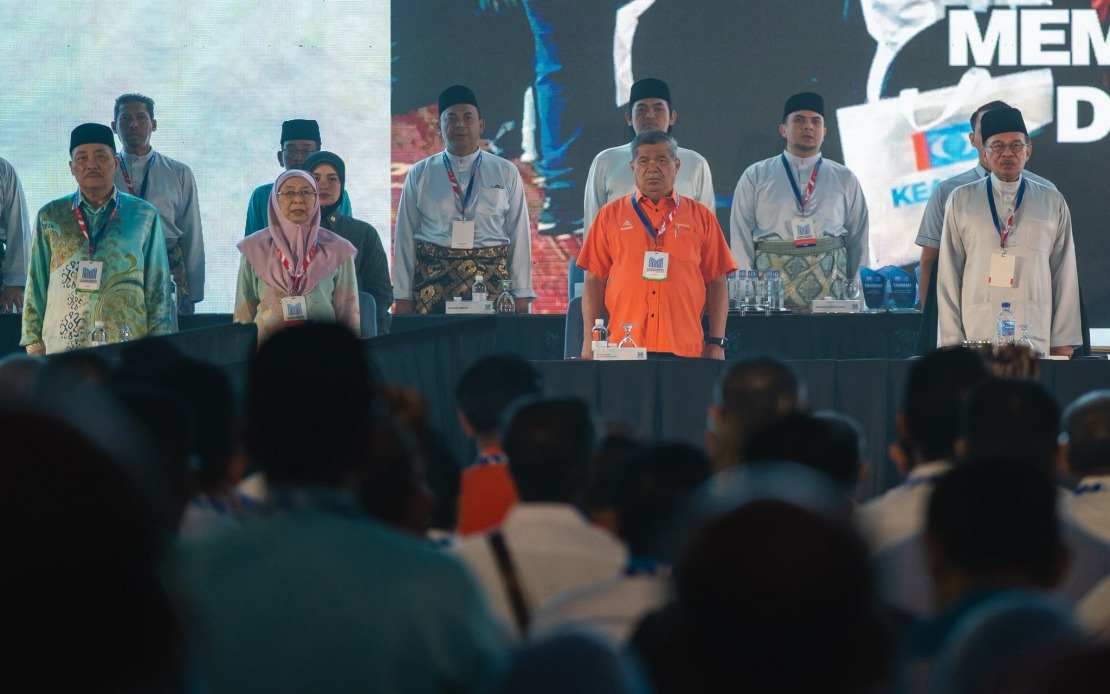
The commitment to reform must endure beyond the initial transition to government, according to Parti Amanah Negara (Amanah) president Datuk Seri Mohamad Sabu, who warned that the struggle for genuine institutional change represents a marathon rather than a sprint. Speaking at the Melaka International Trade Centre in Ayer Keroh, the Agriculture and Food Security Minister stressed that holding public office carries an obligation to translate electoral promises into concrete outcomes, with the litmus test being measurable improvements in how the country functions and how resources benefit ordinary Malaysians.
The remarks come at a moment when Malaysian political coalitions are consolidating power following recent electoral cycles, and questions persist about whether reform initiatives gain momentum or lose urgency once governing parties settle into office. Mohamad Sabu's intervention underscores an internal coalition conversation about maintaining reformist credentials while managing the competing demands of day-to-day administration. His statement reflects broader anxieties within Pakatan Harapan and its allies that governance can gradually drift towards conventional politics unless deliberate mechanisms keep reform on the agenda.
Corruption remains the centerpiece of Amanah's stated commitment. Mohamad Sabu made explicit that investigating and prosecuting financial misconduct will proceed irrespective of the political affiliation or rank of those implicated. This principle represents a departure from historical Malaysian practice, where perceptions of selective prosecution have long undermined public confidence in institutional independence. By framing anti-corruption work as apolitical and non-negotiable, the Amanah leader signals his party's determination to establish precedent, though implementation will ultimately determine credibility.
The mandate concept figures prominently in Mohamad Sabu's framing. He characterises the trust voters place in political parties as something requiring constant vindication through work and measurable action rather than rhetoric or occasional grand gestures. This distinction matters for Southeast Asian democracies where incumbent parties often point to election victories as sufficient justification for their rule, without establishing mechanisms for accountability between electoral cycles. The emphasis on continuous demonstration of competence and integrity suggests a more demanding standard of political leadership.
An accompanying priority involves implementing the Malaysia Agreement 1963 (MA63) to safeguard the constitutional position of Sabah and Sarawak. This commitment reflects coalition efforts to maintain support among East Malaysian populations who retain historical sensitivity regarding autonomy and resource distribution. The prominence given to MA63 implementation in Mohamad Sabu's remarks indicates that reform extends beyond anti-corruption matters to include federal-state relations and recognition of constitutionally guaranteed rights. For Malaysian readers, particularly those in Sabah and Sarawak, this signals that broader institutional reform encompasses their specific concerns about autonomy and equitable development.
Economic policy receives attention as well, though with a qualitative emphasis distinct from conventional growth metrics. Mohamad Sabu acknowledged that gross domestic product expansion matters, but insisted that such figures hold meaning only when translated into improved household purchasing power and reduced financial pressures on ordinary families. This reframing reflects recognition that strong headline economic growth can mask persistent cost-of-living pressures and stagnant real wages—a pattern visible across the region. The distinction between aggregate growth and distributed prosperity represents a critical tension in Malaysian economic policy, and Amanah's positioning suggests sensitivity to voter frustrations despite headline figures.
The Minister's remarks followed an address by Parti Keadilan Rakyat (PKR) president Datuk Seri Anwar Ibrahim at the 2026 PKR National Congress, where continuity of reform featured prominently. This synchronisation indicates coordination within the governing coalition around messaging regarding reform persistence. The emphasis suggests coalition leaders recognise that their base expects reform momentum to continue, and that allowing such commitments to languish risks undermining voter confidence and potentially creating space for opposition parties to position themselves as alternative reform agents.
Universal higher education reform received endorsement through Mohamad Sabu's welcome of the Universities and University Colleges Act 1971 (AUKU) repeal. This institutional change carries symbolic weight beyond campus confines, as AUKU restrictions on student political activity have long symbolised government control over civic space. The repeal represents tangible reform affecting a demographic—students and young adults—whose political engagement shapes broader democratic participation. For Malaysian readers concerned with democratic deepening, this signals movement towards normalisation of university environments as spaces for political expression.
The broader implication of Mohamad Sabu's statement involves conditioning political legitimacy on institutional performance rather than electoral dominance alone. In Malaysian context, where single elections have historically granted victorious coalitions remarkably stable tenure, this represents a subtle challenge to politics-as-usual. Establishing reform as continuous rather than episodic reframes political accountability as permanent rather than cyclical. Whether this rhetorical positioning translates into structural changes remains the consequential question.
Regional observers noting Malaysian political trajectories will recognise the significance of incumbent politicians explicitly committing to restraint regarding their own power and to continuous institutional scrutiny. Southeast Asian democracies frequently experience gradual democratic erosion once parties secure governmental control. Public statements by senior figures insisting on reform continuity serve as benchmarks against which performance can be measured. For Malaysia specifically, such commitments matter given historical instances where initial reform enthusiasm has dissipated under pressure of governance challenges and factional management within ruling coalitions.
The cost-of-living emphasis reflects Malaysian realities where headline inflation figures and interest rate pressures have squeezed household budgets despite official economic growth claims. Mohamad Sabu's insistence that government must demonstrably alleviate these pressures acknowledges voter frustration with administrations that celebrate economic statistics while households struggle with utility bills, transportation costs, and rental expenses. This framing suggests Amanah recognises that reform legitimacy depends partly on tangible economic relief.
Moving forward, the key test involves whether statements about reform continuity influence actual policy allocation and institutional design. Reform agendas often face pressure from competing priorities once governance commences, with immediate budget pressures, bureaucratic inertia, and coalition dynamics frequently pushing back against structural change. Mohamad Sabu's public commitment to non-negotiable reform standards creates accountability, albeit one dependent on sustained coalition discipline and willingness to prioritise institutional transformation over shorter-term political convenience.

