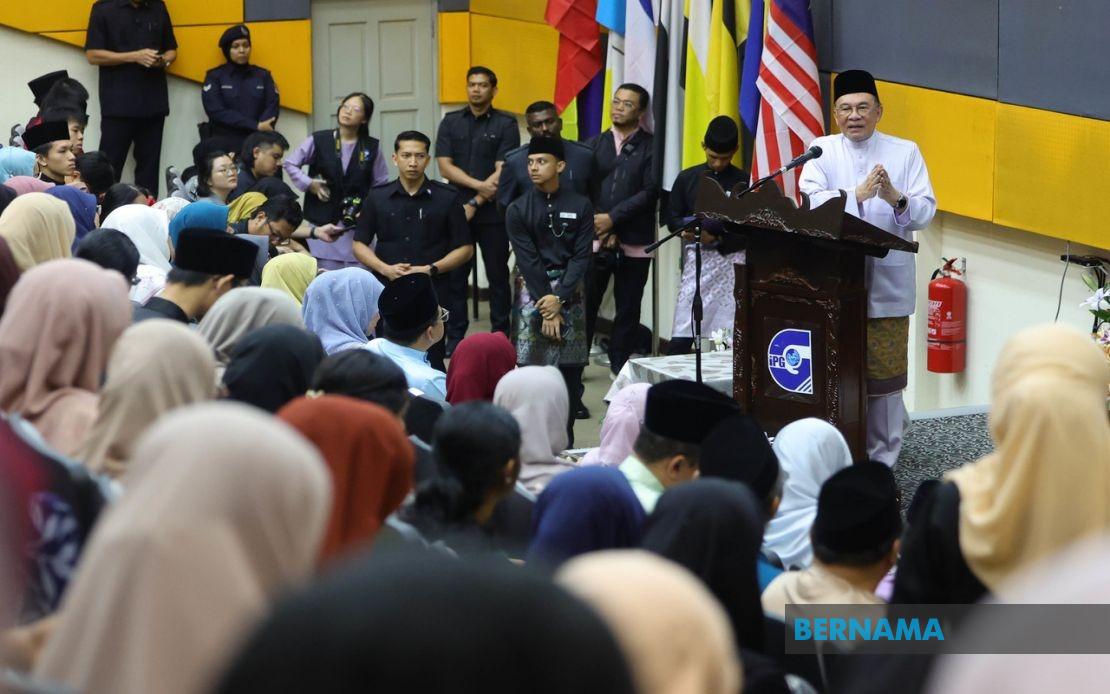
Prime Minister Datuk Seri Anwar Ibrahim has pinpointed the most significant obstacle to Malaysia's comprehensive reform programme: not insufficient resources or technical capability, but rather the unwillingness of certain segments—particularly among the privileged classes—to relinquish established practices rooted in corruption and institutional decay. Speaking during a campus engagement at the Technical Education Campus of the Institute of Teacher Education in Bandar Enstek, Nilai, the Prime Minister articulated a frustration that has emerged repeatedly throughout his tenure, describing a pattern of entrenched resistance that transcends mere technological or operational constraints.
Across his more than three years of government leadership, Anwar has confronted a persistent pushback against reform initiatives designed to dismantle corruption and modernise the nation's administrative framework. The resistance, he explained, emanates from those who have grown accustomed to exploitative systems and who perceive reform as a direct threat to their accumulated advantages and institutional dominance. This observation reflects a deeper structural challenge within Malaysia's governance landscape: the difficulty of dislodging power structures that have consolidated benefits over decades of operation.
The Prime Minister acknowledged that the government's anti-corruption drive and governance strengthening measures face public unpopularity in certain quarters, yet he emphasised their necessity for building a more transparent, accountable and functionally effective administrative apparatus. This stance places Anwar in a position where short-term political comfort is sacrificed for longer-term institutional credibility—a challenging calculus in any democracy, but particularly acute in Malaysia where reform has historically triggered organised opposition from beneficiaries of the status quo.
Anwar articulated a paradox inherent in Malaysia's reform challenge: individuals may present themselves as modern in appearance and lifestyle, yet their resistance to systemic change reveals a deeper conservatism rooted in self-interest. This observation cuts to the heart of why technological advancement and expertise alone cannot drive transformation. The barriers are fundamentally human and political—embedded in power dynamics that resist disruption regardless of rational arguments for change. Those who have prospered within existing structures naturally gravitate toward preserving them, however dysfunctional they may be to broader society.
The Prime Minister framed reform not merely as administrative necessity but as a moral and civilisational imperative. He contended that all systems require continuous improvement, that perfectionism must yield to pragmatic enhancement, and that this principle finds support across religious, cultural and civilisational traditions. By situating reform within these broader philosophical frameworks, Anwar attempted to reposition the debate from a narrow political calculation to a matter of fundamental societal values and progress.
The identification of cultural entrenchment as the primary reform barrier carries significant implications for Malaysia's development trajectory. While neighbouring countries and regional competitors have pursued institutional modernisation, Malaysia's reform efforts have faced systematic internal obstruction. This obstruction operates not through explicit resistance but through institutional inertia, regulatory capture, and the strategic deployment of legal and procedural mechanisms by those invested in maintaining existing arrangements. The challenge extends beyond individual corruption to encompassing systemic practices that have normalised impropriety.
Anwar's observations resonate with international development literature highlighting that institutional reform succeeds or fails based on the political will to confront entrenched interests, not on the availability of technical solutions. Malaysia possesses adequate technological infrastructure and professional expertise; what remains contested is the political consensus necessary to fundamentally restructure institutions. This distinction explains why incremental improvements often founder while comprehensive transformation requires sustained pressure from leadership combined with sufficient public support.
The Prime Minister's remarks suggest a growing recognition that reform momentum cannot be sustained indefinitely without demonstrable results. The frustration evident in his comments reflects the reality that governing reform-minded administrations face constant pressure to produce tangible outcomes, yet institutional resistance systematically delays implementation and dilutes impact. This dynamic places particular strain on Malaysian governance as competing constituencies demand rapid change whilst embedded interests mobilise resources to forestall disruption.
For Malaysian and Southeast Asian observers, this statement illuminates a critical governance challenge affecting the entire region. Economies across Southeast Asia grapple with similar tensions between modernisation imperatives and entrenched institutional interests. The degree to which Malaysia's leadership successfully navigates this friction will substantially influence not only national competitiveness but regional perceptions of whether democratic systems can effectively challenge elite capture and structural corruption. Anwar's framing of reform as civilisational necessity—rather than mere administrative convenience—represents an effort to elevate public discourse and mobilise broader support for institutional change.
The Prime Minister's engagement with students and educators at the teacher training institute served a dual purpose: directly addressing future institutional leaders while signalling broader commitment to generational renewal. Educational institutions represent strategic sites for reform implementation, as they shape attitudes and practices of those who will occupy institutional positions in subsequent decades. By emphasising to this audience that resistance stems from narrow self-interest rather than legitimate policy disagreement, Anwar sought to inoculate younger cohorts against adopting the institutional defensiveness of their predecessors.
Moving forward, the sustainability of Malaysia's reform agenda appears dependent on translating Anwar's diagnostic clarity into institutional outcomes sufficient to maintain momentum and public confidence. The acknowledgment that reform faces determined resistance paradoxically represents both an honest assessment and a potential vulnerability; public frustration with slow progress could eventually erode support for continued efforts if visible improvements remain elusive. The challenge facing Malaysia's reform project thus extends beyond identifying obstacles to developing sustained capacity to overcome them through a combination of strategic pressure, institutional redesign and generational transition.

