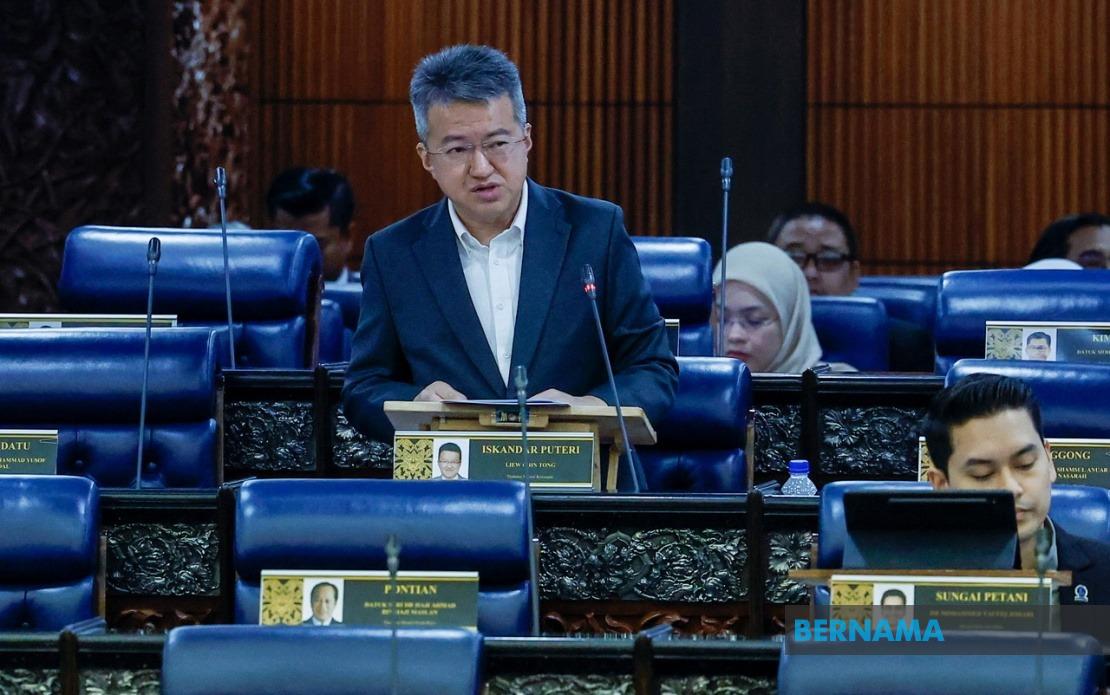
The federal government has moved to dispel concerns that Sabah's newly increased interim special grant represents a trade-off against other development funding for the state. During parliamentary debate on July 14, Deputy Finance Minister Liew Chin Tong provided categorical assurances that the RM1.5 billion boost announced by Prime Minister Datuk Seri Anwar Ibrahim in May would operate as an addition to, rather than a substitution for, the state's regular development budget ceiling under this year's federal allocations.
Liew's clarification addresses a longstanding tension in Malaysia's fiscal federalism. Sabah, one of two states with constitutionally enshrined special grant provisions, has historically navigated complex negotiations over the relationship between special payments and routine development funding. The deputy minister's statement effectively separates these revenue streams, positioning the interim grant as supplementary assistance rather than a reallocation of existing commitments. This distinction matters substantially for state planning, as it signals continued federal investment alongside the special payment mechanism.
The scope of Sabah's development programme underscores the breadth of infrastructure commitments being maintained in parallel with the special grant increase. The state's development allocation has grown from RM6.7 billion to RM6.9 billion in the current fiscal year, reflecting federal dedication to what Liew termed balanced development across Malaysia. The funded projects span critical infrastructure: the Pan Borneo Highway project, which aims to connect Sabah's interior regions to coastal economic centres; rural road networks that remain essential for remote community connectivity; electrification schemes extending to dispersed settlements; and water supply infrastructure serving populations beyond urban centres.
Healthcare and education infrastructure form another pillar of these allocations. Liew specifically highlighted construction and upgrading work on hospitals and clinics, addressing long-standing service gaps in districts far from major towns. Similarly, renovation and replacement of deteriorating school buildings addresses quality-of-life concerns in rural areas, while police station upgrades support law enforcement operations in geographically challenging terrain. These components collectively represent the federal government's developmental footprint in Sabah beyond the special grant mechanism.
Electricity subsidies represent a distinct but complementary form of federal support that continues despite a significant constitutional handover in 2024. When regulatory powers over electricity supply transferred to the state government, the federal government maintained its subsidy commitment—a decision with major implications for household and business operating costs in Sabah. The anticipated subsidy allocation for 2026 is projected to reach RM880 million, a substantial commitment that effectively stabilises energy costs for consumers across the state and insulates the state budget from the full fiscal weight of utility operations.
Rural water supply has similarly benefited from expanded federal commitment. The allocation for this sector grew from RM103.5 million in 2025 to RM143 million in the current year—a 38 per cent increase that reflects prioritisation of basic services infrastructure. For a state where geography and population dispersal create significant cost barriers to comprehensive utility coverage, this escalation signals sustained federal investment in what remains a foundational development challenge.
Cost-of-living assistance programmes further supplement Sabah's fiscal position through federal transfers. The Sumbangan Tunai Rahmah and Sumbangan Asas Rahmah schemes are estimated to channel RM1.2 billion to Sabah, representing direct household income support that reinforces consumption capacity and mitigates poverty pressures. These transfers carry particular significance in Sabah's context, where household incomes and employment patterns differ markedly from peninsular benchmarks.
The procedural framework governing special grant disbursement remains anchored in constitutional provisions, a detail Liew emphasised in his parliamentary response. Articles 112C and 112D of the Federal Constitution establish the constitutional basis for Sabah's special grants, and the federal government must navigate established protocols identical to those implemented in 2022, 2023, and 2025. This constitutional embeddedness distinguishes the special grant from discretionary fiscal transfers, placing it on a more legally secure footing even as disputes over implementation persist.
The federal government's ongoing litigation posture complicates this picture. While Liew confirmed respect for the constitutional principle underlying special grants, he simultaneously disclosed that the federal government has filed an appeal against aspects of the Kota Kinabalu High Court's ruling on the matter. This dual approach—affirming constitutional commitment while contesting judicial interpretations—reflects underlying tensions over implementation mechanics and the relationship between special grants and other federal transfers.
Future grant arrangements remain subject to active negotiation between federal and state authorities. Liew signalled federal commitment to establishing a new mechanism for determining special grant quantum going forward, acknowledging that existing arrangements require refinement to achieve durable consensus. These negotiations will inevitably intersect with broader questions about Malaysia's fiscal federalism, the distribution of revenue-raising capacity between federal and state authorities, and the special constitutional position of Sabah and Sarawak within Malaysia's federal structure.
For Malaysian policymakers and observers tracking federal-state fiscal relations, Liew's statements provide important clarity on the sequencing of federal commitments to Sabah. By explicitly decoupling the special grant increase from development allocations, the federal government preserves both mechanisms as distinct policy instruments. This approach potentially creates more predictable planning frameworks for Sabah's state government while maintaining federal influence through conditional developmental expenditures implemented by federal agencies. The substantive effect is to position Sabah as receiving multiple overlapping streams of federal support, though questions about optimal resource allocation and the efficiency of parallel federal-state spending remain implicit rather than resolved.

