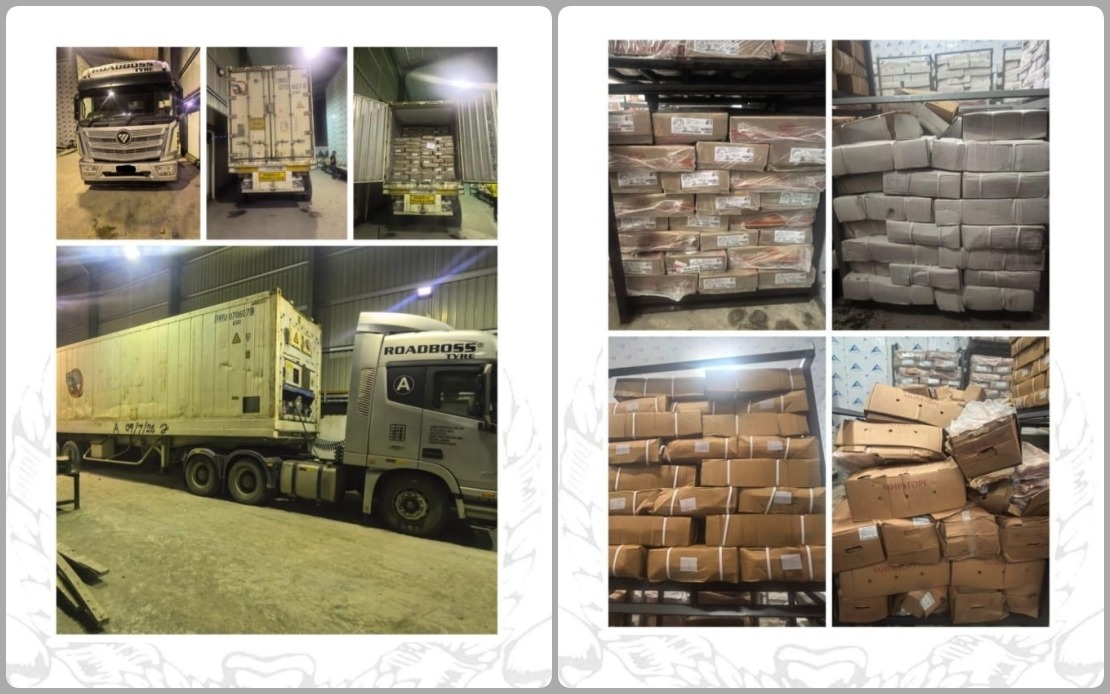
Police have arrested a suspect and confiscated RM6.19 million in frozen pork products believed to have entered the country without proper authorisation following a nighttime raid on a warehouse facility in Miri, Sarawak. The operation, designated Op Taring Chiller, reflects intensifying efforts by Malaysian law enforcement to curb the trafficking and distribution of food items lacking verified halal status and other critical safety documentation. The suspect, identified as a 26-year-old local resident, was apprehended at 8 pm during the enforcement action, marking another significant seizure in the nation's ongoing battle against organised food smuggling networks.
According to Datuk Seri Mohd Yusri Hassan Basri, director of the Internal Security and Public Order Department, the warehouse inspection revealed a substantial cache of illegal pork products in various forms and quantities. Among the seized items were 30,000 kilogrammes of cooked frozen pork large intestines, 18,000 kilogrammes of pork loin distributed across 15 pallets, 750 kilogrammes of pork on a single pallet, multiple pallets containing bone-in pork belly with rind attached, and frozen pork shoulder. The diversity and volume of the confiscated stock suggest an operation geared towards large-scale distribution rather than personal consumption, indicating possible links to wider smuggling networks operating across the region.
The enforcement operation demonstrates the multi-agency coordination that has become standard practice in Malaysian food security operations. The Wildlife Crime Bureau and Special Investigation Intelligence division of the JKDNKA led the raid, working in tandem with personnel from the Miri district police headquarters and the Sarawak Veterinary Services Department. This collaborative framework enables authorities to cross-reference intelligence, deploy specialist expertise, and execute operations with greater efficiency and effectiveness. Such integrated approaches have become increasingly vital as smuggling networks adapt their methods and distribution channels to evade detection.
Legal proceedings against the arrested individual are proceeding under Sections 9(1) and 9(3) of the Veterinary Public Health Ordinance 1999, a statute that carries significant penalties for violations involving unauthorised importation and storage of animal products. The authorities have issued a RM25,000 compound notice under the same ordinance, offering the suspect a potential avenue for settlement whilst maintaining deterrent effect. The selection of these particular legal instruments underscores the seriousness with which Malaysian regulators treat breaches of veterinary and food safety standards, particularly when involving products of uncertain origin and health credentials.
The Miri seizure represents a single operation within a much broader enforcement campaign that has accelerated throughout 2024. Data released by the JKDNKA indicates that between January 1 and July 10, the Wildlife Crime Bureau and Special Investigation Intelligence units conducted 201 raids across Malaysia, resulting in 375 arrests spanning multiple categories of illegal activity. These enforcement actions have generated seizures with an estimated combined value of RM264.86 million, spanning smuggled duty-unpaid merchandise, diverted subsidised goods, frozen food products, wildlife trafficking, and electronic waste. The scale of these operations and their financial impact underscore the resourcefulness and persistence of organised criminal networks operating across Southeast Asia.
The enforcement push against smuggled food products reflects growing concern among Malaysian health authorities regarding the risks posed by products lacking proper documentation, traceability, and halal certification. Frozen pork products arriving through irregular channels present particular challenges, as their origins cannot be verified, their storage conditions during transit remain unknown, and they may have been subjected to inappropriate handling or preservation methods. When such items enter the formal supply chain or are distributed through informal networks, they pose potential public health hazards to consumers and create unfair competition for legitimate importers and retailers who comply with regulatory requirements.
For Malaysian consumers, the implications extend beyond food safety considerations alone. The proliferation of undocumented imported food products can artificially depress prices for illegally distributed items, creating incentive structures that encourage further smuggling and undermine legitimate traders operating under compliance costs. Small and medium-sized enterprises in the legitimate food import and retail sectors face persistent competitive pressure from networks operating outside regulatory frameworks, constraining their margins and investment capacity. The enforcement operations targeting smuggled products thus serve broader economic purposes beyond immediate public health protection.
The enforcement emphasis in Sarawak reflects the state's particular vulnerabilities to smuggling activities, given its extensive international borders and maritime coastlines. Sarawak's geography and economic structure create multiple transit routes and storage possibilities for illicit goods, requiring law enforcement to maintain heightened vigilance. The concentration of resources in the state, as evidenced by the Miri operation and the participation of the Sarawak Veterinary Services Department, indicates that authorities recognise these geographic challenges and have allocated personnel accordingly.
The Royal Malaysia Police statement accompanying the Miri seizure emphasises continued commitment to intelligence gathering, monitoring, and coordinated enforcement campaigns designed to combat smuggling and organised crime. This language signals that the current enforcement tempo will likely persist, with police expecting to execute additional raids and detain further suspects in coming months. For businesses engaged in legitimate food importation and distribution, this environment presents both compliance challenges and competitive opportunities, as rigorous enforcement creates barriers to entry for smaller operators whilst protecting established firms that maintain strict regulatory adherence.
The RM6.19 million seizure also carries implications for Malaysian-Singaporean trade relations and broader ASEAN food security cooperation. Illicit pork products moving through the region may originate from multiple source countries before reaching Malaysian territory, suggesting the involvement of transnational trafficking networks. Coordinated regional approaches to food smuggling, involving intelligence sharing and harmonised enforcement standards across ASEAN member states, will likely become increasingly important as authorities seek to disrupt supply chains that exploit regulatory gaps and jurisdictional boundaries.
Moving forward, the frequency and scale of such seizures may provide authorities with valuable data for identifying trafficking patterns, preferred routes, and storage locations favoured by smuggling networks. The intelligence generated from the Miri operation and similar raids feeds into broader law enforcement strategies aimed at disrupting criminal networks rather than merely pursuing individual transactions. Success in this arena ultimately depends on sustained political will, adequate resource allocation, and continued inter-agency cooperation—factors that appear present in current Malaysian enforcement efforts.

