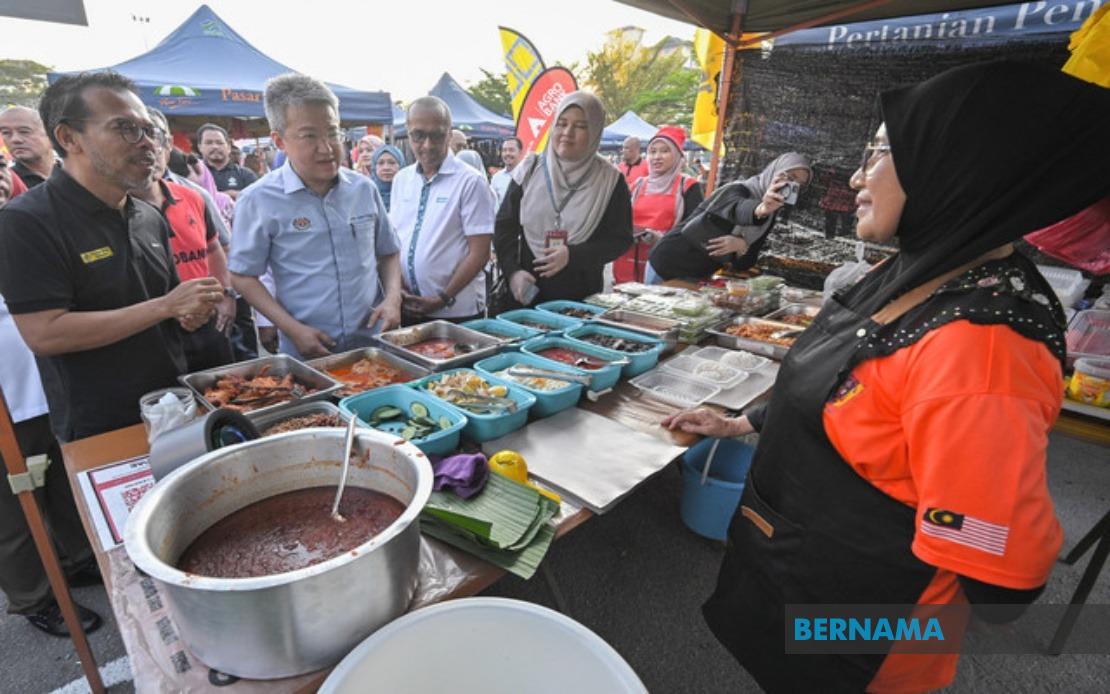
The Malaysian government is deploying RM9.8 billion in microfinancing capacity across six major institutional lenders to strengthen access to affordable credit for hawkers and small-scale business operators throughout the country. Deputy Finance Minister Liew Chin Tong announced the initiative during a visit to the Dataran Puchong Permai Farmers' Market, underscoring the administration's commitment to preventing financial exclusion among Malaysia's informal economy participants who often struggle with traditional banking requirements.
The policy response reflects growing recognition that small traders form a crucial economic backbone, particularly in urban and semi-urban areas where informal commerce drives employment and consumer spending. By removing barriers to capital access, the government aims to empower entrepreneurs to scale operations, invest in better equipment, and ultimately formalise their business structures. Liew emphasised that this substantial financial allocation ensures grassroots traders receive sustainable funding support rather than relying on informal credit networks or loan sharks that charge exploitative interest rates.
The structured approach involves six key participating agencies: Bank Simpanan Nasional (BSN), Agrobank, Bank Rakyat, the Companies Commission of Malaysia, TEKUN Nasional, and Majlis Amanah Rakyat. Each institution brings distinct expertise and lending mandates. While BSN operates as a community-focused bank, Agrobank specialises in rural and agricultural financing, and TEKUN Nasional targets young entrepreneurs and small business development. This diversified institutional framework ensures tailored credit products matching different trader profiles and business models rather than applying one-size-fits-all lending criteria.
The "Mikro Kredit Turun Padang" programme represents a deliberate pivot towards decentralised finance delivery. Rather than requiring traders to navigate complex bank branch applications, the initiative brings lending officers and advisory services directly into market communities. This ground-level approach reduces transaction costs for applicants and provides personalised guidance on documentation, eligibility criteria, and loan structuring. The Puchong edition follows successful rollouts at Taman Melawati Farmers' Market, Kelana Jaya Farmers' Market, and Bandar Tasik Permaisuri Farmers' Market, indicating expanding geographic coverage.
Early results from the Dataran Puchong Permai site demonstrate tangible momentum. Twelve hawkers have already secured financing approvals, with seven receiving support from Amanah Ikhtiar Malaysia (AIM), three from BSN, and two from Agrobank. These approvals represent diverse trader profiles, suggesting the programme accommodates varying credit needs from modest working capital requirements to equipment purchases. Critically, AIM's significant portion reflects its specialisation in microfinance for the lowest-income segments, populations often overlooked by conventional banking.
Beyond immediate lending, the Ministry of Finance is systematically collecting grassroots feedback to inform policy refinement at the highest governmental level. Liew indicated that trader input from these outreach programmes will be compiled and escalated to the Prime Minister during budget deliberation cycles. This feedback loop suggests policymakers recognise that programme design must evolve based on real-world operational challenges and borrower needs rather than remaining static after initial deployment. Such responsiveness could shape future allocations and policy adjustments.
The timing carries significance for Malaysia's post-pandemic economic recovery. Hawkers and small traders experienced severe disruption during lockdowns and restrictions, with many exhausting savings and incurring additional debt. Renewed access to formalised microfinance provides recovery pathways unavailable through emergency assistance programmes alone. Furthermore, elevated interest rates in the current monetary tightening cycle make affordable government-channelled credit particularly valuable, preventing cost-of-capital squeeze that could otherwise drive viable small businesses toward insolvency.
Regional context amplifies the initiative's relevance. Southeast Asian economies increasingly recognise microfinance as instrumental for inclusive growth, particularly given persistent informal sector employment. Countries across the region—from Vietnam to Indonesia—have expanded microfinance capabilities to absorb rural-to-urban migration flows and support displaced workers. Malaysia's RM9.8 billion commitment positions it within this regional trend while addressing domestic labour market dynamics where informal commerce remains substantial despite urbanisation.
Implementation challenges warrant monitoring. Loan default risk among microcredit portfolios historically exceeds conventional banking, requiring robust client assessment and support mechanisms beyond simple credit provision. Hawkers operating in competitive, low-margin environments face genuine repayment pressure despite good intentions. Success depends on whether supporting services—such as business mentoring, market access facilitation, and digital payment infrastructure—accompany capital provision. Isolated credit without complementary business development may generate unsustainable debt rather than genuine entrepreneurial advancement.
The programme's emphasis on direct application facilitation addresses critical barriers. Many small traders lack formal business registration, comprehensive financial documentation, or awareness of available schemes. By embedding lending officers within market communities and simplifying procedural requirements, the government removes friction that previously disqualified viable entrepreneurs. This accessibility focus proves particularly important for women traders and recent migrants who may face additional cultural or informational barriers to conventional banking relationships.
Longer-term implications extend toward financial inclusion metrics that policymakers increasingly monitor. International development organisations emphasise access to formal financial services as foundational for poverty reduction and economic resilience. Malaysia's microfinance expansion directly contributes to these objectives by drawing informal traders toward regulated financial systems, creating credit histories that enable future borrowing and supporting market-based rather than subsidy-dependent economic development pathways.
The allocation's sustainability depends on institutional capacity and portfolio quality maintenance. Rapid expansion without corresponding investment in lending staff, technology infrastructure, and risk management could strain participating institutions. Additionally, macroeconomic conditions affecting trader repayment capacity—such as consumer spending trends, inflation impacts, and competitive market dynamics—will determine whether the programme achieves projected outcomes or generates problematic arrears among participant institutions.
Successful implementation would represent meaningful progress toward broad-based economic participation. When hawkers and small traders access reliable capital at reasonable costs, they extend credit to suppliers and employees, multiplying programme impact across supply chains and labour markets. This inclusive finance model acknowledges that Malaysia's economic strength depends not only on large corporations and manufacturing exports but equally on vibrant informal economy ecosystems that employ millions and anchor community stability.

