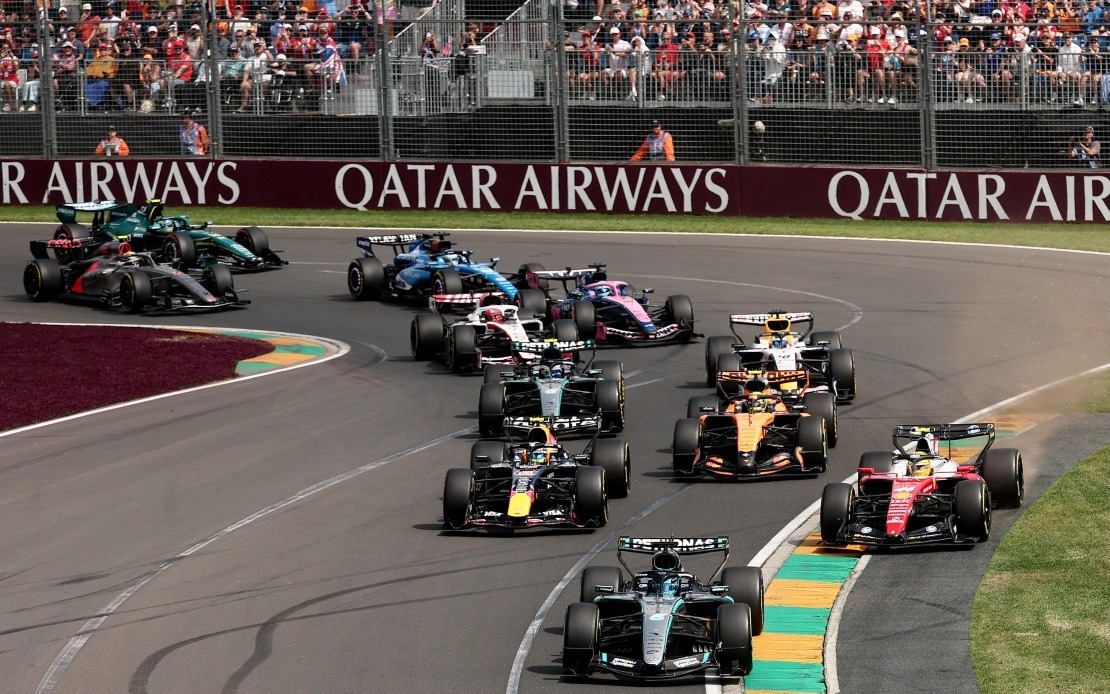
George Russell's deteriorating Formula 1 season reached a nadir at Spa-Francorchamps on Sunday when a combination of technical failures and on-track contact forced him out of the Belgian Grand Prix. The British driver's frustration boiled over on the team radio, delivering a colourful outburst that underscored the mounting pressure he faces as his world championship aspirations slip further away with each race weekend.
The championship mathematics now paint a bleak picture for Russell. His Mercedes teammate Kimi Antonelli, the Italian teenager who joined the team this season, has established a commanding 50-point advantage following his sixth victory from the ten rounds completed so far. For Russell, who entered the campaign with genuine podium credentials, the gap represents a chasm that grows wider with each round. The psychological toll is evident not merely in his radio exchanges but in his own admission that he has become increasingly inured to setback after setback.
Russell's race unravelled through a sequence of cascading problems that began before the opening lap was completed. An engine glitch during the first lap left him exposed to the pursuing field, instantly eroding the strategic position he needed to maintain pace with the team's championship leader. This initial mechanical failure then precipitated the more costly retirement when contact with Lewis Hamilton, his former Mercedes teammate, forced him out of contention entirely. The incident exemplified how one failure creates vulnerability to subsequent disasters on a Formula 1 circuit where margins of error are measured in tenths of seconds.
The technical gremlins haunting Russell's weekend centred on battery deployment difficulties within his Mercedes power unit. During a crucial straight section of the circuit, the system failed to deliver the electrical energy needed to maintain competitiveness, a deficit he estimated as potentially accounting for half a second or more relative to Antonelli. On the team radio, Russell's exasperation exploded into expletive-laden complaint, questioning the state of charge management and labelling the entire situation as fundamentally unacceptable. His words reflected not merely frustration with a single race but accumulated exhaustion from what he characterised as a consistent pattern of mechanical unreliability throughout the season.
The diagnosis initially suggested Russell's driving technique might bear responsibility for the battery management issue, a suggestion that would have allowed Mercedes to address the problem at the driver's end. However, engineering analysis rapidly dispelled this theory, revealing instead that a genuine fault within the power unit itself had compromised performance. The irony was not lost on Russell: a legitimate technical problem that his engineer initially attributed to his driving style, leaving him to absorb criticism for circumstances beyond his control. Such episodes accumulate psychological damage beyond the immediate championship points lost.
Qualifying had already established the pattern for the weekend when Russell lined up half a second adrift of Antonelli, a gap explained by the same deployment riddle that would later terminate his race. The reliability issue proved impossible to fully resolve during preparation, forcing Russell into the Grand Prix knowing his equipment was operating at diminished capacity. This combination of known deficiency and inability to remedy it before racing conditions encapsulates the frustration permeating his comments both on and off the radio.
Mercedes team principal Toto Wolff acknowledged Russell's emotional state whilst attempting to contexualise the situation within the broader framework of elite Formula 1 competition. Wolff's response carefully balanced recognition of legitimate technical failures with an appeal to professionalism and perspective, reminding Russell that driving for Mercedes represents an honour held by few competitors globally. He emphasised that the team remained fully committed to resolving the reliability challenges and rebuilding the optimism necessary to sustain a championship campaign, whilst also acknowledging that every driver experiences difficult periods requiring mental resilience.
Wolff's technical analysis of the power unit issue revealed the Byzantine complexity of modern hybrid power plants. The harvesting, deployment, and interaction between driver inputs and electronic management systems create countless potential failure points. Mercedes identified a specific engine anomaly that restricted available energy deployment around turn 18, a circuit characteristic that exposed the problem acutely at Spa-Francorchamps. Wolff suggested the diagnosis actually carried a silver lining: the problem revealed itself at a high-speed circuit where power delivery proves critical, rather than remaining hidden until the Hungarian Grand Prix, where energy demands less dominate the performance envelope.
However, Wolff's pragmatic silver-lining argument offered limited comfort to Russell. Identifying a problem becomes worthwhile only if resolution arrives before the next race weekend. Russell expressed cautious optimism that Mercedes engineers could implement a fix before Budapest, the final round preceding the summer break, but his tone suggested hope tempered by accumulated disappointment. He acknowledged that what was once termed numb acceptance of setback had now calcified into a defensive emotional posture, an acknowledgement that repeated failure erodes resilience and optimism.
The broader context surrounding Russell's struggles reflects the inherent unpredictability of developing new power unit regulations. Mercedes' partnership with a new engine manufacturer has introduced reliability challenges that disproportionately affected Russell whilst Antonelli has enjoyed relative mechanical fortune. Such variance in reliability, though theoretically random, compounds to create championship-deciding advantages. Russell faces the uncomfortable reality that his comparative underperformance relative to his teammate stems significantly from mechanical factors rather than purely driving performance, a circumstance that limits his ability to directly influence championship outcomes.
The Hungarian Grand Prix looms as a consequential opportunity. Russell requires not merely a competitive result but also confirmation that Mercedes' identified engine fault has been genuinely resolved. Another mechanical failure would likely mark the effective end of any serious championship campaign, shifting focus toward salvaging a respectable points total and rebuilding psychological momentum for 2025. Wolff's comments suggest the team recognises the urgency, positioning Budapest as a potential inflection point where either confidence can be restored or resignation must be accepted.
For Malaysian and regional Formula 1 enthusiasts, Russell's predicament illustrates the cruel mathematics of modern motorsport where championship campaigns can be decided as much by engineering reliability as driver excellence. The technical complexity of contemporary power units means teams can reach strategic decisions about resource allocation that indirectly determine driver fate. Russell's experience also underscores the psychological challenges facing competitors when equipment limitations become apparent, requiring mental discipline to maintain performance when circumstances fall beyond individual control. As the season enters its second half, his recovery depends equally upon Mercedes' engineering prowess and his own capacity to transcend mounting frustration.

