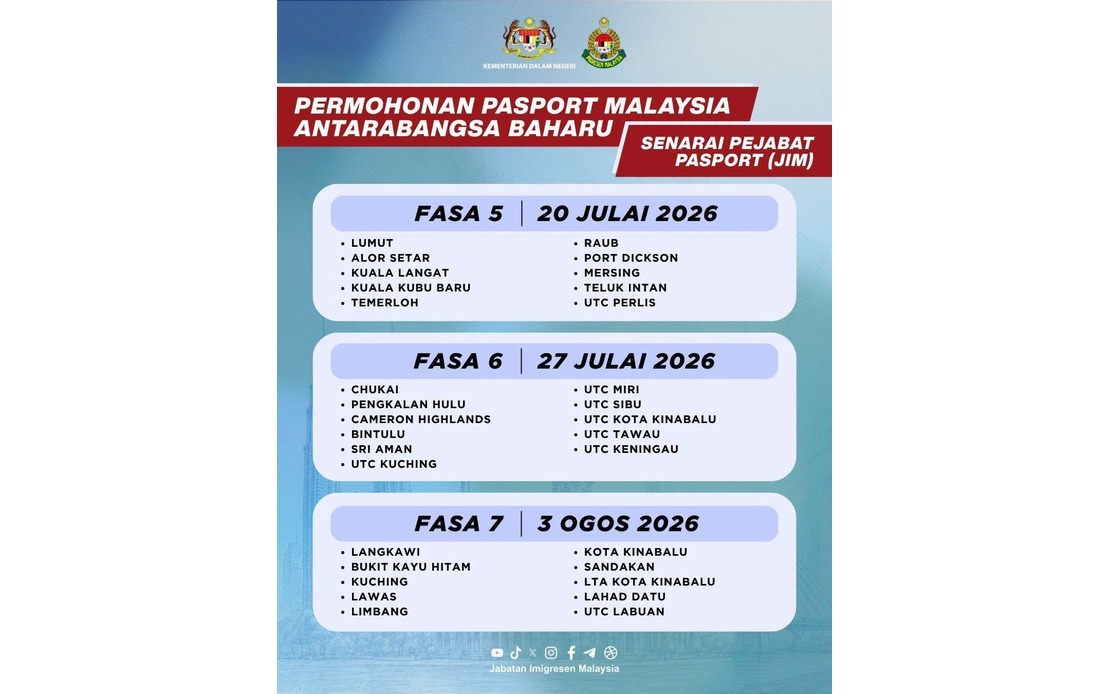
The Immigration Department has launched the next phase of its nationwide passport modernisation programme, bringing the enhanced new Malaysian international passport to Sabah and Sarawak from today. The rollout represents a significant step forward in securing Malaysian travel documents against fraud and counterfeiting, while expanding access to the upgraded passport across the country's two largest states on Borneo island.
The phased approach to implementation reflects the department's careful strategy in managing the transition from the existing passport system to the new international document. Eight passport-issuing offices across both states will begin operations under Phase 6 effective immediately, with these facilities located in Bintulu, Sri Aman, Kuching, Miri, Sibu, Kota Kinabalu, Tawau and Keningau. A further eight offices will commence operations under Phase 7 starting August 3, including additional services at Kuching, Lawas, Limbang, Kota Kinabalu, Sandakan, Kota Kinabalu International Airport, Lahad Datu and Labuan, covering key population centres and transportation hubs throughout the region.
The new Malaysian passport represents a substantial technological upgrade compared to its predecessor. Prime Minister Datuk Seri Anwar Ibrahim officially launched the document on June 30, unveiling a passport equipped with 94 distinct security features designed to provide comprehensive protection against increasingly sophisticated forgery techniques. The enhanced security architecture reflects international best practices in travel document security, positioning Malaysia's passport among the most secure in the region and strengthening the nation's standing in global security frameworks.
Malaysian citizens aged 18 and above have been eligible to apply for the new passport since July 1, with flexibility in selecting validity periods of either five or ten years according to individual circumstances and travel patterns. This choice allows younger citizens and frequent travellers to select shorter validity periods, while those with stable travel plans can opt for the full decade of validity. The dual-option approach acknowledges the diverse needs of Malaysia's population while encouraging early adoption of the enhanced security features.
The nationwide rollout strategy demonstrates the Immigration Department's commitment to managing this significant administrative transition systematically. The programme began with 14 high-volume passport-issuing offices designed to handle substantial application numbers, before expanding to 71 offices across Malaysia with completion anticipated by early August. This measured expansion allows the department to monitor implementation quality, identify operational challenges and refine processes before full national deployment, ensuring a smoother experience for citizens across all states.
For residents of Sabah and Sarawak, this expansion holds particular importance given the geographical challenges of accessing government services across these expansive territories. The inclusion of offices in smaller centres such as Lawas, Limbang and Lahad Datu alongside major urban hubs ensures that citizens throughout the region have reasonable access to the new passport service without requiring lengthy travel to state capitals. The incorporation of Kota Kinabalu International Airport and Labuan's urban transformation centres recognises the importance of serving travellers and providing convenient access points for mobile populations.
Citizens planning to obtain or renew their passports are advised to verify which offices in their area participate in the new scheme before visiting, allowing them to plan their applications efficiently and avoid unnecessary journeys to facilities not yet offering the service. The Immigration Department has emphasised that there is no urgency for existing passport holders to immediately apply for the new document, as current passports remain valid for use up to six months before their expiry date. This reassurance addresses potential anxiety about the transition and prevents bottlenecks at participating offices from citizens rushing unnecessarily to upgrade prematurely.
The rollout across Sabah and Sarawak arrives at a particularly strategic moment for the nation's border management and regional travel infrastructure. Both states serve as important gateways for regional commerce and tourism, with enhanced passport security facilitating smoother international travel and strengthening Malaysia's position within ASEAN visa and border protocols. The improved security features will particularly benefit businesspeople and regular travellers who cross borders frequently, reducing processing delays at immigration checkpoints through faster document verification systems.
For the broader Southeast Asian context, Malaysia's adoption of the new passport standard reflects a regional trend towards strengthened identity security. As countries throughout ASEAN upgrade their travel documents with modern biometric and security features, Malaysia's implementation ensures interoperability with neighbouring nations' advanced border scanning systems. This harmonisation supports the ASEAN Community's objectives of facilitating legitimate travel while maintaining robust security against document fraud and identity misuse.
The staggered implementation across different phases and geographic locations also provides valuable operational data that will inform the Immigration Department's future administrative modernisation initiatives. By carefully monitoring the rollout process, officials can assess citizen adoption rates, identify documentation challenges and refine training programmes for immigration personnel. This evidence-based approach to large-scale administrative change offers lessons applicable to other government service modernisation projects across Malaysia.
Citizens in Sabah and Sarawak should prepare for the transition by gathering required documentation and planning their applications during scheduled operating hours at participating offices. Those approaching passport expiry dates in the coming months may prioritise applications to secure the new document with extended validity, while others can schedule applications at their convenience throughout the rollout period. The availability of the new passport across major urban centres and transport hubs throughout both states ensures that geographical distance no longer presents a barrier to accessing this enhanced travel security feature.

