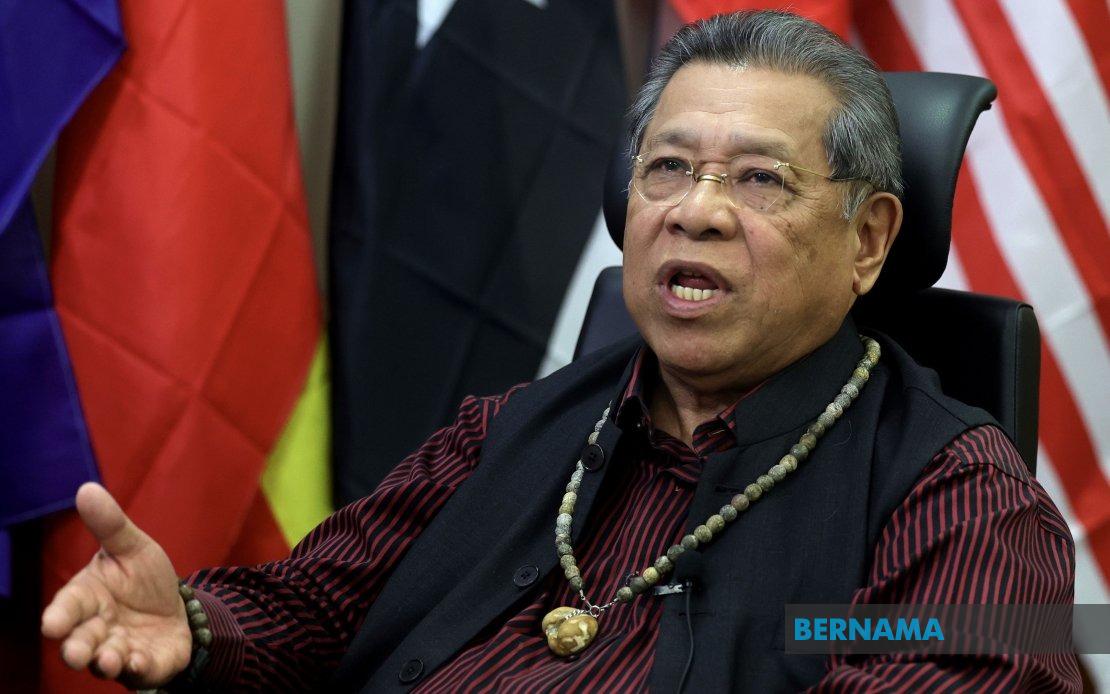
The substantial increase in federal allocations to Sabah represents a significant turning point for the East Malaysian state's development agenda. Speaking at the 2026 PKR National Congress in Melaka, United Sabah National Organisation (USNO) president Tan Sri Pandikar Amin Mulia highlighted how the enhanced funding envelope would unlock opportunities for the implementation of critical infrastructure and social projects across the state. The financial boost signals a renewed commitment to bridging regional disparities and ensuring Sabah's participation in Malaysia's broader economic growth trajectory.
According to Prime Minister Datuk Seri Anwar Ibrahim's policy address at the congress, the federal government has raised allocations to Sabah by 35 per cent over a four-year period. The figure climbed from RM13 billion in 2022 to RM17.6 billion in 2026, translating into an additional RM4.6 billion in available resources for state-level spending. This expansion reflects a deliberate policy shift to strengthen the fiscal capacity of states considered crucial to national economic integration and political stability, particularly given Sabah's geographic position and resource endowment.
Pandikar Amin's remarks underscore the political and economic logic behind prioritising Sabah's development trajectory. In his interaction with journalists on the sidelines of the congress at the Melaka International Trade Centre in Ayer Keroh, he articulated a connection between enhanced infrastructure investment and broader national prosperity. The USNO chief's framing suggests that development concentrated in peripheral regions generates positive spillover effects that strengthen the federation as a whole, rather than representing a net transfer of resources from more developed areas.
The context of this announcement is important for understanding Malaysia's contemporary political economy. Sabah has historically encountered infrastructure deficits, ranging from transportation networks to healthcare and educational facilities, that have constrained its economic potential relative to peninsular states. A funding increase of this magnitude could meaningfully address longstanding bottlenecks, particularly in rural areas where connectivity and service provision remain inadequate. The allocation rise also reflects shifting demographics and the state's growing population, which demand proportionally higher public investment to maintain service quality.
Prime Minister Anwar seized the occasion to rebut criticisms that his MADANI Government has exhibited regional bias or neglected certain jurisdictions. He emphasised that variations in per-state allocations reflect differentiated development priorities rather than political favouritism or administrative oversight. This defensive posture indicates that questions about resource distribution remain politically sensitive within Malaysia's federal structure, where state governments and opposition figures frequently challenge the central government's allocation decisions as evidence of partisan or discriminatory practices.
The timing of this announcement carries electoral and coalition-building implications. By highlighting substantial funding increases to a state where USNO operates as a significant political force, the government reinforces incentives for continued alignment with the MADANI coalition. For Sabah's political leadership, tangible financial commitments serve as concrete validation of their participation in the federal ruling arrangement, essential for justifying coalition membership to constituents and party members. The magnitude of the increase—more than one-third—represents a sufficiently impressive figure to feature prominently in political communication.
For Malaysian policymakers and analysts, the Sabah allocation pattern offers insights into how the federal government prioritises regional development under the MADANI framework. Rather than adopting uniform per-capita approaches, the government appears to target higher absolute increases to strategically important states, particularly those in East Malaysia where geographic challenges and infrastructure deficits demand substantial investment. This targeted approach acknowledges that equitable development requires unequal resource distribution—a principle central to understanding federal resource management in a geographically and economically heterogeneous federation.
The broader implications for Southeast Asia merit consideration. Malaysia's experience with managing federal transfers and regional development within a diverse, multi-ethnic federation offers lessons applicable to other countries grappling with similar challenges. The willingness to substantially increase allocations to underperforming regions suggests confidence in the government's fiscal capacity and commitment to longer-term structural improvements rather than short-term political fixes. However, the effectiveness of increased funding ultimately depends on implementation quality, absorption capacity, and governance standards within Sabah's state apparatus.
Pandikar Amin's personal endorsement of Prime Minister Anwar Ibrahim's continued leadership, expressed during the same statement, reveals how fiscal allocations intertwine with political relationships. By affirming Anwar's necessity for both international diplomacy and domestic governance, the USNO leader signals that Sabah's political elite view continued partnership with the federal government as preferable to alternative arrangements. This sentiment reflects pragmatic calculation: substantive funding flows require stable political relationships and credible commitment devices that regular coalition participation provides.
Moving forward, the critical question concerns implementation. Allocating RM17.6 billion represents a fiscal commitment; converting that amount into completed, functional infrastructure depends on project identification, tender processes, contractor performance, and ongoing maintenance frameworks. Malaysian observers will scrutinise whether Sabah demonstrates capacity to absorb and deploy increased allocations efficiently. Historical patterns of underspending by certain states highlight implementation challenges that funding alone cannot overcome, particularly where bureaucratic capacity or procurement governance remains constrained.
For Malaysian and Southeast Asian readers, this development underscores broader patterns in how federal governments balance competing claims for limited resources. The MADANI Government's demonstrated willingness to materially increase allocations to East Malaysia signals recognition that national cohesion depends partly on perceived fairness in resource distribution. Whether this approach generates corresponding improvements in service delivery, infrastructure quality, and economic opportunity will ultimately determine whether the funding increase translates into the tangible benefits Pandikar Amin and Anwar Ibrahim have publicly championed.

