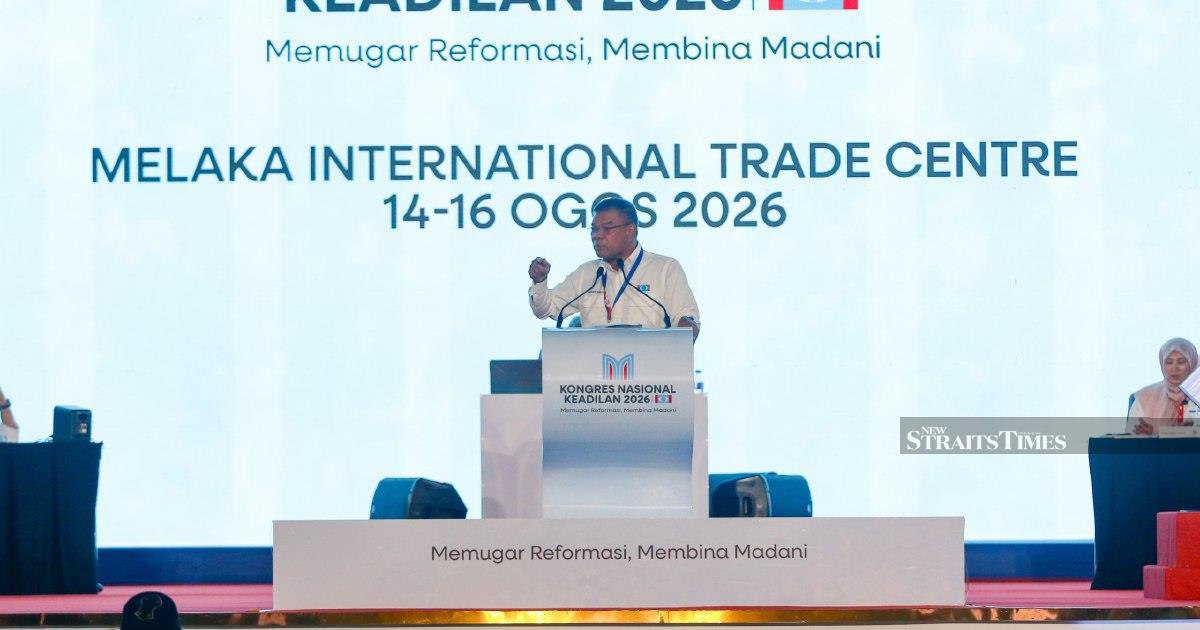
In remarks delivered at Ayer Keroh, PKR vice-president Datuk Seri Saifuddin Nasution Ismail has sounded an important warning about how Malaysia frames its ongoing struggle with graft, insisting that anti-corruption efforts must be grounded in principles of accountability and institutional integrity rather than exploited as a mechanism for advancing narrower political agendas along ethnic or religious lines.
The statement reflects growing concern among reform-minded political leaders that corruption, far from being a technical problem to be solved through procedural efficiency, has become entangled in Malaysia's deeply fractured political and social landscape. When graft is addressed selectively or portrayed primarily through the lens of particular communities or faiths, it risks undermining public confidence in the integrity of the anti-corruption crusade itself and suggests that the real motivation lies elsewhere.
Saifuddin's intervention highlights a central tension in Malaysian public life. The country has experienced high-profile scandals involving figures across the political spectrum and from various backgrounds, yet public perception of anti-corruption enforcement often tracks closely to questions of who is wielding prosecutorial power and against whom. When investigations or convictions appear clustered around particular groups, the legitimacy of the entire endeavour comes into question, even when the underlying facts may warrant serious scrutiny.
For Malaysia's anti-corruption apparatus to function effectively and maintain broad public endorsement, it must be demonstrably impartial and driven by consistent principles of accountability rather than animated by ethnic or religious considerations. This is particularly critical in a multiethnic, multifaith democracy where perceptions of unfair targeting can inflame communal tensions and erode institutional credibility far more quickly than the corruption itself damages governance.
The PKR vice-president's call represents a perspective increasingly shared across segments of the Malaysian reform movement, which recognises that weaponising corruption allegations along communal lines ultimately weakens the cause of clean government. When citizens believe that anti-corruption measures are merely tools deployed by one group against another, they lose their moral force and become yet another theatre for zero-sum political competition.
Moreover, framing graft solely through racial or religious prisms obscures the genuine institutional and systemic factors that enable corruption to flourish. Weak oversight mechanisms, inadequate transparency requirements, insufficient penalties, and inadequate resource allocation to enforcement agencies—these structural deficiencies affect all Malaysians and transcend community boundaries. Effective reform requires addressing such root causes rather than focusing narrowly on particular cases or communities.
Saifuddin's statement also carries implications for how Malaysia's political parties themselves conduct governance. The expectation that corruption should be treated as a universal moral issue applies equally to all political movements, whether in government or opposition. A credible stand against graft requires demonstrating consistent commitment across all circumstances, including when doing so might be politically inconvenient.
The challenge of depoliticising corruption becomes more pressing given Malaysia's recent political history. The country has witnessed major scandals that precipitated significant shifts in government and generated intense public scrutiny. However, the manner in which these cases were prosecuted and the selective intensity of enforcement efforts gave rise to legitimate questions about whether institutional independence was being compromised by political calculations.
Building institutional safeguards that insulate anti-corruption agencies from political pressure—whether that pressure comes from the ruling coalition, opposition parties, or organised interests along communal lines—remains essential work. Malaysian authorities need robust legal frameworks that establish clear, non-negotiable standards for investigation and prosecution, applied uniformly regardless of the political affiliation or background of those under investigation.
Public education also plays a vital role in reframing corruption as a shared national challenge rather than an issue to be claimed or contested along sectional lines. When anti-corruption narratives are shaped primarily by political parties advancing their particular agendas, ordinary Malaysians may struggle to identify with the cause as their own concern. Shifting the conversation toward universal values of integrity, accountability, and the common interest in effective governance requires deliberate effort from diverse voices and institutions.
The implications extend to Southeast Asia more broadly, where several nations grapple with corruption as a persistent governance challenge. Malaysia's experience suggests that instrumentalising anti-graft efforts for partisan advantage ultimately weakens rather than strengthens the capacity to address systemic problems. Regional models of anti-corruption practice that successfully transcend sectarian dimensions may offer instructive lessons for other democracies navigating similar tensions.
Saifuddin's exhortation represents a plea for Malaysian society to recognise that authentic anti-corruption work demands a commitment to universalising standards of accountability—standards that apply equally to all citizens and officials, irrespective of their ethnic origin, religious affiliation, or political alignment. Only when graft-fighting becomes a genuinely collective project, pursued through impartial institutions guided by consistent principles, can Malaysia hope to address this persistent challenge effectively and preserve public faith in the integrity of its institutions.

