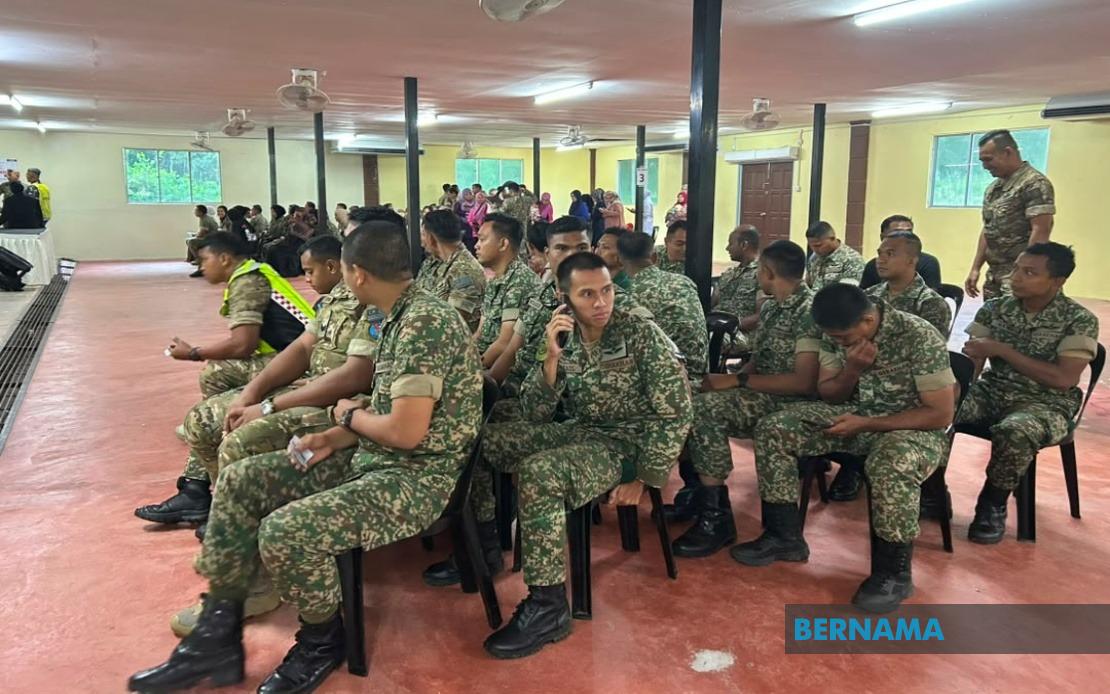
As polling machinery geared up for Johor's state election, senior government figures have issued a clarion call to security forces casting early ballots to recognise the gravity of their civic responsibility. Home Minister Datuk Seri Saifuddin Nasution Ismail and Defence Minister Datuk Seri Mohamed Khaled Nordin addressed the 24,751 eligible early voters through separate social media statements on July 7, emphasising that the franchise represents both a right and a fundamental obligation underpinning Malaysia's democratic framework.
Saifuddin Nasution, who also serves as Pakatan Harapan secretary-general, framed the voting exercise as an opportunity to participate in democracy while maintaining individual accountability. His message underscored the importance of approaching the ballot box with a mature mindset, encouraging voters to exercise their constitutional right whilst recognising the broader implications of their choices for the nation's trajectory. The appeal carried particular resonance given the composition of early voters—predominantly members of the Malaysian Armed Forces and their spouses, alongside police personnel and their families—groups whose professional duties centre on upholding national stability and public order.
Mohammed Khaled complemented this messaging by linking electoral participation directly to Johor's developmental aspirations. The Defence Minister positioned early voting as a mechanism through which security personnel could actively contribute to ensuring the state maintains momentum on its governance and infrastructure agenda. This framing transforms the voting act from a civic formality into a tangible means of influencing the trajectory of regional progress, particularly relevant for frontline personnel whose security roles make them integral stakeholders in any administration's ability to deliver public goods.
Menteri Besar Datuk Onn Hafiz Ghazi, representing the incumbent Barisan Nasional administration, deployed his messaging to consolidate support among early voters by appealing to themes of continuity and stability. His call for voters to place confidence in BN candidates highlighted the coalition's emphasis on maintaining the established governance agenda centred on development initiatives and welfare provisions. This messaging strategy reflects a deliberate political positioning that contrasts incumbent reliability against potential uncertainty associated with electoral change.
The early voting process accommodated two distinct but complementary security constituencies. Military personnel and their spouses totalled 12,041 eligible voters, while police and their families comprised 12,710 individuals. This bifurcated structure acknowledges that both armed and civilian security forces maintain distinct operational requirements that may prevent their participation in standard polling procedures. The arrangement underscores Malaysia's longstanding practice of facilitating security personnel participation in electoral processes despite their professional obligations, a mechanism essential for maintaining their stake in democratic governance.
Logistically, the state election commission established 64 early voting centres across Johor, opening from 8 am with staggered closing times between noon and 6 pm depending on individual centre circumstances and voter registration volumes. This distributed approach aimed to minimise congestion whilst accommodating the practical scheduling constraints facing security personnel working across multiple jurisdictions. The phased closure schedule reflected operational experience accumulated from previous electoral exercises, designed to balance efficiency with thorough management of the voting process.
The broader electoral context framed these early voting operations as preliminary to Saturday's main polling day, which would determine representation across all 56 state assembly constituencies. With 172 candidates fielded collectively by Pakatan Harapan and Barisan Nasional—both contesting every available seat—the competition signalled a comprehensive engagement across the legislative map. The intensity of this contest made the security sector's participation particularly meaningful, as their votes would factor into an election carrying significant implications for regional political alignment.
Saifuddin Nasution's appeal extended beyond early voters to encompass the broader Pakatan Harapan campaign apparatus. He urged party machinery to sustain engagement efforts through the formal campaign period's conclusion, emphasising the importance of maintaining political communication standards that reflected maturity and respect for democratic norms. This meta-messaging about campaign conduct itself revealed underlying concerns about electoral temperature, with party leadership apparently seeking to establish an expectations framework that would distinguish their campaign approach from potential competitor strategies.
The invocation of democratic principles by all three senior figures—representing executive, defence, and state-level political leadership—suggested a deliberate coordination around messaging emphasising electoral integrity and procedural propriety. By focusing public attention on voter responsibilities rather than campaign controversies, the statements attempted to frame the election within a legitimacy narrative centred on institutional processes rather than partisan contestation. This positioning becomes particularly significant in Malaysian electoral contexts where security force voting carries symbolic weight as an indicator of institutional confidence in democratic procedures.
For Malaysian observers monitoring regional political dynamics, the Johor election represents a meaningful data point in assessing whether the political realignment initiated through the 2022 federal election restructuring has achieved stable institutional form. Security personnel attitudes as reflected through their voting behaviour potentially signal broader societal positioning regarding the relative performance of competing governance coalitions. The emphasis placed by senior figures on security force participation suggests recognition that this particular voter cohort carries interpretive significance beyond their numerical contribution to electoral tallies.

