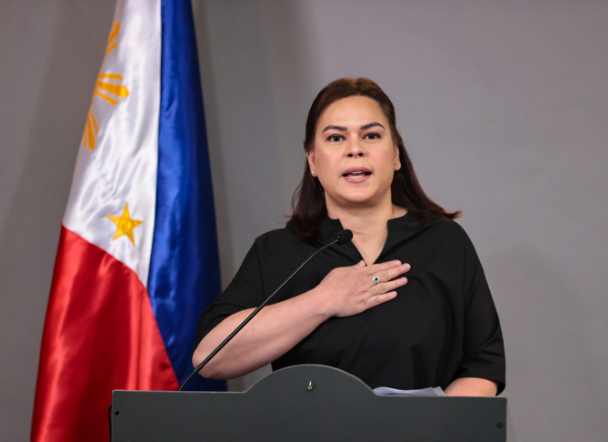
Vice President Sara Duterte delivered a sweeping indictment of the Marcos administration on Tuesday, framing a major gathering of Iglesia ni Cristo members along Edsa as evidence of deepening public discontent with President Ferdinand Marcos Jr.'s leadership. Speaking to media as thousands of INC devotees congregated on the capital's main thoroughfare, Duterte characterised the demonstration as a tangible manifestation of what she termed a "growing sentiment" she has championed throughout 2024—one that extends well beyond the religious organisation's specific grievances to encompass broader frustration with governmental performance.
The timing of Duterte's remarks proved strategically significant, as the gathering itself had been organised to protest what the Iglesia ni Cristo described as "selective justice" and "distortion of law" in the context of a newly announced plunder complaint against Senator Rodante Marcoleta. Rather than remaining confined to the INC's particular ecclesiastical concerns, however, Duterte seized the moment to launch a comprehensive critique of executive competence, arguing that the administration's defining characteristic has been "poor governance" manifested in its inability to grapple with the nation's most pressing challenges.
At the core of Duterte's attack lay an economic argument with immediate relevance for millions of ordinary Filipinos struggling with deteriorating living standards. She highlighted how the administration has remained "detached" from the concrete suffering inflicted by surging prices, mounting job insecurity, and the relentless squeeze on household budgets that characterises life for working-class and middle-class families across the archipelago. This framing attempts to position her as a voice for the economically vulnerable—a claim with particular resonance given her father's political machine had traditionally relied on populist appeals to such constituencies in Mindanao and beyond.
However, Duterte's critique extended substantially beyond economic management to encompass what she characterised as an authoritarian drift within the administration's political culture. She accused the Marcos government of responding to criticism not with substantive policy adjustments or transparent engagement, but rather through an apparatus of intimidation designed to silence opponents. According to her account, those who dare to question allegations of corruption within Malacañan, scrutinise the administration's actual performance against its electoral promises, or lodge accusations against the President himself face systematic pressure—a pattern she suggested represented a fundamental betrayal of democratic principles.
The Vice President drew an explicit link between what she portrayed as this suppressive environment and deteriorating democratic health within the republic. She argued that institutional safeguards meant to constrain executive power and protect citizens' fundamental rights had been subordinated to partisan advantage, creating what she termed "an increasingly oppressive political environment." This language invoked the spectre of authoritarianism—a potent reference in Philippine political discourse, given the nation's experience under Ferdinand Marcos Sr., the current President's father. By suggesting that his son's administration exhibits comparable traits, Duterte attempted to tap into deep historical anxieties about democratic backsliding.
She further asserted that governance failures stemmed from deficiencies in presidential character and leadership itself. Rather than viewing poor policy outcomes as technical problems amenable to administrative correction, Duterte located their origin in the President's personal inadequacies—a rhetorical move that transforms political disagreement into a more fundamental moral indictment. This personalisation of governance critique, while emotionally resonant, also served to elevate what might otherwise be dismissed as partisan squabbling into a matter transcending conventional politics altogether.
In Duterte's framing, the stakes extended beyond partisan competition to encompass nothing less than "the honor of the State and the future of a people." This maximalist rhetoric suggested that the administration's shortcomings represented not merely policy errors but existential threats to the nation's collective dignity and prosperity. She contrasted the President's apparent indifference to this predicament with the ongoing economic hardship endured by ordinary citizens, positioning those whose voices face "repression" as the true guardians of national interests.
The Vice President's salvo carries particular significance given her precarious political position. She currently faces an impeachment trial before the Senate Impeachment Court, which is scheduled to commence on July 6. The House of Representatives had voted to impeach her on multiple grounds: alleged threats made against President Marcos and his wife, unexplained accumulation of wealth, and purported misappropriation of confidential funds. This prosecution has transformed Duterte from the administration's troublesome heir apparent into an outright opposition figure—one now leveraging public demonstrations as platforms for counter-narrative construction.
For Malaysian observers, the Philippine situation illuminates broader Southeast Asian patterns of executive consolidation and increasingly fractious elite politics. The Marcos administration's approach to dissent, whether or not Duterte's characterisation proves accurate, reflects wider regional trends toward narrowing democratic space even within ostensibly democratic structures. The willingness of powerful political actors like Duterte to mobilise public gatherings for partisan purposes—regardless of their origins—demonstrates how institutional conflict between branches of government inevitably bleeds into street-level politics.
Moreover, the economic grievances Duterte articulates resonate across the region. Inflation, underemployment, and deteriorating real wages constitute shared challenges afflicting Southeast Asian societies, creating constituencies vulnerable to anti-incumbent messaging from whatever quarter it originates. That an impeached Vice President can position herself as champion of the economically distressed reflects the political malleability of such appeals—and the extent to which personalised governance politics can overwhelm institutional or ideological coherence.
Duterte's invocation of democratic principles and warnings against authoritarianism also merit scrutiny. Her own political legacy, particularly as Davao City mayor, included controversial security operations and alleged extrajudicial killings. This history complicates her current posture as democracy's defender, suggesting that her critique of the Marcos administration, however substantively justified, operates partly as a defensive manoeuvre against her own legal jeopardy.
The converging dynamics of INC activism, Vice Presidential defiance, and popular economic discontent have created a volatile political moment in Manila. Whether this represents the opening phase of a serious challenge to Marcos's hold on power, or merely another chapter in the fractious personal rivalries that have long characterised Philippine elite politics, remains uncertain. What appears clear is that governing coalitions in the Philippines—as elsewhere in Southeast Asia—remain fragile constructs vulnerable to rupture when powerful individuals face institutional consequences.

