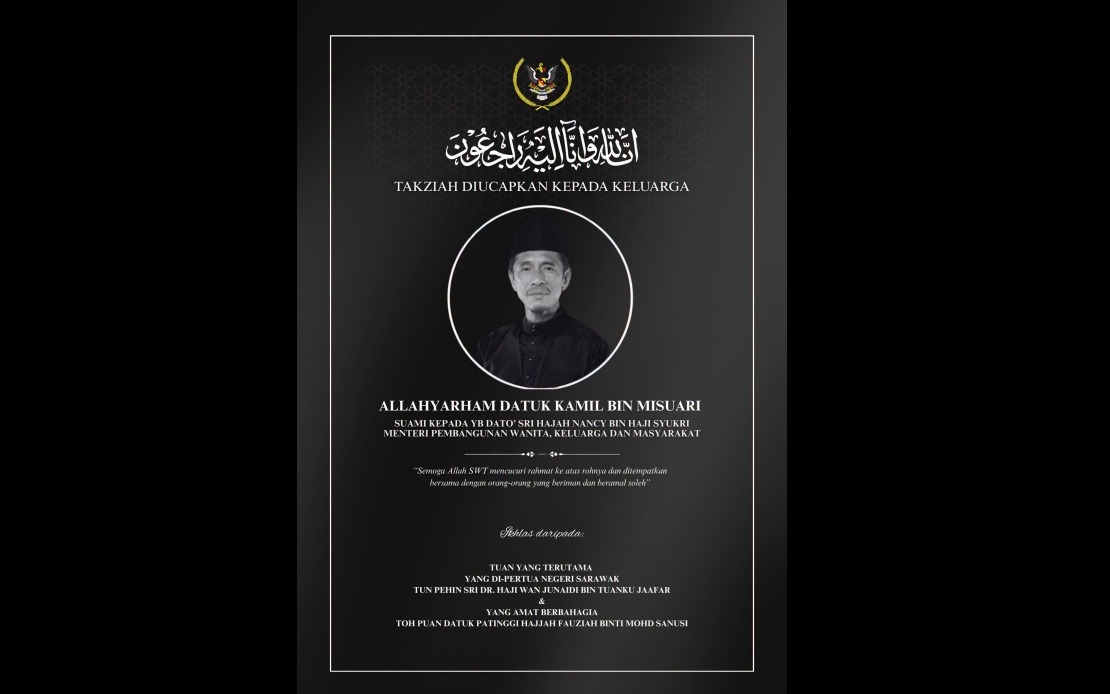
Tun Dr Wan Junaidi Tuanku Jaafar, the Yang Dipertua Negeri Sarawak, has offered his deepest condolences to Women, Family and Community Development Minister Datuk Seri Nancy Shukri following the passing of her husband, Datuk Kamil Misuari, on June 18. The announcement came through a formal statement released by Astana Sarawak, reflecting the high regard with which the state's ceremonial head acknowledges significant losses within Malaysia's ministerial circles and their families.
In his expression of sympathy, Tun Dr Wan Junaidi and his wife, Toh Puan Fauziah Mohd Sanusi, invoked Islamic prayers for the late Kamil's soul, requesting divine blessings upon his memory and the acceptance of his deeds in the eyes of Allah. The gesture demonstrates the formal protocols observed within Malaysia's political establishment when senior public figures experience personal bereavement, underscoring the interconnected nature of the country's leadership community and their shared customs of mourning and support.
Beyond spiritual remembrances, the state leadership conveyed wishes that Datuk Seri Nancy and her immediate family would find the emotional resilience and fortitude necessary to navigate the profound grief accompanying the loss of a spouse. Such official statements serve not merely as ceremonial gestures but as acknowledgements of the human dimensions underlying political life, particularly when ministers face circumstances that challenge their personal stability during their tenure in public office.
The late Kamil Misuari, aged 65, passed away at a hospital facility in Kuala Lumpur on the evening of June 18. His death represents the conclusion of a four-decade marriage to Nancy, whom he had wed in 1985. Throughout their union, the couple was blessed with three children, establishing a family structure that now faces the adjustments and transitions that widowhood necessarily entails during a critical period of ministerial responsibility.
Following standard practice for high-ranking government officials with ties to Sarawak, arrangements were made to transport Kamil's remains to his home state. The body is scheduled for repatriation to Kuching on June 19, where funeral rites will proceed according to Islamic custom. His final resting place will be Samariang Muslim Cemetery, a burial ground that holds significance for many established families within Sarawak's community.
The timing of Kamil's death during Nancy's tenure as Women, Family and Community Development Minister raises considerations about the balance between demanding ministerial duties and personal family circumstances. As someone responsible for advocating women's welfare and family-related policy matters at the national level, Nancy's own experience of sudden widowhood inevitably adds personal dimensions to her understanding of the challenges facing Malaysian families navigating loss and transition, potentially informing her approach to policy formulation around family support systems.
For Sarawak specifically, the condolence statement represents an instance of the state's political establishment extending formal recognition to a federal minister with deep Sarawak roots. The involvement of the Yang Dipertua Negeri in such matters underscores the ceremonial role played by state constitutional heads in maintaining the dignity and social fabric of Malaysia's federal structure, particularly when acknowledging the personal misfortunes of prominent political figures who maintain connections to their home states.
The announcement also reflects broader Malaysian traditions governing political mourning, where expressions of sympathy from state and federal leadership figures are expected and documented. Such formal responses serve multiple functions: they demonstrate solidarity within the political community, acknowledge the disruption caused by loss, and implicitly reassure the affected minister of continued institutional support during personal difficulty. These conventions have evolved as essential elements of Malaysia's political culture, balancing the formal requirements of office with the informal networks of support that sustain those serving in public positions.
Beyond the immediate family circle, Nancy's colleagues and subordinates within the Women, Family and Community Development Ministry would similarly be navigating the implications of her personal loss. Ministerial operations necessarily continue during such periods, requiring both the minister and her staff to compartmentalise personal tragedy while maintaining the continuity of government functions. This intersection of private grief and public duty remains an understated but significant dimension of how Malaysia's senior civil service and ministerial class manage extraordinary circumstances while preserving governmental stability.

