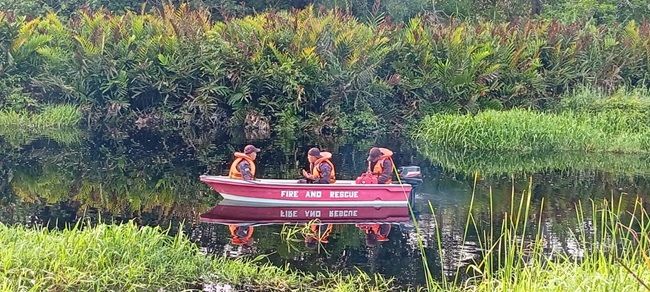
Rescue operations continued for a third consecutive day in Brunei yesterday as authorities pressed ahead with efforts to locate a man feared to have been attacked by a crocodile in Sungai Bera near Kampong Baru. Despite intensive searches involving multiple government agencies and advanced surveillance technology, there remains no sign of the victim, raising concerns about his survival prospects in what has become one of the country's most serious recent wildlife incidents.
The Fire and Rescue Department (FRD) received an emergency distress call on Wednesday, June 24, alerting them to the apparent crocodile attack. Responders initially dispatched two fire engines carrying nine personnel, led by Acting Station Officer Mohd Zulkifli Md Tahir, to the riverside location where the attack was reported. Upon reaching the scene, preliminary interviews with the victim's family confirmed that the man had been fishing in the river when the incident occurred, placing him in exactly the kind of environment where crocodile encounters are most likely in Brunei's waterways.
The scale of the search effort underscores the seriousness with which authorities are treating the case. The operation has been strategically coordinated from a Tactical Command Post established at the scene, with the Commanding Officer of the Operations Branch, Senior Superintendent Amirul Hadi Junaidi, taking overall command. This level of senior leadership involvement suggests that officials are treating the matter as a high-priority emergency requiring sustained commitment of resources and personnel.
Multiple search methods have been deployed to maximise the chances of locating the victim. Continuous river patrols using dedicated FRD boats have covered the affected waterway, with crews maintaining vigilance from water-based vantage points. Simultaneously, ground teams have conducted systematic searches along both riverbanks, examining areas where the victim might have been swept ashore or washed up by currents. This combination of water and land-based operations reflects standard search and rescue protocol for river incidents in Southeast Asia.
Technology has played a significant supporting role in the operation. The FRD has deployed drone surveillance to cover areas that would be difficult or dangerous for personnel to access on foot or by boat, particularly dense vegetation or unstable riverbank sections. Aerial reconnaissance also allows searchers to identify patterns in the river that might help predict where human remains might be located if the victim did not survive the initial attack.
The operation has benefited from inter-agency coordination that demonstrates Brunei's institutional approach to emergency management. Royal Brunei Police Force (RBPF) personnel have been fully integrated into the search effort, including specialist officers from Seria Police Station and particularly the Royal Brunei Police Force Marine Police (POLMAR), whose waterborne expertise is invaluable in river operations. The Wildlife Division has also been brought into the response, likely providing expertise on crocodile behaviour and habitat patterns that could inform search strategies.
Crocodile attacks in Brunei remain relatively uncommon, making this incident noteworthy within the country's safety record. However, the nation's river systems, particularly in less developed areas, do harbour saltwater crocodiles that can pose genuine threats to people engaging in fishing or water-based activities. The attack represents the kind of wildlife encounter that underscores the ongoing tensions between human activity and natural habitats in Southeast Asia, particularly in areas where traditional livelihoods like fishing bring residents into contact with dangerous fauna.
The incident carries implications for how Brunei manages public safety awareness around wildlife encounters. Fishing remains an important livelihood and cultural practice in communities throughout the sultanate, yet encounters with crocodiles demonstrate the very real risks involved in such activities, particularly during dawn or dusk hours when visibility is poor and crocodile activity typically peaks. The lack of any discovery of the victim after three days significantly decreases the likelihood of a successful rescue, though search efforts typically continue for extended periods in such cases.
For Malaysian readers, the incident offers perspective on similar risks that exist across the region. Crocodile attacks, while statistically rare, do occur periodically throughout Southeast Asia, including in Malaysian states with significant river systems. The coordinated response mounted by Brunei illustrates best practices in emergency management that neighbouring nations often draw upon, particularly regarding inter-agency cooperation during wildlife-related crises.
The emotional and social impact on the victim's family and the broader Kampong Baru Sungai Bera community cannot be understated. Such incidents often prompt local discussions about safety protocols and environmental management. The continuation of search operations into the third day reflects both the authorities' commitment to thorough investigation and the cultural importance placed on providing closure to affected families, even when prospects of recovery become increasingly remote.
As the search continues, the incident serves as a reminder of the unpredictable nature of wildlife encounters and the importance of appropriate safety measures when engaging in water-based activities in areas known to harbour dangerous animals. The outcome of this operation will likely inform future public safety messaging in Brunei regarding crocodile awareness and risk mitigation strategies.

