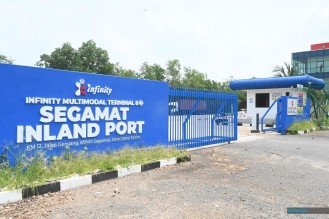
Segamat Inland Port (SIP) has reset its sights on ambitious cargo targets, projecting it will move over 6,000 twenty-foot equivalent units (TEUs) of containers before the calendar year closes, marking a significant milestone following its operational restart in late June after prolonged dormancy. The facility, now managed by Infinity Logistics & Transport, processed approximately 1,000 TEUs during its first month in operation through July, demonstrating renewed momentum in a facility that had languished relatively unused for more than a decade. This reactivation represents far more than a logistical matter; it signals a deliberate pivot in Malaysia's transport policy toward rail-based cargo movement and away from road-dependent supply chains that have long constrained the nation's logistics efficiency.
The inland port serves a geographically dispersed industrial base stretching across northern Johor, southern Pahang, southern Negeri Sembilan and Melaka—regions where manufacturing and processing operations have historically faced connectivity disadvantages compared to coastal or Klang Valley facilities. According to Samuel Ho, SIP's manager, the facility's reactivation aligns directly with the government's Road to Rail initiative, a collaborative framework with Keretapi Tanah Melayu Bhd designed to systematically strengthen rail's role in Malaysia's freight ecosystem. This strategic positioning reflects broader recognition that the nation's logistics infrastructure, which has relied heavily on trucking, requires fundamental restructuring to remain competitive amid rising congestion, operational costs, and safety concerns that afflict road-dependent supply chains.
The safety argument underpinning SIP's revival carries particular weight in Malaysia's context. Rail transport eliminates exposure to highway accidents and traffic delays that plague trucking operations, while producing measurable environmental and economic benefits. Ho emphasised that a single freight train journey displaces approximately 80 container trucks from Malaysian roads—a reduction with cascading implications for highway congestion, fuel consumption, and driver safety. By redirecting containerised cargo from road networks to rails, SIP contributes directly to the country's transport safety objectives whilst reducing diesel dependency, a factor of growing importance as Malaysia navigates energy efficiency targets and carbon reduction commitments.
Previously, SIP's operational constraints severely limited its commercial viability. The facility operated under a single-track railway system that forced cargo schedules to yield priority to passenger trains, rendering freight services impractical and unpredictable. This structural limitation made the facility economically uncompetitive; operators could manage only about one cargo trip weekly, insufficient to justify investment in handling infrastructure or attract shipper interest. The completion of the double-tracking project extending to Johor fundamentally altered this calculus, enabling SIP to scale up to four cargo receiving and dispatch trips per week. This quadrupling of capacity transforms the facility from a marginal operation into a genuinely competitive logistics node capable of reliable service for industrial users across a five-state region.
The geographic positioning of SIP relative to Malaysia's major ports creates tangible competitive advantages that extend beyond Segamat itself. The facility now functions as an inland connection point for containerised cargo originating from or destined to Port Klang, Port of Tanjung Pelepas, and Johor Port in Pasir Gudang. Shippers in the hinterland regions—particularly in industrial zones around Batu Pahat and Kluang—can now consolidate cargo and access ocean container services with greater efficiency than trucking directly to coastal ports. This benefit extends to both import and export operations, creating a pull-through effect that enhances the commercial proposition for manufacturers and logistics operators in underserved districts.
Ho articulated a broader developmental ambition for SIP that transcends mere cargo-handling targets. The facility functions, in his estimation, as a catalyst for broader economic transformation across northern Johor. By providing reliable, cost-effective rail-based logistics infrastructure, SIP aims to attract manufacturing investment and warehouse development in surrounding industrial zones. This supply-side approach to economic development reflects understanding that transport infrastructure constraints often inhibit business expansion in peripheral regions. As SIP demonstrates operational competence and reliability, its existence removes a logistical friction point that may have previously discouraged facility investment in the Segamat region and nearby industrial areas.
Operational scale-up carries immediate employment implications. SIP's first-phase operations, conducted across 20.23 hectares adjacent to Segamat Railway Station, have already generated over 200 jobs for local residents, concentrated in logistics and ancillary services. The facility's overall development plan encompasses three phases, suggesting employment creation will accelerate as additional capacity comes online. This job generation capacity holds particular significance for northern Johor districts where alternative employment opportunities may be limited, creating multiplier effects across local economies as logistics workers spend wages within their communities.
The facility's educational dimension reflects forward-thinking capacity-building strategy. SIP's management has established collaboration with Universiti Tun Hussein Onn Malaysia (UTHM) to develop expertise in rail-based inland port operations through fieldwork exposure and applied research initiatives. This knowledge-transfer arrangement ensures that Malaysian institutions develop domestic understanding of containerised rail logistics rather than remaining dependent on foreign expertise. The research component positions UTHM to generate evidence-based insights into operational best practices, cost structures, and supply chain integration possibilities—knowledge that could inform development of similar inland port facilities elsewhere in Malaysia.
Transport Minister Anthony Loke Siew Fook's presence at SIP's official launch on June 25, 2026 underscored the facility's significance within national transport policy priorities. Loke articulated expectations that SIP would catalyse economic development whilst strengthening Malaysia's logistics network and enhancing overall transport system efficiency. The minister specifically highlighted SIP's potential to eliminate approximately 18,000 lorry movements—including trailers and container trucks—from Malaysian roads monthly. This reduction represents a meaningful contribution toward congestion alleviation in regions where road infrastructure capacity increasingly constrains commerce, whilst simultaneously optimising utilisation of the nation's rail network.
The comparative advantage SIP offers reflects technical improvements in Malaysia's rail infrastructure that have matured over recent years. Double-tracking expansion has been among the most consequential upgrades to the main line, removing the operational bottleneck that previously made freight services impractical. These infrastructure investments, though substantial, produce multiplier effects through facilities like SIP that can now operate predictably and competitively. The inland port thus represents not merely a single logistics node but rather the practical realisation of infrastructure investments already made, a validation that strategic rail development creates genuine commercial opportunities when accompanied by operational facilities that can aggregate demand and interface with multimodal supply chains.
SIP's trajectory from establishment in 1997 through years of underutilisation and into current revival illustrates the temporal dynamics of infrastructure success. Initial operations generated limited commercial traction, likely because the single-track constraint undermined operational viability during that earlier period. The facility's dormancy underscores that infrastructure alone proves insufficient; facilities must align with enabling conditions—in this case, adequate rail capacity and management expertise—to function commercially. Current conditions appear substantially more favourable, with double-tracking elimination of the bottleneck constraint, improved port connectivity, and demonstrated management commitment through Infinity Logistics & Transport's operational engagement.
The 6,000-TEU annual target, whilst ambitious relative to SIP's nascent reactivation, appears grounded in realistic assessment of market potential across the five-state service area. Current performance—1,000 TEUs in the first month—suggests that scaling to targets requiring 500 TEUs monthly on average falls within achievable range, particularly as shipper awareness of SIP's revived capabilities spreads and supply chain integration deepens. Success in reaching these targets would validate the economic case for inland port expansion and potentially encourage investment in similar facilities in other underserved regions, expanding Malaysia's logistics infrastructure beyond its traditional coastal concentration.

